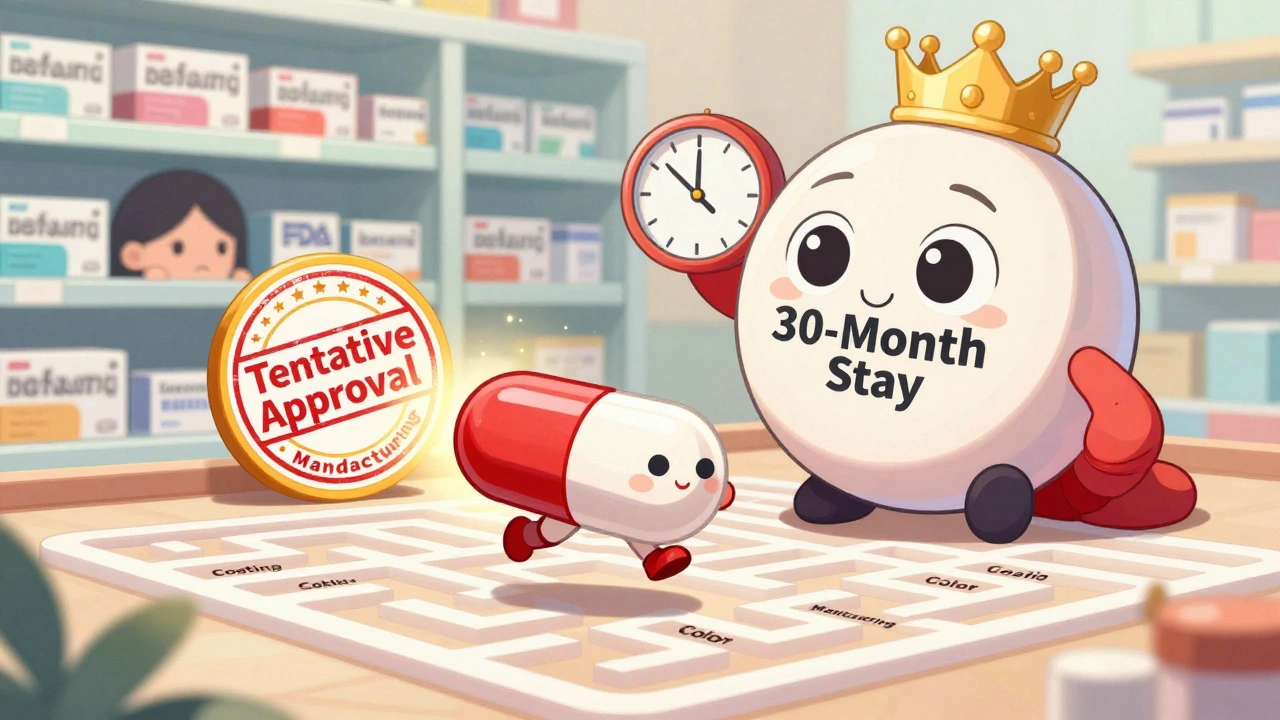
When a brand-name drug hits the market, it’s protected by patents that give the company exclusive rights to sell it-often for 20 years. But here’s the catch: that clock doesn’t start ticking when the drug is invented. It starts when it’s approved by the FDA. By the time a drug reaches patients, it might already have 7 or 8 years of patent life used up. That leaves maybe 12 years to make back the billions spent on research. So when a generic manufacturer steps in to challenge those patents, the system hits pause. That pause? It’s called the 30-month stay.
What Exactly Is the 30-Month Stay?
The 30-month stay isn’t a court order. It’s a rule written into the Hatch-Waxman Act of 1984, a law designed to balance two goals: getting cheap generic drugs to patients fast, while still giving drugmakers enough time to protect their inventions. Here’s how it works in practice. When a generic company files an Abbreviated New Drug Application (ANDA) to copy a brand drug, they have to check the FDA’s Orange Book-a public list of patents tied to that drug. If they believe one of those patents is invalid or won’t be infringed, they file what’s called a Paragraph IV certification. This is basically a legal challenge. Once they do that, they must notify the brand-name company. If the brand company sues for patent infringement within 45 days, the FDA is legally blocked from giving final approval to the generic drug for up to 30 months. That’s the stay. It doesn’t mean the FDA stops reviewing the application. In fact, they can-and often do-give tentative approval during this time. But the generic can’t hit shelves until the stay ends, the patent is ruled invalid, or the case settles.Why Does This Matter for Patients?
You might think: “So what? 30 months isn’t that long.” But here’s the reality: the 30-month stay isn’t the end of the delay. It’s just the beginning. A 2021 study from USC and the University of Michigan found that even after the 30-month stay ends, there’s typically a median gap of 3.2 years before the generic actually launches. Why? Because companies aren’t always ready. They need to scale production, negotiate with insurers, set up distribution. But that’s not the whole story. The real problem is patent thickets. Brand companies don’t just file one patent. They file dozens-sometimes over 10-for the same drug. A patent on the pill’s color. One on the coating. One on how it’s manufactured. One on a minor formulation tweak. The FDA allows all of them to be listed in the Orange Book. And if a generic challenges one, the brand can wait until the stay expires, then file a new lawsuit on another patent. That triggers another 30-month stay. The 2003 Medicare law tried to stop this by limiting companies to one 30-month stay per ANDA filer. But loopholes remain. Some companies file lawsuits against multiple generic applicants at once. Others wait until the last minute to sue, hoping the generic company runs out of money before the case ends.Who Pays the Price?
The cost of these delays doesn’t show up on your pharmacy receipt right away. But it’s there. According to the FTC, patent litigation delays tied to the 30-month stay add about $13.9 billion to U.S. drug costs every year. That’s billions that could’ve gone to insulin, heart meds, or cancer drugs if generics had entered on time. Take the drug Enbrel, a biologic for rheumatoid arthritis. Its patents were challenged multiple times. Even though the core patent expired in 2029, the brand company filed a string of secondary patents, triggering repeated stays. Biosimilars didn’t enter until 2023-over a decade after the original patent expired. Patients paid $2,000 a month instead of $200. The same thing happened with Humira. The first biosimilar didn’t launch until 2023, even though the main patent expired in 2016. The 30-month stay wasn’t the only blocker, but it was part of a system built to stretch out exclusivity.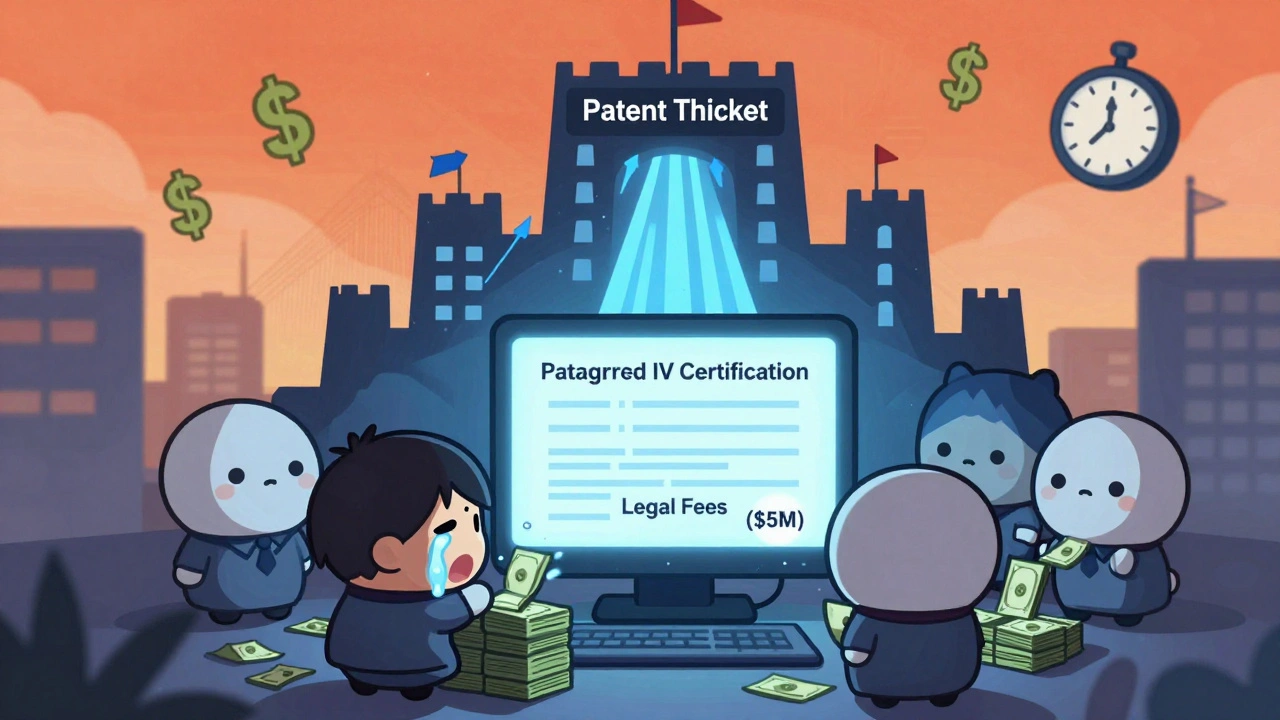
How Do Generic Companies Respond?
Generic manufacturers aren’t sitting still. They’ve turned patent litigation into a high-stakes game of chess. The first company to file a successful Paragraph IV certification gets 180 days of exclusive rights to sell the generic before anyone else can. That’s worth millions. So multiple companies race to be first. In 2022, 72% of drugs facing generic challenges had more than one filer. That competition drives down prices faster-once the first generic launches, others follow quickly. But the cost of playing is brutal. A 2022 survey by the Association for Accessible Medicines found that 63% of generic companies spend between $3 million and $5 million per ANDA on legal fees alone. That’s on top of the $10-$20 million it costs to develop the drug. Many smaller companies go bankrupt before they even get to market. And the clock is ticking. Generic companies typically file their challenges 4.1 years before the patent expires. That means they’re spending years preparing, filing, litigating, and waiting. Meanwhile, the brand company is still raking in billions.How Does the U.S. Compare to the Rest of the World?
The U.S. is an outlier. In the European Union, generic companies can apply as soon as the patent expires. There’s no 30-month stay. If a brand sues, the court handles it-but the generic can still sell the drug while the case is ongoing. Canada has a 24-month stay, but it’s shorter and less flexible. The U.S. system was designed to give innovators a predictable window to resolve disputes. But today, it’s often used as a delay tactic. The FDA lists an average of 8.3 patents per drug in the Orange Book today-up from just 1.2 in 1995. That’s not innovation. That’s strategy.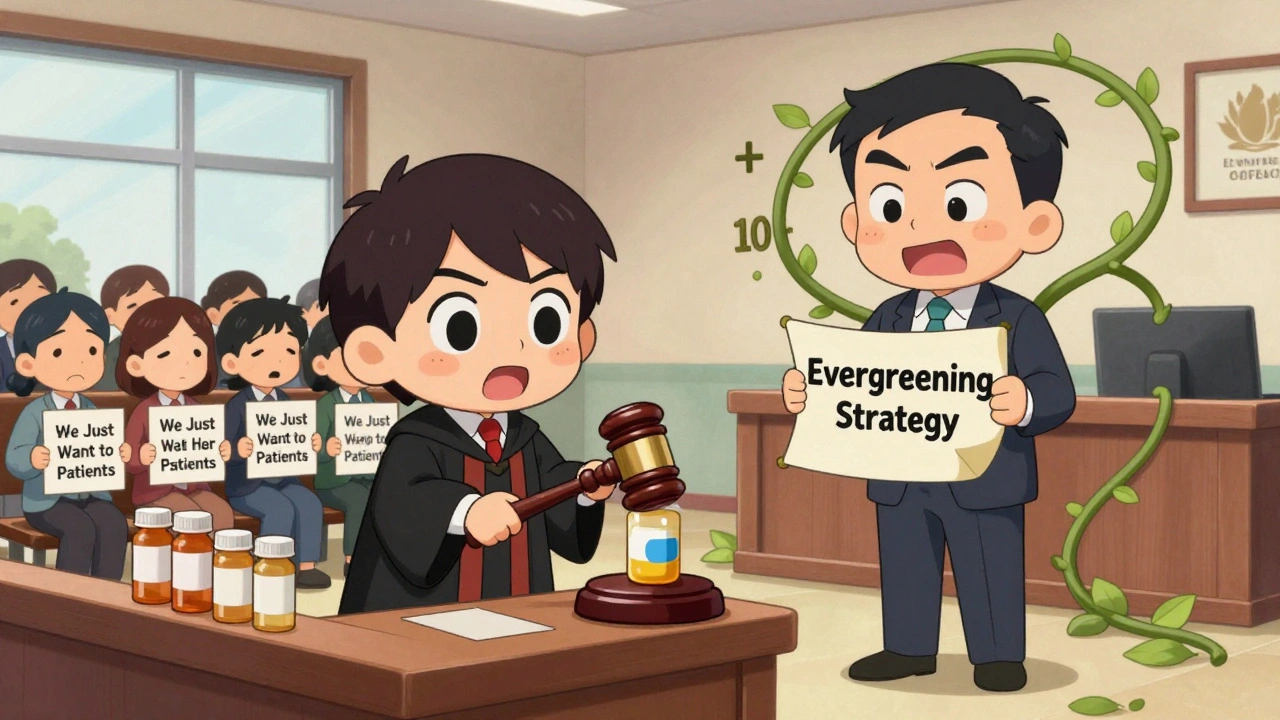
What’s Changing?
There’s growing pressure to fix this. In 2023, Congress introduced the Affordable Prescriptions for Patients Act. It proposes cutting the 30-month stay to 18 months and banning stays for secondary patents-like those on color or packaging-that don’t protect the actual medicine. The FDA also proposed new rules requiring more detailed patent disclosures. If a company lists a patent that doesn’t actually cover the drug’s active ingredient, it could be removed from the Orange Book. That would stop “evergreening”-the practice of extending monopoly power through tiny changes. The FTC has been clear: the current system is broken. Their 2022 report found that the 30-month stay delays generic entry by an average of 26 months for drugs with Paragraph IV challenges. That’s not a feature. It’s a flaw.What’s Next?
The Hatch-Waxman Act saved consumers $2.2 trillion since 1984. That’s undeniable. But the system was built for a different time. Back then, drugs had one or two patents. Now, they have ten. Back then, generics were simple. Now, they’re complex-biosimilars, injectables, inhalers. The 30-month stay was meant to be a bridge, not a wall. But for too many drugs, it’s become a wall. And patients are paying the toll. The next five years will decide whether the U.S. keeps this system as-is-or finally fixes it. If reform comes, billions could be saved. If it doesn’t, patients will keep waiting-for drugs they can’t afford, and for a system that’s out of balance.What triggers a 30-month stay?
A 30-month stay is triggered when a generic drug manufacturer files a Paragraph IV certification challenging a patent listed in the FDA’s Orange Book, and the brand-name drug company files a patent infringement lawsuit within 45 days of receiving notice. The FDA is then legally barred from granting final approval for up to 30 months.
Can the FDA approve a generic during the 30-month stay?
Yes. The FDA can-and often does-issue tentative approval during the 30-month stay. This means the generic meets all scientific and manufacturing requirements. But final approval is blocked until the stay ends, the patent is invalidated, or the case settles.
Does the 30-month stay always delay generic entry?
Not always. The stay often ends before the generic actually launches. A 2021 study found a median 3.2-year gap between stay expiration and generic launch. Delays after the stay are often due to commercial readiness, not legal barriers.
What is patent evergreening, and how does it relate to the 30-month stay?
Patent evergreening is when brand companies file new patents on minor changes-like a new coating or dosage form-to extend market exclusivity. These patents are often listed in the Orange Book and can trigger additional 30-month stays, even if the original patent has expired. A 2019 Brookings study found 67% of patents on top-selling drugs were filed after the original approval.
Are there alternatives to the 30-month stay in other countries?
Yes. The European Union and Canada have shorter or no litigation-based stays. In the EU, generics can launch immediately after patent expiration, even if lawsuits are pending. Canada has a 24-month stay, but it’s less commonly used. The U.S. system is unique in tying regulatory approval directly to patent litigation outcomes.
13 Comments
Anna Roh
This system is insane. We’re paying $2000 for a drug that could cost $200, and it’s all because lawyers figured out how to game the clock.
Simran Chettiar
It is fascinating, truly, how the legal architecture of pharmaceutical regulation has been perverted into a mechanism of economic preservation rather than public health advancement. The 30-month stay, ostensibly a compromise, has become the primary instrument of corporate entrenchment - a legal firewall against competition, disguised as intellectual property protection. One must wonder: if the intent of Hatch-Waxman was to balance innovation and access, then why does the system now incentivize the filing of patents on pill color and packaging? Is this innovation, or is it litigation theater? The data speaks volumes: over 8 patents per drug on average, up from 1.2 in 1995. That is not progress. That is parasitism.
And let us not forget the human cost - patients who cannot afford insulin, diabetics rationing doses, cancer patients waiting for biosimilars that should have arrived years ago. The FTC’s $13.9 billion annual figure is not just a statistic - it is the sum of countless individual tragedies masked as fiscal policy.
Meanwhile, generic manufacturers, many of them small, risk bankruptcy on legal fees that exceed their R&D budgets. The 180-day exclusivity window is a cruel carrot, dangled before companies already drowning in debt. This is not capitalism. This is feudalism with a patent lawyer.
And yet, the EU manages without this circus. Canada has a shorter stay. Why must America cling to a broken model because it once worked? Because tradition? Because lobbying? Because the pharmaceutical industry funds half of Congress? The answer is obvious, and it is shameful.
I do not blame the FDA - they are constrained by law. I do not blame the generic companies - they are playing the only game available. I blame the legislators who refuse to act. The Affordable Prescriptions for Patients Act is a start, but it is too little, too late. We need to abolish stays for secondary patents entirely. We need to purge the Orange Book of frivolous claims. We need to stop pretending that a coating patent protects innovation.
And if we do not? Then we will continue to live in a world where life-saving medicine is a luxury, and the only thing truly patented is greed.
Philippa Barraclough
The structural incentives here are deeply misaligned. The 30-month stay was meant to be a temporary pause while courts adjudicated legitimate disputes, but it has become a strategic tool for delaying competition. The fact that companies can file successive lawsuits on minor patents - essentially resetting the clock - reveals a fundamental flaw in the design. It’s not just about legal loopholes; it’s about the absence of meaningful penalties for abuse. There’s no consequence for dragging out litigation when the financial payoff is billions. And the FDA, bound by statute, is powerless to intervene until the legal process concludes - even when the patents in question have nothing to do with the drug’s actual therapeutic function.
What’s more, the 180-day exclusivity period for the first generic filer creates perverse incentives: companies race to be first, not to be most efficient or most innovative, but to be the first to file a challenge. This leads to strategic filings based on legal technicalities rather than genuine scientific merit. The result? A crowded courtroom, not a crowded pharmacy shelf.
Reform is overdue. But I worry that any change will be watered down by industry lobbying. The fact that the FTC and academic studies have consistently flagged this issue for over a decade, and yet nothing substantial has changed, speaks volumes about the power imbalance in this system.
Olivia Portier
Hey everyone - I just want to say thank you to the generic drug companies who are fighting this battle. I know it’s expensive, it’s exhausting, and sometimes you lose even when you’re right. But you’re the reason millions of people can afford their meds. I have a friend on Humira who paid $15,000 a year before biosimilars came in - now she pays $1,200. That’s not just savings. That’s dignity. Keep going. We see you.
Tiffany Sowby
Why do we even let foreign companies make our drugs? This is why America is falling behind. If we just made everything here, none of this would be a problem. Stop outsourcing our healthcare to India and China.
Asset Finance Komrade
Interesting how the U.S. treats patent litigation like a chess match, while the EU treats it like a traffic violation. One system rewards delay; the other assumes the market will self-correct. I’m not sure which is more naive. But one thing’s clear: if you want to extend monopoly profits, patenting the color of a pill is the most elegant form of economic theater ever devised. 🤖
Brianna Black
Let’s be real - this isn’t about patents. It’s about power. The pharmaceutical industry spends more on lobbying than any other sector in the U.S. They don’t just influence policy - they write it. The 30-month stay? It was never meant to be a bridge. It was built as a moat. And now, the rest of us are drowning in the cost of keeping that moat full. I’m tired of hearing about ‘innovation’ when the real innovation is in legal loopholes, not medicine.
And yet - we still act surprised when people die because they can’t afford insulin. We don’t have a drug pricing crisis. We have a moral crisis.
Ruth Witte
WE CAN FIX THIS. 💪 Every time you call your rep, every time you share this post, every time you choose a generic - you’re pushing back. This system is rigged, but we’re not powerless. Let’s make them hear us. 🌍❤️
Noah Raines
Bro, the fact that a company can sue over a patent on the shape of the pill and get 30 more months of monopoly? That’s not capitalism. That’s a scam with a law degree. And we’re all paying for it.
Guylaine Lapointe
It is unconscionable that the United States, a nation that prides itself on innovation and fairness, has institutionalized a system that prioritizes corporate profit over human life. The Hatch-Waxman Act, once a beacon of balanced policy, has been corrupted into a tool of exploitation. The practice of evergreening - filing patents on trivial modifications - is not merely unethical; it is a violation of the public trust. The FDA’s continued acceptance of these patents, and Congress’s refusal to act, constitutes a dereliction of duty. Patients do not owe pharmaceutical corporations their health. The time for reform is not tomorrow. It is now.
Suzanne Johnston
There’s a deeper philosophical question here: when does protection become oppression? The original intent of patents was to incentivize innovation by granting temporary exclusivity - a social contract between the innovator and society. But when that exclusivity is stretched through legal gymnastics on packaging, color, or dosage form, the contract is broken. The public no longer receives the promised benefit - affordable access - and the innovator receives more than was ever agreed upon. This isn’t just policy failure. It’s a moral failure of the system we’ve allowed to evolve.
Perhaps we need to redefine what ‘invention’ means in the 21st century. Is a change in pill coating an invention? Or is it a technicality designed to delay competition? If we can’t answer that, then we shouldn’t be surprised when the system collapses under its own hypocrisy.
ian septian
Fix the law. Let generics in faster.
Arun Kumar Raut
So many people suffer because drugs are too expensive. The system is not fair. We need to change it. Simple.