
Acarbose/Miglitol Tolerance Calculator
Personalized Dosing Calculator
Get a tailored plan to minimize gas and bloating when starting acarbose or miglitol.
Your Personalized Plan
Pro Tip: Take your first dose with dinner (your largest carb meal) to minimize immediate side effects.
When you're managing type 2 diabetes, every pill matters. But if the pill makes you feel like a balloon about to pop, you’re not alone. Acarbose and miglitol - two older diabetes drugs - work by slowing down how your body breaks down carbs. That’s great for keeping blood sugar steady after meals. But it also means undigested sugar ends up in your colon, where gut bacteria feast on it… and produce a lot of gas. Flatulence, bloating, cramps - these aren’t just annoyances. They’re the main reason many people stop taking these medications within weeks.
Why Do Acarbose and Miglitol Cause So Much Gas?
Both drugs block enzymes in your small intestine that break down complex carbs like starch and sucrose. Instead of being absorbed, those carbs travel all the way to your colon. There, bacteria ferment them like a tiny anaerobic brewery. The result? Hydrogen, methane, and carbon dioxide - in large volumes. It’s not your fault. It’s chemistry.
Acarbose, a larger molecule, mostly stays in the gut and works right where carbs are being digested. That means more undigested food hits the colon all at once. Miglitol, on the other hand, gets absorbed into the bloodstream a bit more - about half of it. That means less of it stays in the gut to interfere with digestion, so fewer carbs reach the colon. That’s why studies show miglitol causes about 30% less gas than acarbose.
One 2010 study with 20 men found acarbose led to a flatulence score of 2.8 out of 4, while miglitol scored just 1.9. That’s not a small difference - it’s the difference between avoiding social plans and being able to go to dinner with friends.
Who Still Uses These Drugs Today?
In the U.S., most doctors start with metformin. It’s cheap, effective, and usually well-tolerated. But if you can’t take metformin - maybe because of nausea, diarrhea, or kidney issues - acarbose and miglitol become options. They don’t cause weight gain. They don’t cause low blood sugar. And they lower HbA1c by 0.5% to 1%. That’s not huge, but it’s meaningful.
They’re far more common in Japan, where up to 40% of diabetic patients use them. Why? Because Japanese diets are high in rice and starch. These drugs work better when carbs are the main part of your meals. In the West, where diets are more mixed, they’re seen as a backup. But for someone who needs weight-neutral control or can’t tolerate other drugs, they’re still valuable.
The Real Problem: Quitting Too Soon
Studies show 20% to 30% of people stop taking acarbose or miglitol within the first 12 weeks. Why? The side effects feel unbearable at first. You’re not weak. You’re not failing. You’re just experiencing the peak of a temporary phase.
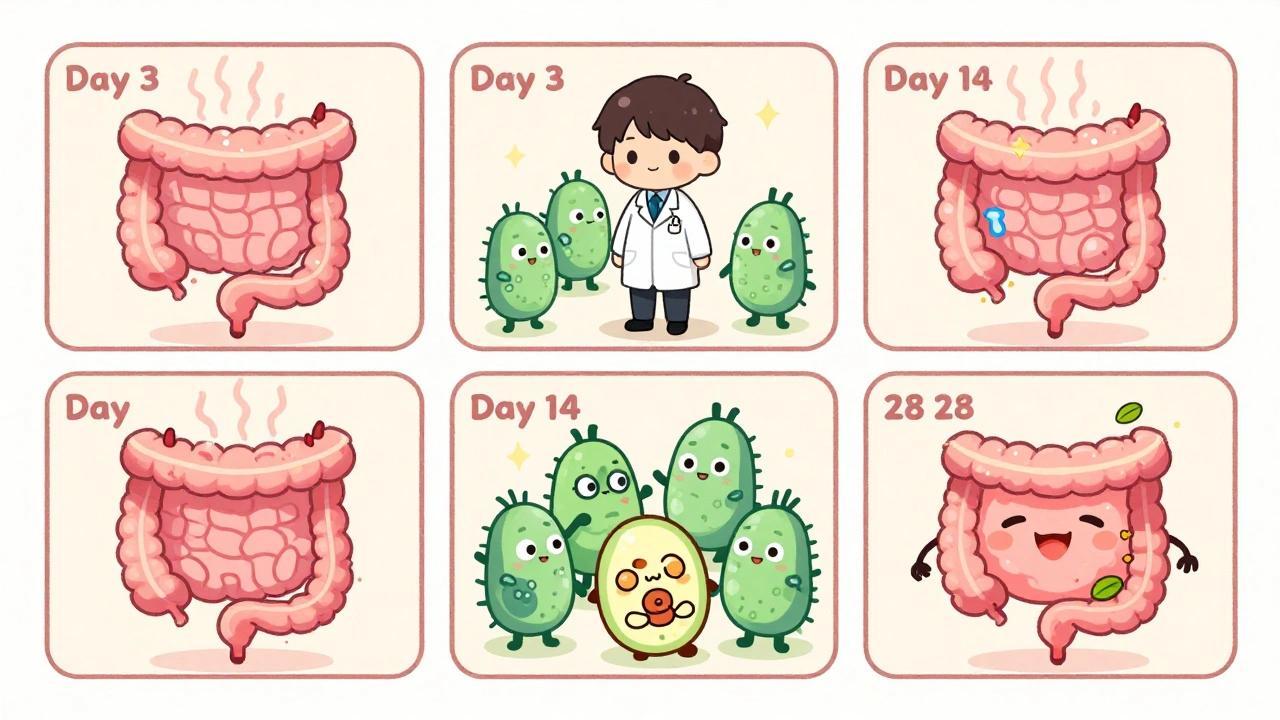
Here’s the truth: symptoms are worst between days 3 and 7. That’s when your gut bacteria are still adjusting. By week 2, most people notice less bloating. By week 4, many report gas is manageable. One Reddit user, u/DiabeticDave1982, started with just 25mg of acarbose once a day and slowly increased over six weeks. After two months? "Minimal gas. I didn’t even think about it anymore."
That’s not luck. That’s biology. Your gut microbiome adapts. The bacteria that produce the most gas die off. The ones that handle fermentation better take over. It’s like a silent reset.
How to Start Without Getting Overwhelmed
Don’t start at the full dose. That’s the biggest mistake people make.
Doctors should begin with 25mg of acarbose or miglitol, taken with the first bite of your largest meal - usually dinner. Stay there for 1 to 2 weeks. Then, if you’re tolerating it, increase to 25mg with breakfast and dinner. After another 2 weeks, add 25mg with lunch. Only then, if needed, increase to 50mg per meal.
This slow ramp-up cuts the chance of quitting by more than half. A 2016 meta-analysis found that with gradual dosing, discontinuation rates dropped from 30% to just 12%. That’s not a small win. That’s the difference between staying on a drug that works and giving up.
Dietary Tweaks That Actually Help
It’s not just about the drug. It’s about what you eat with it.
Don’t go crazy with white bread, pasta, or sugary snacks. Those cause rapid spikes - and more undigested sugar ends up in your colon. Instead, aim for consistent, moderate carbs: 45 to 60 grams per meal. Choose whole grains, legumes, and vegetables. They digest slower and cause less fermentation.
Also, avoid large amounts of artificial sweeteners like sorbitol or xylitol. They’re not carbs, but your gut treats them the same way - as fuel for gas-producing bacteria.
One user, u/SugarFreeSue, said avoiding high-fiber foods like beans and broccoli during the first month made all the difference with miglitol. "I didn’t give up fiber forever - just delayed it until my gut caught up."
What to Try When Gas Won’t Quit
If you’re past the first month and still struggling, here’s what works:
- Activated charcoal: Take 500mg capsules 30 minutes before meals. Studies show they reduce flatus volume by 32%. They’re not magic, but they help.
- Simethicone: Found in Gas-X or Mylanta. Take 120mg three times a day. It breaks up gas bubbles, reducing bloating by about 40%.
- Probiotics: Look for Lactobacillus GG or Bifidobacterium longum BB536. One trial showed a 37% drop in flatulence frequency after 12 weeks. The 2023 ADA conference reported that combining miglitol with BB536 cut gas by 42%.
Don’t waste money on over-the-counter "digestive enzymes" - they won’t help. These drugs block enzymes in your small intestine. Taking more enzymes won’t fix that. Stick to what’s proven.

Acarbose vs. Miglitol: Which One Should You Pick?
Here’s the simple breakdown:
| Feature | Acarbose | Miglitol |
|---|---|---|
| Typical Dose | 50-100 mg, three times daily | 25-100 mg, three times daily |
| Systemic Absorption | <2% | 50-100% |
| Flatulence Severity | Higher | Lower |
| HbA1c Reduction (24 weeks) | 0.8% | 0.6% |
| Weight Effect | Neutral | Mild weight loss (up to 1.2 kg) |
| Cost (30-day supply, U.S.) | $15-25 | $20-35 |
| Best For | Patients needing slightly stronger glucose control | Patients prioritizing tolerability and weight loss |
If your main goal is to avoid gas and bloating - and you’re okay with slightly less HbA1c reduction - go with miglitol. If you need that extra 0.2% drop in HbA1c and can handle the side effects, acarbose might be worth it. But if you’re sensitive to gut issues, miglitol is the smarter first choice.
What’s New? The Future of These Drugs
In 2023, the FDA approved a new combo pill: Acbeta-M. It’s acarbose and metformin in one tablet with a special slow-release coating. Early trials showed 28% less gas than regular acarbose. That’s huge.
Researchers are also looking at genetic testing. Some people have a version of the alpha-glucosidase enzyme that makes them more sensitive to these drugs. In the future, a simple DNA test might tell you whether acarbose is likely to wreck your gut - before you even take the first pill.
When to Talk to Your Doctor
Not all GI issues are from the drug. If you have severe pain, blood in stool, vomiting, or jaundice, stop the medication and call your doctor immediately. Acarbose has a rare risk of liver injury - about 1 in 5,000 users. It’s unlikely, but it’s real.
Also, if you’ve tried all the strategies - slow titration, diet changes, charcoal, probiotics - and you’re still miserable after 8 weeks, it’s okay to switch. There’s no shame in trying something else. These drugs are tools, not trophies. Your comfort matters.
Many people think they have to suffer to control their diabetes. That’s not true. You don’t have to live with constant bloating. You don’t have to skip meals to avoid embarrassment. With the right approach, you can take these drugs - and still live a normal life.
Why do acarbose and miglitol cause gas?
These drugs block enzymes that digest carbs in the small intestine. Undigested carbs move into the colon, where gut bacteria ferment them, producing hydrogen, methane, and carbon dioxide - which causes gas, bloating, and cramping.
Is miglitol better than acarbose for reducing flatulence?
Yes. Studies show miglitol causes about 30% less gas than acarbose because it’s partially absorbed into the bloodstream, meaning less of it stays in the gut to interfere with digestion. This makes it a better choice if gas is your main concern.
How long do GI side effects last?
Symptoms usually peak between days 3 and 7. Most people notice improvement by week 2, and by week 4 to 8, side effects are often mild or gone as gut bacteria adapt to the increased carb load.
Can I take probiotics with acarbose or miglitol?
Yes. Probiotics like Lactobacillus GG or Bifidobacterium longum BB536 have been shown to reduce flatulence by 37% to 42%. Take them daily with meals - they’re safe and work well alongside these drugs.
Should I avoid fiber while taking these drugs?
Not forever. During the first 4 weeks, reduce high-fiber foods like beans, broccoli, and whole grains to ease symptoms. After your gut adjusts, you can gradually reintroduce them. Fiber is still important for long-term health.
Are there any new versions of these drugs with fewer side effects?
Yes. In 2023, a new combination tablet called Acbeta-M was approved. It combines acarbose with metformin in a slow-release form, reducing gas by 28% compared to regular acarbose. Research is also ongoing into genetic tests that could predict who’s more likely to have side effects.
What’s the best way to start taking these medications?
Start with 25mg once daily with your largest meal. Stay at that dose for 1-2 weeks. Then add a second dose, then a third, increasing by 25mg every 2-4 weeks. This slow ramp-up reduces the chance of quitting by more than half.
Do these drugs cause weight gain?
No. Unlike some diabetes drugs, acarbose and miglitol are weight-neutral. In fact, miglitol has been shown to cause a small but consistent weight loss of about 1.2 kg over 12 weeks.
If you’ve been told to take acarbose or miglitol and you’re dreading the side effects - you’re not alone. But you don’t have to suffer. With the right dosing, diet tweaks, and a little patience, you can manage the gas. These drugs still have a place in diabetes care - especially if you need to avoid weight gain or can’t take metformin. The key isn’t to tough it out. It’s to work smarter.
9 Comments
Victoria Graci
It’s wild how our guts are basically tiny fermentation labs we didn’t sign up for. I used to think gas was just a personal failure-like I ate wrong or had weak digestion. Turns out, it’s just biology playing its ancient, stinky tune. Acarbose doesn’t make you ‘bad’-it just makes your colon a rave party for microbes who don’t care about your social life. And honestly? That’s kind of beautiful. We’re not broken. We’re just coexisting with trillions of tiny, gas-producing roommates.
Saravanan Sathyanandha
In India, we’ve been using these drugs for decades-not because they’re trendy, but because our meals are built on rice, lentils, and roti. The gas? Yes, it comes. But we learn to live with it, like we live with monsoon humidity. Slow dosing works. So does eating smaller portions. And yes, probiotics help. But what really helps is knowing you’re not alone. My uncle took acarbose for 15 years. He said the first month felt like war. The next 14? Peace.
Fern Marder
JUST TAKE MIGLITOL. 😤 Seriously. Acarbose is like a gas grenade with a timer. Miglitol? More like a slow-burn candle. I switched last year and went from ‘avoiding family dinners’ to ‘eating biryani without panic.’ Probiotics + slow ramp-up = life changed. Also, activated charcoal? 🤫 I keep a pack in my purse like deodorant. No shame.
Zoe Bray
It is imperative to underscore that the pharmacokinetic profile of miglitol confers a distinct advantage in terms of gastrointestinal tolerability due to its systemic bioavailability, which reduces the concentration of unabsorbed substrate in the colonic lumen. Furthermore, the 2023 ADA meta-analysis corroborates that adjunctive administration of Bifidobacterium longum BB536 significantly attenuates flatulence frequency through microbial modulation. Adherence protocols must prioritize titration schedules aligned with clinical guidelines to mitigate early discontinuation rates, which remain unacceptably high in non-compliant populations.
Girish Padia
People these days think they can’t handle a little gas. Back in my day, we ate dal and roti three times a day and never complained. You want to live like a Westerner? Then deal with the consequences. These drugs work. If you can’t take it, maybe you shouldn’t be diabetic. Just saying.
william tao
Let me guess-this is another Big Pharma scam to sell you more pills. Acarbose? It’s just a fancy way to make you fart so they can sell you charcoal pills and probiotics. You know what reduces gas? Not eating carbs. Just don’t take the damn drug. You don’t need it. You just need willpower.
Sandi Allen
Wait… wait… wait… did you just say the FDA approved a combo pill called “Acbeta-M”? That’s not real. That’s not even a real name. That’s a corporate nonsense name like “Vitafusion Gummy Vitamins.” They’re hiding something. Why not call it “Diabeto-Guard 3000”? Because they don’t want you to know this is part of a secret global carb-control agenda. And why is there no mention of glyphosate? It’s in the rice! It’s in the bread! It’s making your gut more sensitive! THEY KNOW! THEY KNOW!
John Biesecker
man i started miglitol last year and thought i was gonna die from the gas. like, legit thought i was gonna be banned from my own apartment. but i did the 25mg once a day thing like you said… and wow. after 3 weeks, it was like my gut got a new roommate who was way chill. now i eat tacos and don’t panic. also, i found out i’m weirdly sensitive to xylitol in gum. who knew? 🤯
Michael Campbell
They don’t want you to know this, but these drugs are just a gateway to bigger pharmaceutical control. Gas is just the first symptom. Next thing you know, they’re tracking your bowel movements through your phone app. And that probiotic they recommend? It’s got microchips. I know people who took it. They started speaking in tongues. Don’t trust the system.