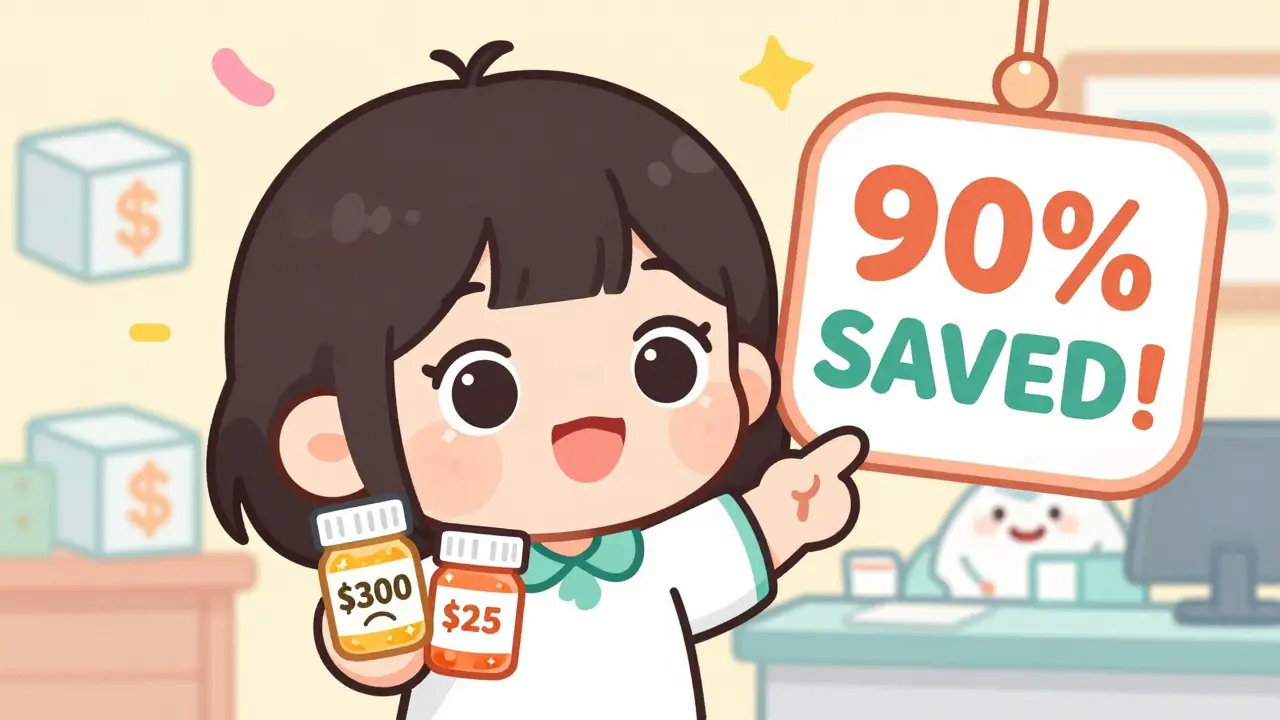
Imagine filling a prescription for a common medication-say, a pill for high blood pressure or asthma-and paying $300 for it. Then, a few months later, your pharmacist hands you a similar-looking pill for $25. Same condition. Same effect. Just a fraction of the price. That’s not magic. That’s generic combinations at work.
Most people assume generic drugs are cheap because they’re old or low quality. But here’s the truth: some generics are wildly overpriced. And the real savings aren’t always in picking the cheapest generic-they’re in picking the right generic. Sometimes, that means swapping one generic for another. Or skipping a combo pill entirely and buying two separate generics instead. The difference can be hundreds of dollars a year.
Why Some Generics Cost More Than Others
Not all generics are created equal. A 2022 study of 1,000 top-selling generics in Colorado found that 45 of them were charging up to 15 times more than other generics treating the exact same condition. One drug cost $7.50 per pill. Another, with identical ingredients and effectiveness, cost just $0.48. That’s a 94% drop in price for the same treatment.
Why does this happen? It’s not about quality. It’s about market dynamics. When a brand-name drug loses patent protection, multiple companies can make the generic. But sometimes, only one or two manufacturers enter the market. With little competition, prices stay high. Other times, a company buys up the rights to a generic and raises the price just enough to stay above the competition-without triggering a price war.
Think of it like buying toilet paper. If you have five brands on the shelf, you’ll pay $1 per roll. But if only one brand is available, they can charge $5. Same product. Same function. Just no one else to compete.
Combination Pills: Convenience vs. Cost
Many drugs come in combination pills-two medications in one tablet. Advair Diskus, for example, combines an inhaled corticosteroid and a long-acting bronchodilator for asthma. When it went generic as Wixela Inhub, the price dropped from $334 per inhaler to $115. That’s a 66% savings right there.
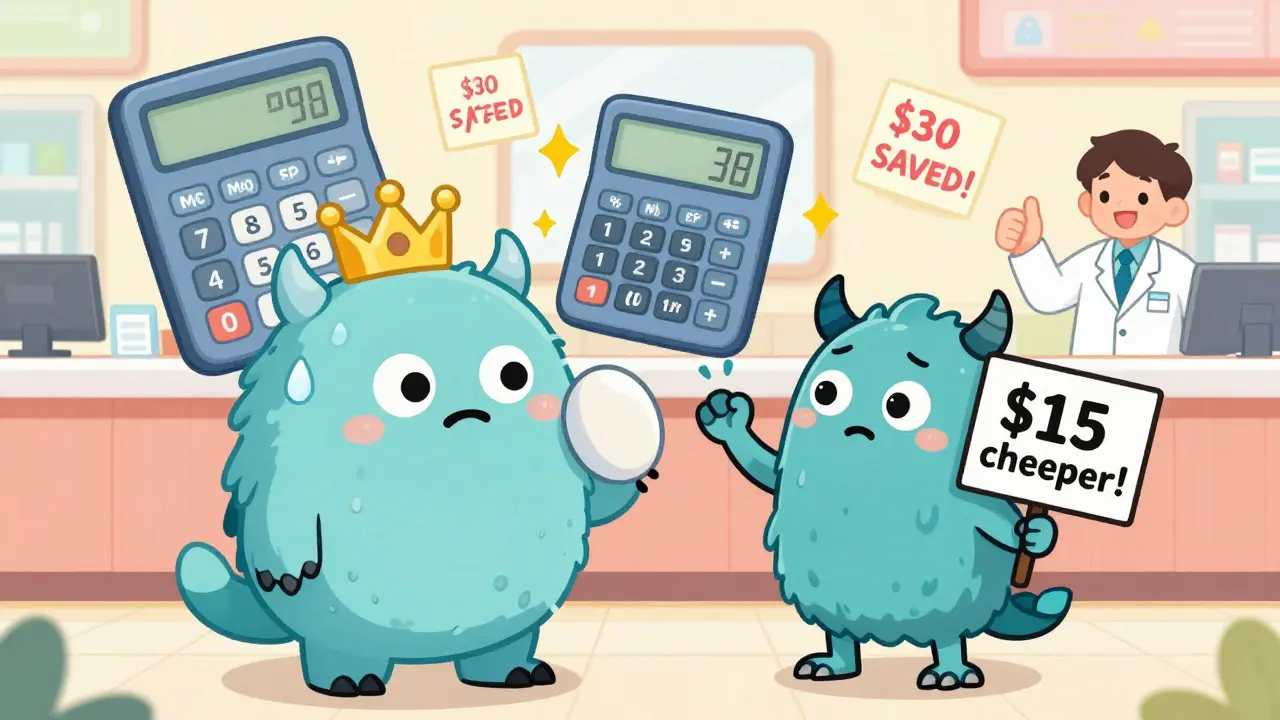
But here’s the twist: sometimes, buying the two drugs separately as individual generics costs even less. A 2023 analysis showed that for some patients, buying fluticasone and salmeterol as separate generics saved an extra $15-$30 per month compared to the combo pill. Why? Because combo pills are often priced as a single unit, even if the ingredients are cheap on their own. The convenience comes at a premium.
And it’s not just asthma. Same thing happens with blood pressure meds like lisinopril-hydrochlorothiazide, diabetes drugs like metformin-sitagliptin, and even cholesterol meds. The combo sounds simpler. But if your pharmacy can fill the two pieces separately for less, you’re leaving money on the table.
The Power of Therapeutic Substitution
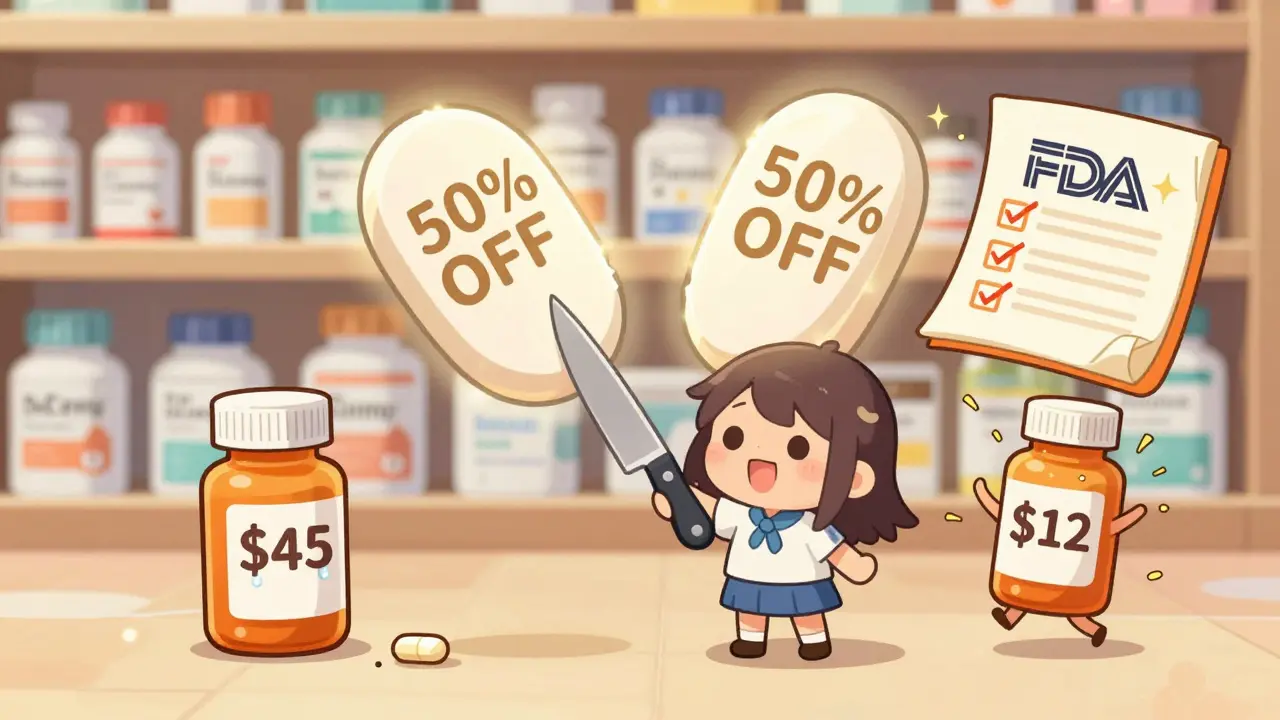
Therapeutic substitution isn’t about switching to a different drug. It’s about switching to a different version of the same drug. For example, if you’re prescribed a 10mg tablet of a generic statin that costs $45, your pharmacist might suggest a 20mg tablet that costs $12. You split it in half. Same effect. Half the cost.
The Colorado study found that 62% of the highest-cost generics could be replaced with lower-cost versions of the same drug-just in a different strength or form. One drug’s 5mg tablet cost $8. The 10mg tablet? $1.20. Split it. Save $6.80 per pill. Multiply that by 30 days. That’s over $200 a month saved.
Doctors and pharmacists don’t always bring this up. They assume you want the exact dose and form listed on the prescription. But if your doctor approves it, you can often switch to a higher strength and split the pill. Or switch from a capsule to a tablet. Or from daily dosing to every-other-day. All of these changes can slash your bill.
How Much Are People Really Saving?
The numbers are staggering. In 2023 alone, the top 10 generic drugs saved U.S. patients $89.5 billion. Crestor (rosuvastatin) generics dropped from $5.78 per pill to $0.08. Prilosec (omeprazole) fell from $3.31 to $0.05. That’s 98-99% savings.
And it’s not just big-name drugs. A 2023 study of over 840 million prescriptions found that 11.8% of generic fills had potential out-of-pocket savings. For uninsured patients, the average savings per prescription was $6.08. That might not sound like much-but if you take five generics a month, that’s $30.40 saved. $365 a year. Enough to cover a month of groceries.
Even with insurance, savings add up. Medicare patients saved an average of $4.64 per prescription. Private insurance, $3.69. Military, $5.05. And for those paying cash? Up to $11.39 saved per fill.
What You Can Do Right Now
You don’t need a degree in pharmacology to save money. Here’s how to start:
- Ask your pharmacist: “Is there a lower-cost version of this generic?” or “Can I get the same medicine in a different strength or form?”
- Check the Orange Book: The FDA’s database lists which generics are therapeutically equivalent. You don’t need to look it up yourself-just ask your pharmacist to verify.
- Compare combo vs. separate: If you’re on a combination pill, ask if buying the two components separately would cost less. Many pharmacies can compound or dispense them separately.
- Ask about splitting: If you’re taking a high-cost tablet, ask if a higher-strength version is available and if it’s safe to split. Many pills are scored for this.
- Review your list quarterly: Drug prices change. A generic that was cheap last year might be expensive now. Check your list every few months.
Why This Isn’t Common Knowledge
Pharmacies and insurers don’t always push these options. Why? Because it’s complicated. It requires manual checks, communication between providers, and sometimes a doctor’s note. It’s easier to just refill the same prescription.
Also, some generic manufacturers make more profit from high-priced versions. There’s no incentive for them to tell you about the cheaper alternative. And many patients assume their prescription is already the best deal.
But the data doesn’t lie. The same clinical outcome-whether it’s lowering blood pressure, controlling asthma, or reducing cholesterol-can be achieved at a fraction of the cost. You’re not trading quality. You’re trading overpayment.
The Bigger Picture
Over the past decade, generic drugs have saved the U.S. healthcare system $3.7 trillion. That’s more than the GDP of most countries. But the system is cracking. Generic shortages have doubled since 2012. A handful of manufacturers control 40% of the market. That means less competition-and more risk of price spikes.
That’s why your role matters. When you ask for a cheaper option, you’re not just saving money. You’re pushing the system to be more transparent. You’re forcing manufacturers to compete. You’re helping keep prices down for everyone.
Every time you choose the right generic, you’re making a small but powerful statement: healthcare shouldn’t be a lottery. You deserve to pay for what you get-not what someone else decided to charge.
Are generic drugs as effective as brand-name drugs?
Yes. The FDA requires generic drugs to have the same active ingredients, strength, dosage form, and route of administration as the brand-name version. They must also meet the same strict standards for quality, purity, and performance. Generic drugs are not “weaker” or “inferior.” They’re identical in how they work in your body.
Why is one generic more expensive than another?
It’s usually because of market competition. If only one company makes a generic, they can charge more. If five companies make it, prices drop. Sometimes, a company buys up the rights to a generic and raises the price slightly above competitors-just enough to avoid losing customers. It’s not about quality-it’s about supply and demand.
Can I split a higher-dose generic pill to save money?
Many pills can be safely split, especially if they’re scored (have a line down the middle). For example, a 20mg tablet that costs $1.50 can be split into two 10mg doses, saving you 50%. But not all pills can be split-especially extended-release or coated ones. Always check with your pharmacist or doctor before splitting any medication.
Is it better to take a combination pill or two separate generics?
It depends on the price. Combination pills are convenient, but they’re often priced higher than the sum of their parts. For example, a combo pill for asthma might cost $115, while buying the two separate generics costs $85. In that case, buying separately saves you $30 a month. Always ask your pharmacist to compare the total cost of both options.
How often should I check if my generic drugs have gotten cheaper?
Every three to six months. Generic prices can drop suddenly when a new manufacturer enters the market. A drug that cost $40 last quarter might cost $12 this month. Don’t wait for your refill to remind you-call your pharmacy or check online price tools like GoodRx. A quick check could save you hundreds a year.
What if my insurance won’t cover the cheaper generic?
Ask your doctor to file a prior authorization or exception request. Many insurers will cover a cheaper generic if it’s clinically equivalent. If they still refuse, pay cash. Often, the cash price of a generic is lower than your insurance copay. Use tools like GoodRx or SingleCare to compare cash prices before you pay.
Final Thought: Your Prescription, Your Power
You don’t have to accept the first price you’re given. The system is designed to make you passive-to hand over your script and trust that it’s already the best deal. But the truth is, you hold more power than you think. A quick question to your pharmacist, a quick check of your options, a quick call to your doctor. That’s all it takes.
Generic drugs are one of the most powerful tools we have to make healthcare affordable. But only if we use them right. Don’t just take the generic. Take the right generic. Your wallet-and your health-will thank you.
12 Comments
Debra Cagwin
Just wanted to say thank you for sharing this. I’ve been splitting my statin pills for a year now-20mg tablet, split in half-and my monthly drug bill dropped from $120 to $15. My pharmacist didn’t mention it, but when I asked, she said it was totally safe. This kind of info should be standard, not a secret.
Sydney Lee
Oh, so now we’re celebrating pharmaceutical arbitrage like it’s some kind of civic virtue? You treat medication like a stock market trade. ‘Split this. Swap that. Avoid the combo pill.’ How charming. You’re reducing human health to a spreadsheet. Where’s the dignity in that? The FDA doesn’t approve these substitutions because they’re ‘cheaper’-they approve them because they’re *clinically equivalent*. You’re conflating frugality with wisdom.
And let’s not pretend your ‘$0.08 per pill’ statin is somehow a moral triumph. It’s the result of a broken supply chain, consolidation, and corporate malfeasance. You’re not saving money-you’re just surviving a system that was designed to exploit you.
Stop patting yourself on the back for playing the game. Fix the game.
Hakim Bachiri
Bro… you’re telling me I can save $200/month by splitting pills?? I’ve been paying $400 for my blood pressure med… I just split my 40mg into two 20mg… now it’s $80. I’m not even joking. I did it last week. My pharmacist said ‘I’ve seen this before’ like it’s normal. It’s not normal. It’s criminal. And now I’m mad. Why didn’t my doctor say this? Why didn’t my insurance? Who’s profiting here? It’s not the pharmacists. It’s the ones who own the patents. The ones who let ONE company control the market. It’s not a conspiracy-it’s a cartel. And we’re the suckers.
Samantha Hobbs
OMG I did this with my asthma meds!! I was paying $130 for the combo inhaler and my pharmacist was like ‘hey, fluticasone is $25 and salmeterol is $32’-so I got both separate and now I’m paying $57. I thought I was being weird for asking. Turns out I’m just awake.
Ellen-Cathryn Nash
It’s not just about the money-it’s about the shame. The way the system makes you feel like you’re doing something wrong for asking, for negotiating, for wanting to live without bankruptcy. I cried the first time I asked my pharmacist if I could split my pill. I felt like a criminal. But I saved $180 a month. And now I tell everyone. Not because I’m proud. Because I’m furious.
sonam gupta
India also do this. My mom takes metformin 500mg split from 1000mg tablet. Cost $0.10 per pill. US same pill cost $5. Why? Because US let few companies control everything. Pharma mafia. Simple.
Gran Badshah
lol i just found out my 10mg lisinopril costs $1.50 but the 20mg is $1.80 so i split it. saved $40 a month. my pharmacist just shrugged and said ‘yeah, that’s how we do it here.’ i thought i was the only one. turns out everyone’s doing it. just nobody talks about it.
Celia McTighe
This made me cry 😭 I’ve been on 4 different generics this year and I had NO IDEA I could save so much. I just assumed my insurance was covering the ‘best’ option. Now I’m checking every refill with GoodRx. I feel empowered. Thank you for making this so clear. 🙏
Kelsey Youmans
While the economic rationale presented is compelling, one must also consider the broader sociopolitical implications of pharmaceutical pricing asymmetries. The normalization of pill-splitting and therapeutic substitution reflects not individual ingenuity, but systemic failure. The absence of regulatory intervention to ensure equitable access to low-cost therapeutics constitutes a moral deficit in public health policy. One may economize within the system, but the imperative remains to transcend it.
Payton Daily
Think about it. This isn’t about pills. It’s about control. The system wants you to be passive. To trust. To pay. To not ask. To not question. To just take what they give you. But when you split a pill? When you compare prices? When you say ‘no, I’ll take the cheaper one’? You’re not just saving money. You’re breaking the spell. You’re saying: I see you. I know what you’re doing. And I won’t play along anymore. That’s the real power here. Not the $200 savings. The rebellion.
oluwarotimi w alaka
USA fake news. Pharma companies from USA control global drug prices. They make cheap generics in China and India then sell same thing in USA for 100x. They lie to you. They lie to doctors. They lie to FDA. This is not about savings. This is about war. And we are losing.
Julius Hader
Just got my refill. Switched from the combo pill to two separate generics. Saved $47 this month. 🙌 My pharmacist gave me a high-five. I didn’t even know you could do this. Thanks for the wake-up call.