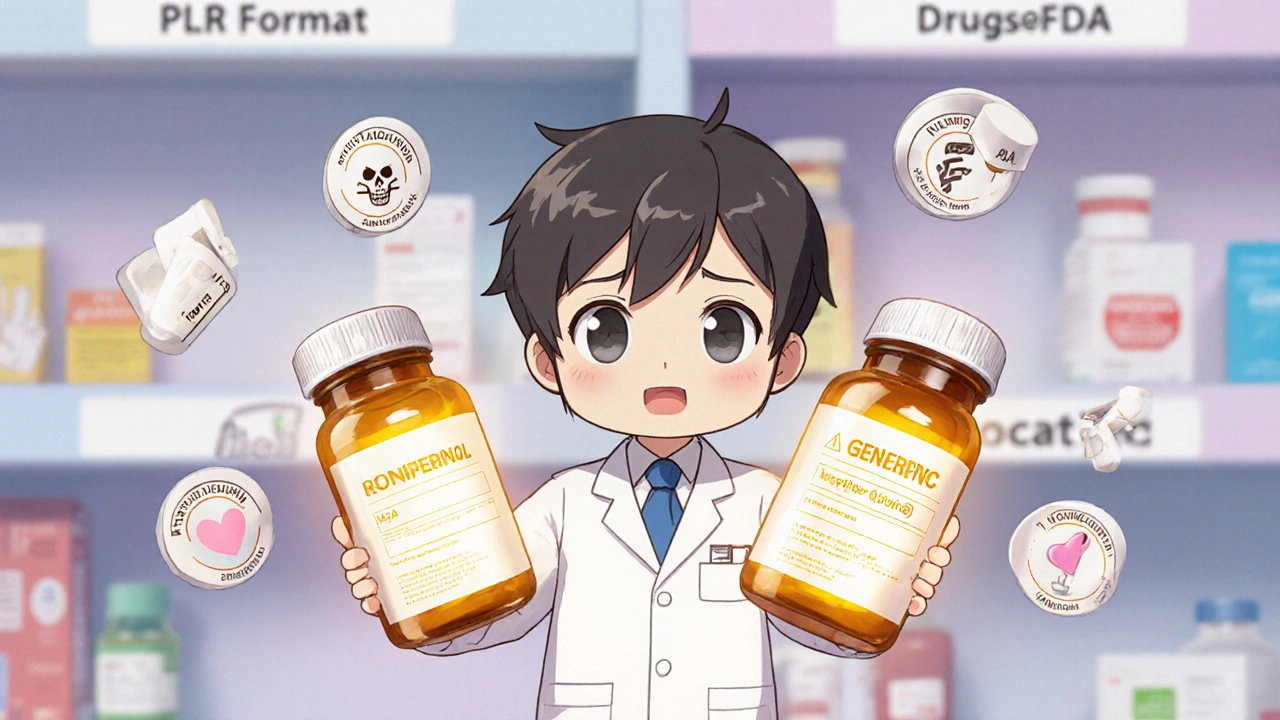
When you pick up a generic pill at the pharmacy, you expect it to work just like the brand-name version. But what you don’t see is the strict rulebook behind the label on that bottle. The FDA doesn’t just approve generic drugs for safety and effectiveness - it demands their labels match the brand-name drug exactly, down to the wording. This isn’t about branding. It’s about patient safety.
Identical Labeling Is the Law
Under Section 505(j)(2)(A)(v) of the Federal Food, Drug, and Cosmetic Act, generic drug manufacturers must submit labeling that mirrors their Reference Listed Drug (RLD). This means every section - from warnings to dosage instructions - must be word-for-word the same. The FDA doesn’t allow generic companies to rewrite, simplify, or rephrase safety information, even if they think it’s clearer. The only exceptions? The manufacturer’s name, address, and National Drug Code (NDC). Everything else? Locked in.
This requirement comes from the Abbreviated New Drug Application (ANDA) process. To get approval, a generic maker doesn’t need to run new clinical trials. Instead, they prove their drug is bioequivalent - meaning it delivers the same amount of active ingredient into the bloodstream at the same rate. But that’s only half the job. The other half? Matching the RLD label exactly. Failure here is one of the top reasons the FDA issues complete response letters. In fiscal year 2024, labeling issues accounted for 37% of all rejections.
The Physician Labeling Rule (PLR) Format
Since 2006, all new prescription drug labels in the U.S. must follow the Physician Labeling Rule (PLR). This isn’t optional. Generic drugs must adopt the PLR format as soon as their RLD does. The PLR forces a standardized structure with 24 specific sections. These include:
- Highlights of Prescribing Information
- Recent Major Changes
- Indications and Usage
- Dosage and Administration
- Contraindications
- Warnings and Precautions
- Adverse Reactions
- Use in Specific Populations
- Drug Interactions
- Clinical Pharmacology
Each section has strict formatting rules. For example, boxed warnings - the FDA’s strongest safety alert - must appear at the very top of the label. If the brand-name drug gets a new boxed warning for liver damage, the generic version must update to include it. No delays. No exceptions. The FDA’s Division of Labeling Review (DLR) reviews about 1,200 ANDAs each year, and nearly 4 in 10 of the rejections are because the label doesn’t match the RLD exactly.
How Generic Companies Track Label Changes
Keeping up isn’t easy. There are over 2,850 Reference Listed Drugs in the FDA’s Drugs@FDA database, and labels change weekly - usually on Tuesdays. Generic manufacturers can’t afford to miss a single update. One missed change could mean a warning letter, a product recall, or worse - a patient harmed by outdated information.
Leading companies use a mix of tools. Most subscribe to CDER’s electronic notifications, which send email alerts when labeling changes affect specific drug classes. According to an FDA survey, 82% of manufacturers rely on this system. Others use automated monitoring software that scans Drugs@FDA daily. But even the best systems have gaps. A 2024 FDA audit found that 17% of RLD entries in the Orange Book had temporary mismatches with Drugs@FDA during updates. That means companies often have to cross-check multiple sources just to be sure.
For companies with dozens or hundreds of generic products, this is a full-time job. Industry surveys show top manufacturers assign 3 to 5 regulatory staff per 50 approved products just to handle labeling. Small companies spend an average of $147,500 per product annually just to stay compliant.
The Safety Gap: Why Generic Labels Lag Behind
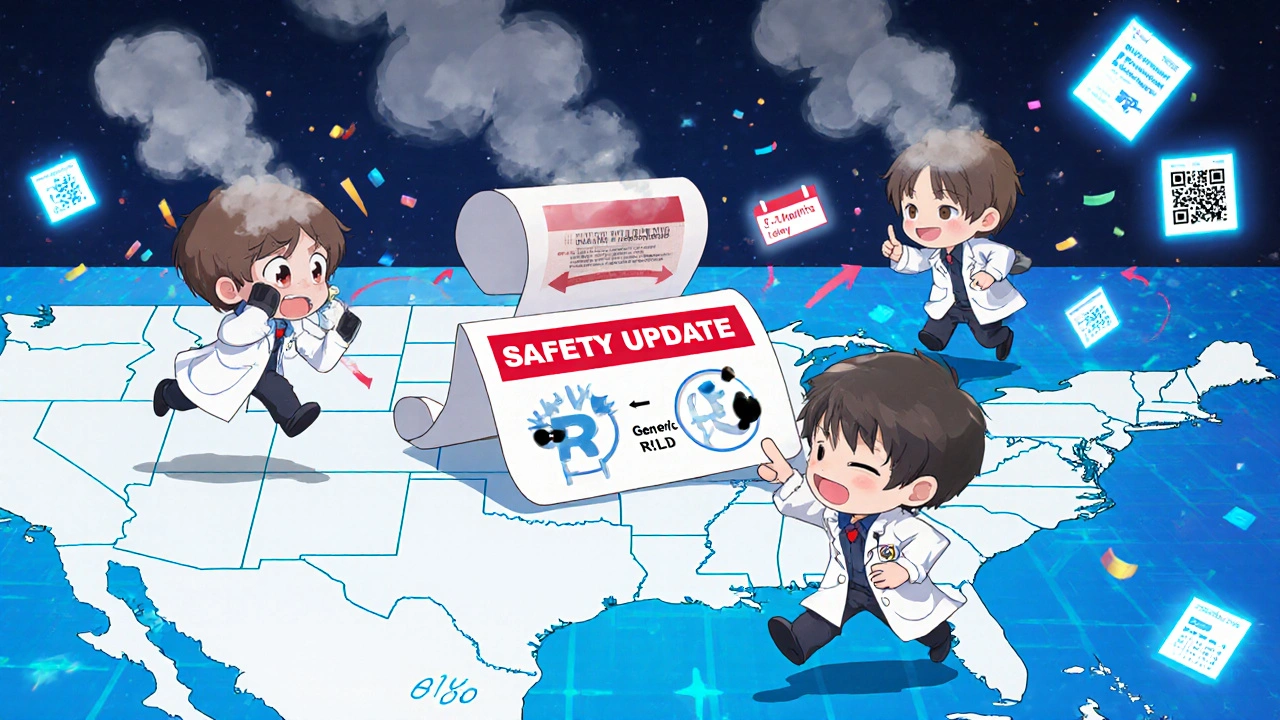
Here’s the hidden problem: brand-name drug makers can update their labels on their own. If they discover a new risk - say, a dangerous interaction with a common supplement - they can file a “Changes Being Effected” (CBE) supplement. That lets them change the label immediately, then notify the FDA afterward.
Generic manufacturers can’t do that. They have to wait. They must wait for the brand to update its label. Then they must wait for the FDA to approve that change. Only then can they update their own label. This delay can last 6 to 12 months.
A 2024 study in JAMA Internal Medicine found this gap affects 9,400 generic drugs - nearly 9 out of 10 prescriptions filled in the U.S. That means millions of patients are taking medication with labels that don’t reflect the latest safety data. The 2022 valsartan recall is a chilling example. Contamination risks were discovered in the brand-name version, but generic makers couldn’t update their labels until months later - even though patients were taking the exact same drug.
What’s Changing? The MODERN Labeling Act and Beyond
The FDA knows this system is broken. In 2020, Congress passed the MODERN Labeling Act to fix outdated labels when the original brand drug is no longer sold. That’s a big deal. There are over 1,200 RLDs that have been discontinued - but their generic versions are still on shelves. Without the MODERN Act, those generics would have labels from 20 years ago, with no way to update them.
Now, under new FDA guidance released in January 2025, generic manufacturers can update labels for these orphaned products using data from other approved sources - like the original brand’s final label or published clinical studies. It’s a step forward.
But the bigger issue - the delay in safety updates - remains unresolved. In November 2023, the FDA proposed a rule that would let generic makers update labels for new safety information without waiting for the RLD. That rule is still pending as of early 2025. If it passes, it could be the biggest change to generic labeling in decades.
What’s Next? AI and Digital Labels
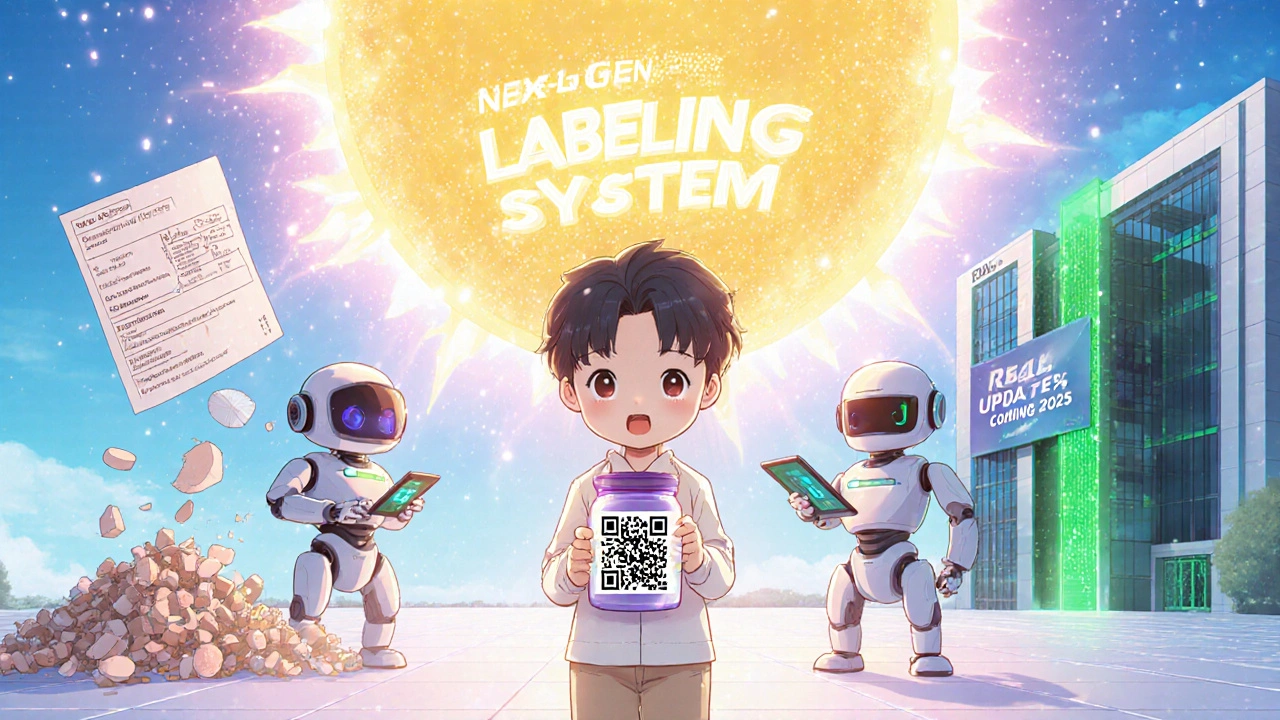
The FDA isn’t just fixing rules - it’s rebuilding the system. By Q3 2025, it plans to launch the Next Generation Generic Drug Labeling System. This new platform will use AI to automatically detect changes in RLD labels and notify generic manufacturers in real time. Beta testing starts in April 2025 with 15 major companies.
Also, the FDA now requires electronic labeling for medication guides. Instead of printing a 10-page insert, manufacturers must include a URL or QR code that links directly to the current FDA-approved label in PDF format. The link must use HTTPS and point to the official version on Drugs@FDA. This cuts down on outdated paper inserts and ensures patients always get the latest info.
Why This Matters to You
If you take generic medication - and most Americans do - this affects you. Generic drugs make up 92.6% of all prescriptions filled in the U.S. But they cost only 23.4% of total drug spending. That’s over $647 billion saved every year. That savings only works if the labels are accurate. A wrong warning, a missed interaction, or a delayed safety update can lead to hospitalizations, ER visits, or worse.
Pharmacists and doctors rely on those labels. If the label says “safe in pregnancy” but new data shows a risk, and the generic hasn’t updated yet - that’s a real danger. The system was designed for consistency, not speed. And right now, consistency is winning over safety.
The FDA’s next move will determine whether generic drugs remain the affordable, safe option they’re meant to be - or become a ticking time bomb of outdated information.
Can a generic drug have a different label than the brand-name version?
No. By law, the labeling for a generic drug must be identical to its Reference Listed Drug (RLD), except for the manufacturer’s name, address, and National Drug Code (NDC). All safety information, dosage instructions, warnings, and contraindications must match word-for-word. The FDA enforces this strictly - any mismatch can lead to rejection of the drug application or enforcement action.
Why can’t generic drug companies update their labels when they discover a new safety risk?
Unlike brand-name manufacturers, generic companies cannot file their own safety updates. They must wait for the brand-name drug’s label to be updated by its maker, then wait for the FDA to approve that change. Only after that can they update their own label. This creates a delay of 6 to 12 months, which has been called a dangerous safety gap by experts. The FDA has proposed a rule to fix this, but it has not been finalized as of early 2025.
What is the Physician Labeling Rule (PLR), and does it apply to generics?
The Physician Labeling Rule (PLR) is a standardized format for prescription drug labels that requires specific sections like Highlights, Recent Major Changes, Warnings, and Dosage Instructions. It became mandatory in 2006. Generic drugs must adopt the PLR format as soon as their Reference Listed Drug does. This ensures all drugs in the same therapeutic class have consistent, easy-to-read labeling.
How do generic drug manufacturers know when the brand-name label changes?
Manufacturers monitor the FDA’s Drugs@FDA database, which publishes updated labeling documents weekly, usually on Tuesdays. Most companies subscribe to CDER’s electronic notification system, which sends alerts when labeling changes occur for specific drug classes. Leading firms also use automated software to scan for changes daily. However, discrepancies sometimes occur between Drugs@FDA and the Orange Book, so companies often cross-check multiple sources.
What happens if a generic drug’s label doesn’t match the brand’s?
The FDA considers this a serious compliance violation. It can result in a complete response letter during application review, delaying approval. For already-approved drugs, the FDA may issue a warning letter, demand a label update, or even initiate a recall. Between January 2023 and December 2024, the FDA issued 47 warning letters specifically for labeling discrepancies in generic drugs.
Are electronic labels required for generic drugs?
Yes. The FDA now requires medication guides for generic drugs to include a direct link - either a URL or QR code - to the current FDA-approved labeling in PDF format. The link must use HTTPS and point to the official document on Drugs@FDA. This replaces outdated printed inserts and ensures patients always access the most up-to-date safety information.
8 Comments
doug schlenker
Man, I had no idea the label had to be word-for-word identical. I always assumed generics could tweak the wording to make it clearer for patients. Guess that’s why so many people get confused when the side effects section reads like a legal document.
Leah Doyle
So if a brand adds a new warning about grapefruit interactions but the generic hasn't updated yet... people are literally taking a drug with outdated safety info? 😳 That's wild. And scary. I take a generic statin-hope my pharmacist checks this stuff.
Alexis Mendoza
It’s like the system was built for the 1980s. We’ve got AI, real-time data, and QR codes for everything else-but the safety info on your pills is stuck in a bureaucratic time warp. If the drug is the same, why can’t the label update faster? It’s not like we’re changing the recipe.
Michelle N Allen
I mean sure the labels have to match but honestly how many people even read them anyway I just swallow the pill and go about my day the pharmacist knows what they're doing right
Madison Malone
Big thanks to the FDA for keeping things consistent. But this delay thing is serious. Imagine being a grandma on blood pressure meds and the label says it’s safe with turmeric but now it’s not-and it’s been 9 months since the warning came out. That’s not just paperwork, that’s someone’s health.
Jacob Hepworth-wain
The QR code thing is actually genius. No more losing those tiny inserts. Just scan and boom-latest label. I wish all meds had this. Even my dog’s flea pill should have a link to the safety info.
Craig Hartel
Love that the FDA’s trying to fix this with AI and real-time alerts. It’s about time. Generic drugs save us billions-but they shouldn’t be a safety loophole. Kudos to the folks grinding away in regulatory departments. You’re the unsung heroes keeping us from accidentally mixing meds with grapefruit juice.
Chris Kahanic
One sentence: The current system prioritizes regulatory uniformity over patient safety, and until generic manufacturers are granted the same labeling authority as originators, the gap will persist. The MODERN Act is a start, but it’s not a solution.