Imagine your 78-year-old mother switches from brand-name Synthroid to a generic version of levothyroxine. Six months later, her thyroid levels are all over the place, requiring three dosage adjustments. Was the generic drug bad? Or was it something else entirely? This scenario plays out in pharmacies across the country every day. While the FDA insists that generic drugs are just as safe and effective as their brand-name counterparts, older adults face unique physiological hurdles that make this equation far more complex.
If you’re caring for someone over 65-or approaching that milestone yourself-you need to understand how aging bodies process medications differently. It’s not just about the label on the bottle; it’s about what happens inside the body after you swallow it. Here is the reality: generic drugs are chemically identical in active ingredients, but the way an 80-year-old metabolizes them can differ drastically from a 40-year-old. And sometimes, those inactive ingredients matter more than you think.
The Real Difference Between Generic and Brand-Name Drugs
Let’s clear up the biggest myth first. A generic drug is not a diluted or weaker version of the original. It contains the same active ingredient, strength, dosage form, and route of administration. The FDA requires generics to demonstrate bioequivalence, meaning the drug enters the bloodstream at a similar rate and extent to the brand-name version. Specifically, the allowable range is 80-125% of the brand-name drug’s pharmacokinetic profile.
So why do people worry? The difference lies in the inactive ingredients-fillers, binders, and dyes. For most healthy adults, these don’t matter. But for older adults with sensitivities or specific dietary restrictions, they can cause issues. More importantly, the perception gap is real. A 2023 study found that 42% of surveyed seniors believed generic warfarin was riskier than brand-name Coumadin, despite clinical studies showing 98.7% therapeutic equivalence. This anxiety often leads to non-adherence, which is a bigger safety risk than the drug itself.
Why Aging Bodies Process Drugs Differently
Your body changes as you age, and so does its relationship with medicine. Medication metabolism can decline by up to 30% in adults over 75. This isn’t a defect; it’s biology. Reduced kidney function means drugs stay in your system longer. Lower liver enzyme activity slows down breakdown. Changes in body composition-more fat, less water-alter where drugs go and how concentrated they become.
This creates a dangerous scenario where a "normal" dose becomes an overdose. Central nervous system (CNS) medications are particularly tricky. Older adults are extra sensitive to sedatives, opioids, and antidepressants. A dose that knocks out a younger person might leave an elderly patient confused, dizzy, or prone to falls. The American Academy of Family Physicians notes that beta-blockers can cause bradycardia in 25-30% of older patients, while insulin and sulfonylureas carry a 20-25% incidence of hypoglycemia leading to falls.
| Physiological Change | Impact on Drug Metabolism | Safety Risk for Older Adults |
|---|---|---|
| Reduced Renal Clearance | Drugs accumulate in blood; half-life extends | Toxicity from standard doses (e.g., Digoxin) |
| Decreased Hepatic Metabolism | Slower breakdown of active ingredients | Prolonged side effects from CNS drugs |
| Increased Body Fat / Decreased Water | Lipophilic drugs concentrate in fat tissues | Delayed release and prolonged action |
| Altered Gut Absorption | Variable pH and motility affect uptake | Inconsistent drug levels (e.g., Levothyroxine) |
The Polypharmacy Trap
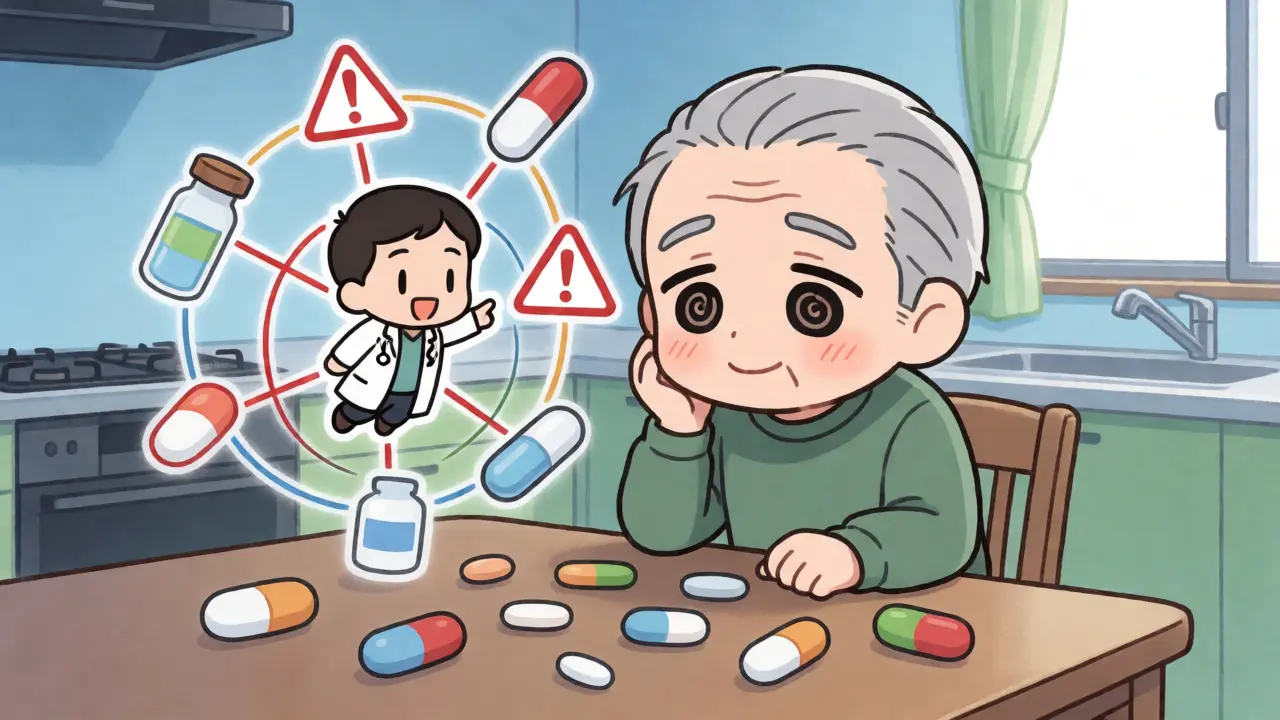
It’s rarely one drug that causes trouble-it’s the cocktail. Polypharmacy, defined as taking five or more medications, is rampant among Medicare beneficiaries aged 65+, who fill an average of 48 prescriptions annually. The risk scales exponentially. Taking two medications carries a 13% risk of adverse drug reactions (ADRs). That jumps to 58% with five meds and skyrockets to 82% with seven or more.
Here’s where generics intersect with complexity. If you’re switching brands, you might inadvertently change the timing or absorption of one component in a delicate balance. The Beers Criteria, updated in 2023 by the American Geriatrics Society, highlights specific combinations to avoid regardless of whether they are generic or brand-name. For instance, combining opioids with benzodiazepines increases overdose risk by 154%. Adding gabapentinoids to opioids raises respiratory depression risk by 70%.
Dr. Michael Steinman, a geriatrician at UCSF, puts it bluntly: "The fundamental issue isn't generic versus brand, but rather appropriate medication selection considering age-related pharmacokinetic changes and multimorbidity." In other words, stopping unnecessary drugs matters more than choosing the brand-name version of a necessary one.
Narrow Therapeutic Index Drugs: Where Precision Matters
For most drugs, small variations in concentration don’t matter. But for Narrow Therapeutic Index (NTI) drugs, a tiny shift can mean the difference between treatment and toxicity. Warfarin, digoxin, and levothyroxine fall into this category. While the FDA maintains that generics are equivalent, post-market surveillance shows slight discrepancies in reporting rates for NTI drugs among the very old. For example, the FDA Adverse Event Reporting System noted 1.8x higher reporting rates for generic warfarin among adults 80+ compared to other demographics.
This doesn’t mean generics fail. It means monitoring must be tighter. If you switch from brand-name to generic for an NTI drug, schedule follow-up blood tests sooner rather than later. Don’t wait for symptoms to appear. Proactive testing catches instability before it becomes a crisis.
Practical Strategies for Safer Medication Management
You can’t stop aging, but you can manage the risks. Start with communication. Dr. Dima Qato, a lead researcher on senior drug beliefs, found that counseling patients about generics results in 37% higher acceptance and proper use. Ask your pharmacist specifically: "Are there any inactive ingredients here my father should avoid?" and "Will this generic require different monitoring than the brand?"
Organization is your second line of defense. Vision challenges affect 65% of adults 65+. Request large-print labels from the pharmacy. Use color-coded pill organizers or automated dispensers, which reduce medication errors by 34%. Keep a current list of all medications-including supplements-and bring it to every doctor visit. Duplicate therapies account for significant waste and risk; updating your list reduces duplicates by 41% in Medicare beneficiaries.
- Review Quarterly: If you take 5+ meds, get a comprehensive medication review by a pharmacist every three months. This reduces adverse events by 27%.
- Check Expiration Dates: 22% of medication errors in seniors involve expired or improperly stored drugs. Heat and humidity degrade potency.
- Watch for Look-Alike Errors: 28% of confusion cases involve similar-looking generic pills vs. 12% for branded ones. Verify names carefully.
What Does the Data Say About Effectiveness?
Despite fears, the data supports generics. A 2021 study in the Journal of Thrombosis and Haemostasis confirmed high therapeutic equivalence for generic warfarin. User testimonials vary widely because individual physiology differs. One caregiver reported saving $1,200 annually with generic atorvastatin with identical LDL results over 18 months. Another saw unstable TSH levels after switching thyroid meds. Both experiences are valid.
The key takeaway? Individual response varies. If a generic works well, stick with it. If you notice changes in efficacy or side effects after a switch, talk to your provider. It might not be the drug being "bad," but your body needing a dosage adjustment due to age-related metabolic shifts.
Are generic drugs really as safe as brand-name drugs for seniors?
Yes, according to the FDA and the National Institute on Aging, generic drugs are equally safe and effective. They contain the same active ingredient and meet strict bioequivalence standards. However, older adults may experience different side effects due to age-related physiological changes, not necessarily because the generic is inferior.
Should I stick with brand-name drugs if I have a narrow therapeutic index medication?
Not necessarily, but caution is advised. Drugs like warfarin and levothyroxine require precise dosing. If you switch to a generic, monitor your levels closely (e.g., INR for warfarin, TSH for thyroid) immediately after the switch. If stability is maintained, continue. If not, discuss returning to the brand or adjusting the dose with your doctor.
What are the biggest risks of polypharmacy in older adults?
The primary risks include adverse drug reactions, falls, cognitive decline, and hospitalization. Taking five or more medications increases the risk of adverse reactions to 58%, and seven or more pushes it to 82%. Interactions between drugs, even if each is safe individually, can create unpredictable effects in aging bodies.
How often should older adults review their medications?
Experts recommend a comprehensive medication review at least once a year, or quarterly if you are taking five or more medications. Regular reviews help identify duplicate therapies, outdated prescriptions, and interactions that may have developed over time.
Do inactive ingredients in generic drugs pose a risk?
For most people, no. However, some older adults may have allergies or intolerances to specific dyes, lactose, or gluten used as fillers in generic formulations. If you suspect an allergic reaction or digestive upset after switching, ask your pharmacist for the inactive ingredient list.
14 Comments
Eric Schultze
The FDA is a revolving door for pharmaceutical lobbyists. They claim equivalence, but they do not account for the micro-variations in inactive ingredients that trigger autoimmune responses in the elderly population. We are being experimented on with substandard fillers while corporations profit from the brand-name premium. This is not science; it is economics disguised as public health policy.
Amy B
oh wow this hits home!! my grandma had such a rough time switching meds last year and i felt so helpless watching her struggle with the dizziness and confusion. it’s wild how much the body changes after 65 like suddenly everything is harder to process lol. i never realized how big of a deal the inactive stuff actually was until i read about the sensitivities part. super interesting breakdown of the polypharmacy trap too because she definitely has way too many pills floating around her kitchen counter right now. thanks for sharing this info it’s gonna help me talk to her doctor next week!
Adam Viruet
Generic drugs are fine. Stop worrying. It's just marketing fear-mongering by Big Pharma to keep prices high. The active ingredient is the same. Period. If your mom feels bad, maybe check if she's eating enough or sleeping well instead of blaming the pill manufacturer. People love to find problems where there aren't any. Just take the cheaper option and move on with your life. Simple solution to a non-problem.
Neil Martin
To dismiss the pharmacokinetic nuances presented here is intellectually lazy and clinically negligent. The bioequivalence window of 80-125% is statistically significant when dealing with Narrow Therapeutic Index (NTI) agents in geriatric populations with compromised hepatic clearance. You are conflating chemical identity with biological interchangeability, which is a fundamental error in pharmacology. The variance in excipients can alter dissolution rates, impacting AUC and Cmax in ways that matter immensely for patients with reduced renal reserve. Your oversimplification ignores the reality of inter-individual variability in drug metabolism.
Adam Viruet
Wow. So fancy words to say nothing new.
Kimberley Odish
I find the generalization regarding
Evelyn Reed
this is solid info
i work in palliative care and see this exact scenario weekly. the key isn't necessarily avoiding generics but ensuring continuity of care. switching manufacturers frequently causes more instability than the generic vs brand debate itself. consistent sourcing matters more than the label. also, the point about counseling increasing acceptance by 37% is backed by data we see in our clinic. trust is built through transparency about what is in the pill, not just what it does.
Kim Pender
good post.
my dad takes 6 meds. he gets confused easily. color coded boxes helped him a lot. simple things make a difference.
Somnath Thombre
hey everyone! great article really helpful for us caregivers!!! i think people forget that older adults have different bodies so we need to be patient with them. its not just about the medicine but also how they take it and remember it. let's support each other in managing these complex situations together. positive vibes only!!
Falgun R Patel
This reflection invites us to consider the deeper relationship between the human spirit and the substances we introduce to sustain it. When an elder struggles with medication, it is often a manifestation of their changing place in the world. We must approach their regimen not merely as a chemical equation, but as a dialogue with their history and physiology. Compassion requires patience with the slow adjustments needed for aging bodies. Let us guide them gently through these transitions, honoring their dignity above all else.
Jenn Bell
love this perspective!!
it’s so important to feel empowered rather than scared when making these switches. knowing what to ask the pharmacist makes such a huge difference. i’m going to print out those questions for my aunt. thank you for breaking down the scary stats into manageable steps!
Neil Sahli
Oh fantastic another reason to blame the system for our own lack of organization. Maybe if seniors used a pillbox like normal humans they wouldn't be 'confused' by two different colored tablets. But sure let's complicate it further with more monitoring and more appointments. Great advice for those who can afford to spend half their day at the pharmacy.
Amanda SF
I am absolutely appalled by the negligence shown in some prescribing practices mentioned implicitly here. To suggest that a simple switch is harmless without considering the specific metabolic profile of an octogenarian is borderline malpractice. The data clearly indicates higher adverse event reporting for NTI drugs. Ignoring this disparity is dangerous. We demand better oversight and personalized medicine, not one-size-fits-all assumptions that endanger lives. This is unacceptable.
Pramay Dattani
In India we have excellent generics at low cost. Why US pay so much? The quality is same. Inactive ingridients dont matter much if you eat healthy. My father takes generic blood pressure meds and he is fine. Stop overthinking it. American healthcare system is broken because of greed. Generic drugs are the future for everyone. Trust the science not the fear.