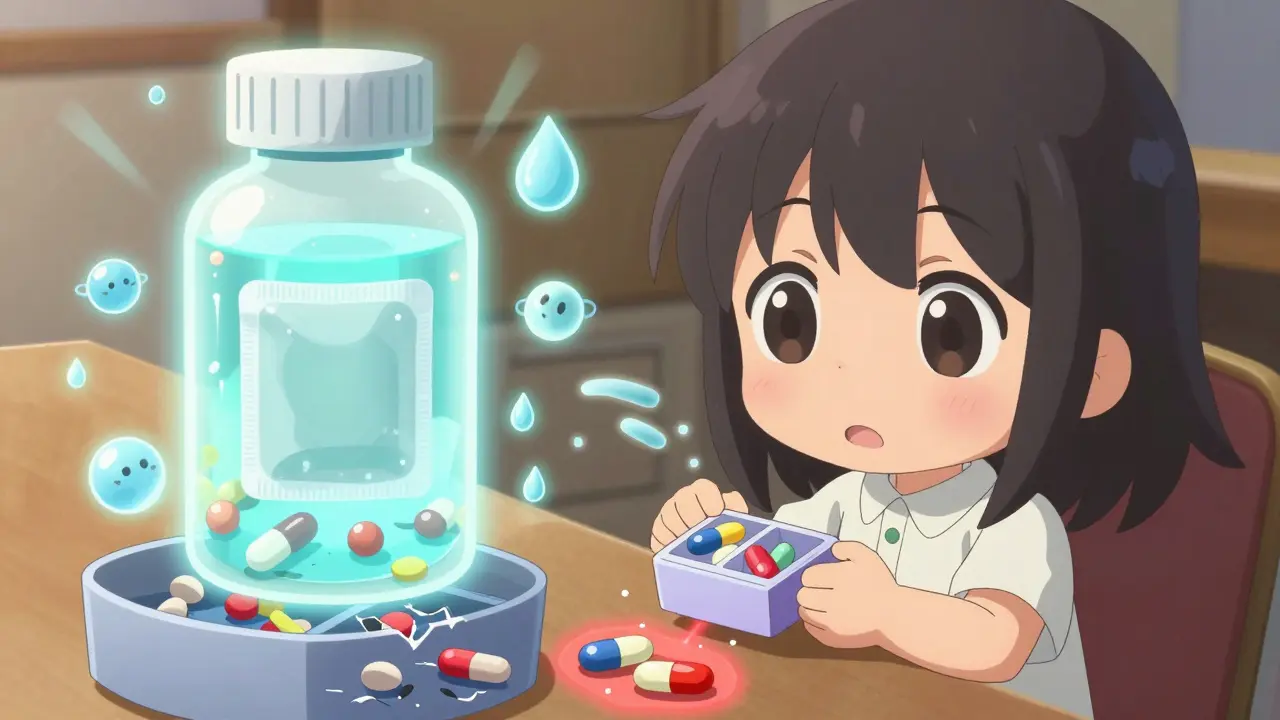
When you take medication out of its original bottle and put it into a pillbox or a pharmacy repackaging vial, you might think it’s still just as safe and effective as the day you got it. But that’s not true. The container matters - a lot. Medications don’t just expire because time passes. They degrade because of moisture, light, oxygen, and heat. And when you move them from a sealed, desiccant-packed bottle into a simple plastic vial or a plastic pill organizer, you’re exposing them to conditions they were never designed to handle.
Why Original Packaging Matters
Pharmaceutical companies spend years testing how their drugs hold up in their original packaging. That’s why the expiration date on your prescription bottle isn’t arbitrary. It’s based on real data: how the drug behaves under controlled temperature, humidity, and light conditions inside that specific bottle, with its specific cap, desiccant, and material. For example, an albuterol sulfate tablet in its original HDPE bottle with a desiccant packs only 3.2% degradation over 90 days. But when moved into a standard pharmacy prescription vial? That number jumps to 15.7%. That’s more than four times the degradation. And that’s just one drug. The FDA’s guidance on container closure systems says these systems must protect against moisture, gases, and contamination. But most pharmacy vials? They’re not built for that. Their moisture vapor transmission rate is 0.35-0.50 g/m²/day. The original manufacturer’s bottle? Often 0.10-0.25 g/m²/day. That means your pillbox or repackaged vial is letting in nearly twice as much moisture. For drugs like amoxicillin or insulin, that’s a big deal.What Happens When Medications Degrade?
Degradation isn’t just about potency loss. It can create harmful byproducts. For instance, tetracycline antibiotics break down into toxic compounds when exposed to moisture. Nifedipine, a blood pressure drug, turns brown and loses effectiveness under light. Atenolol, another beta-blocker, can clump and become unevenly dosed if it absorbs too much humidity. In one 2023 FDA lab study, 22% of repackaged medications tested beyond 90 days had degradation levels exceeding USP limits. Only 3% of the same drugs in original packaging did. The problem gets worse with pillboxes. When you put five different drugs into one organizer - say, amlodipine, metformin, levothyroxine, atorvastatin, and aspirin - you’re not just changing the container. You’re creating a chemical environment. Some drugs release moisture. Others are sensitive to light. Some might react chemically with others. A 2022 study found that 18.7% of multi-drug pillboxes showed physical changes like caking, discoloration, or sticking within just 14 days. That’s not a coincidence. It’s chemistry.How Long Can You Really Keep Repackaged Medications?
Forget the original expiration date. That’s for the original container only. Once it’s repackaged, the clock resets. The International Pharmaceutical Federation (FIP) and the FDA both agree: solid oral medications repackaged in standard pharmacy containers should not be used beyond six months. But even that’s too long for many drugs. Here’s what experts recommend based on actual stability data:- Amoxicillin and other hygroscopic antibiotics: 30 days max
- Nifedipine, nitroglycerin, and other light-sensitive drugs: 60 days max in amber vials
- Atenolol, lisinopril, metformin: 90 days if stored in dry, cool conditions
- Levothyroxine: 60 days - it’s extremely sensitive to moisture
- Insulin (if repackaged): Not recommended. Always use original vials or pens
What Should Pharmacies Actually Do?
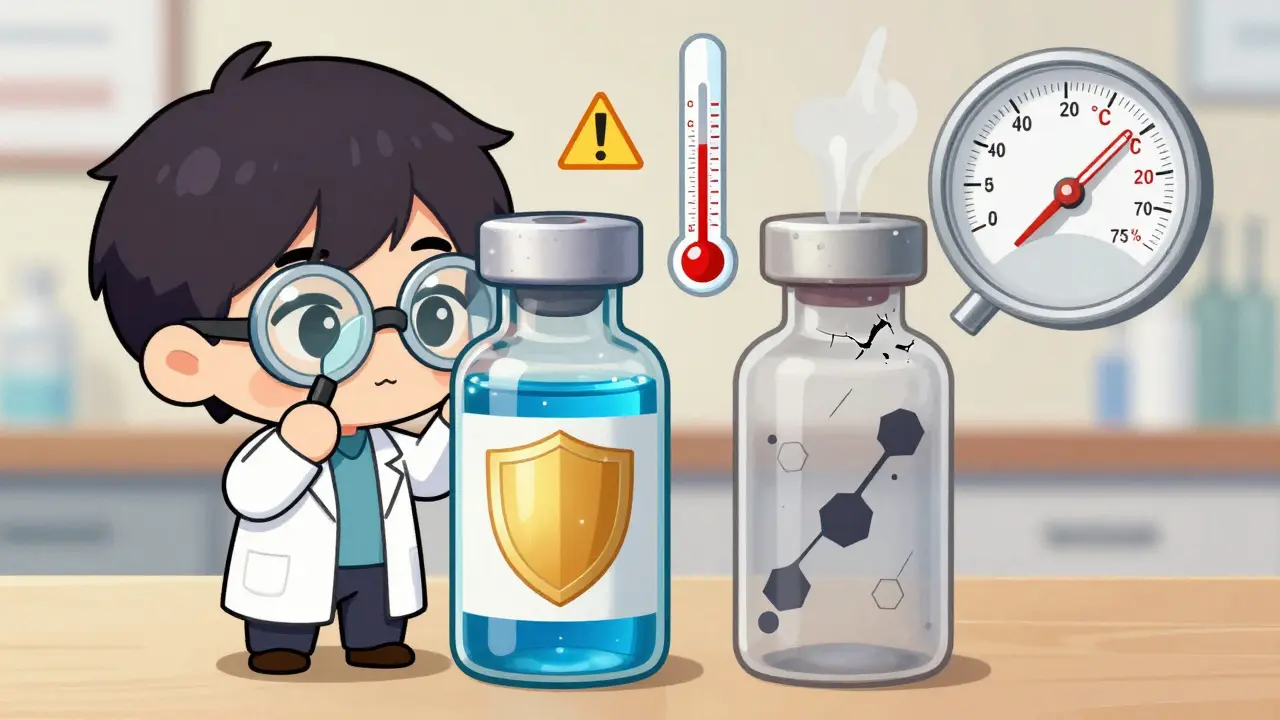
Many pharmacies skip formal stability testing because it’s expensive. HPLC machines cost tens of thousands of dollars. Most independent pharmacies don’t have them. But that doesn’t mean you can guess. The University of Michigan’s protocol - now used by over 120 hospitals - starts with a simple stress test: place 10 repackaged samples in a 40°C (104°F) and 75% humidity chamber for 14 days. If the drug changes color, clumps, or smells off, it’s unstable. That’s your red flag. For high-risk drugs - those with narrow therapeutic windows like warfarin, digoxin, or lithium - you need real data. That means HPLC testing to measure active ingredient concentration. A 2021 study showed that HPLC can detect degradation as low as 0.05%. That’s how you know if a drug is still safe. For lower-risk meds, use bracketing. If you’ve tested metformin, atenolol, and simvastatin in the same vial and they all hold up for 90 days, you can reasonably assume other similar drugs will too. But you still need to document it.What About Pillboxes?
Pillboxes are the trickiest. They’re not designed for drug stability. They’re designed for convenience. But convenience shouldn’t come at the cost of safety. Here’s what works:- Use amber pill organizers for light-sensitive drugs
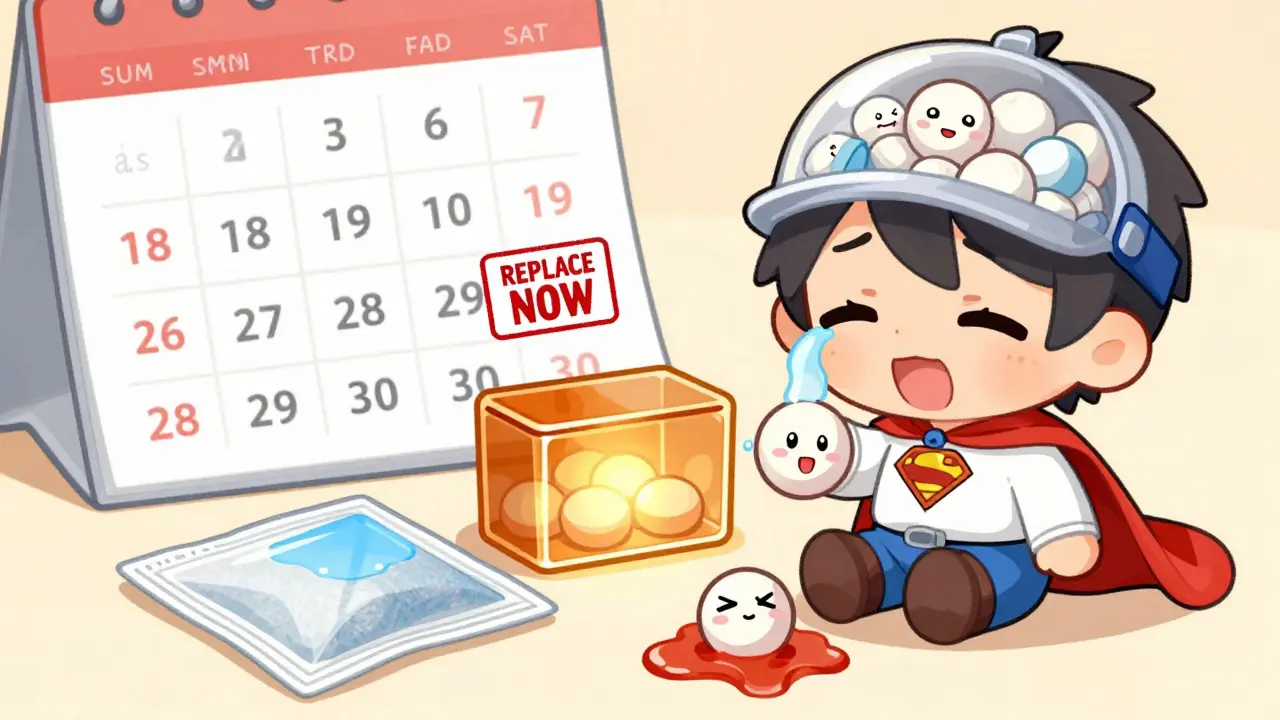
- Put a desiccant pack inside - studies show this extends stability by 47%
- Don’t mix more than 3-4 drugs in one compartment
- Label each compartment with the date you filled it
- Replace the entire organizer every 30 days, even if you haven’t used it all
What You Can Do as a Patient
You don’t need a lab to protect yourself. Just ask the right questions:- “Is this medication in its original bottle, or was it repackaged?”
- “What’s the expiration date on this vial or pillbox - and how was it determined?”
- “Does this drug need to be kept dry or out of light?”
- “Can I get it back in the original container if I don’t use a pillbox?”
The Bottom Line
Medication stability isn’t about the date on the bottle. It’s about the container, the environment, and the drug itself. Repackaging changes everything. A drug that lasts two years in its original bottle might be unsafe after 60 days in a pillbox. Ignoring that isn’t just careless - it’s dangerous. The FDA, USP, and ASHP all agree: you can’t assume. You have to test. Or at least follow conservative, evidence-based limits. Because when a drug degrades, it doesn’t just stop working. It can hurt you.Can I use the original expiration date for repackaged medications?
No. The original expiration date only applies if the medication stays in its original container with the original closure and desiccant. Once it’s repackaged - even into a pharmacy vial - that date is no longer valid. The FDA explicitly states that repackaged drugs require their own expiration dating based on stability testing.
Are pillboxes safe for long-term use?
Pillboxes are convenient but not ideal for long-term storage. Studies show that 18.7% of multi-drug pillboxes develop physical changes like caking or discoloration within 14 days. For safety, refill pillboxes every 30 days, use desiccant packs, avoid mixing more than 3-4 drugs per compartment, and choose amber containers for light-sensitive drugs.
What drugs are most at risk when repackaged?
Hygroscopic drugs (like amoxicillin, levothyroxine, and insulin) absorb moisture and degrade quickly. Light-sensitive drugs (like nifedipine, nitroglycerin, and riboflavin) break down under normal indoor lighting. Drugs with narrow therapeutic indexes (like warfarin, digoxin, and lithium) are dangerous even if they lose a small amount of potency. These should always be kept in original containers.
Do pharmacies test repackaged medications for stability?
Many don’t. A 2020 ISMP survey found that 32% of community pharmacies lack formal stability protocols. Large chains and hospital pharmacies are more likely to test, especially for high-risk drugs. Independent pharmacies often rely on conservative expiration dates (30-90 days) because they lack access to HPLC equipment. Always ask your pharmacy how they determine expiration dates for repackaged meds.
Is there a legal limit for repackaged medication expiration?
Yes. In 41 of 50 U.S. states, regulations limit repackaged medication expiration to 6 months or less. Seventeen states impose stricter limits of 30-90 days for certain drugs. The FDA has issued warning letters to pharmacies that assign expiration dates without testing. Using outdated repackaged meds can be considered a violation of federal drug safety standards.
Can I use desiccant packs to make repackaged meds last longer?
Yes. A multicenter trial with over 8,400 repackaged units showed that adding a desiccant pack extended stability by 47%. This is especially helpful for moisture-sensitive drugs like antibiotics, thyroid meds, and antifungals. Ask your pharmacy to include one - or buy small silica gel packs and add them yourself to pillboxes or vials.
10 Comments
Agbogla Bischof
Just to clarify: moisture vapor transmission rates (MVTR) are measured in grams per square meter per day. Original HDPE bottles? Around 0.10–0.25 g/m²/day. Pharmacy vials? 0.35–0.50 g/m²/day. That’s not a small difference-it’s a 100% increase in moisture ingress. For hygroscopic drugs like levothyroxine or amoxicillin, this isn’t just theoretical. It’s a clinical risk.
And don’t forget: humidity isn’t the only factor. Temperature cycling-like leaving a pillbox on a windowsill or in a car-accelerates degradation exponentially. The Arrhenius equation doesn’t lie. Every 10°C rise doubles the reaction rate. So yes, your ‘6-month’ pillbox might be toxic after 3 weeks in summer.
I’ve seen this firsthand. A patient on levothyroxine switched to a pillbox, stopped feeling well, and her TSH spiked. Turned out the tablets had clumped. HPLC showed 12% degradation. She was fine once she went back to the original bottle.
Pharmacies that don’t test are gambling. And patients are the ones losing.
Pat Fur
I’ve been using amber pill organizers with silica packs for years. Game-changer.
peter vencken
honestly i just throw all my pills in a ziplock and call it a day. never had a problem. maybe im just lucky?
Chris Crosson
That’s wild. I never realized how much packaging matters. I’ve been using a 90-day pillbox for my atorvastatin and metformin. Should I be worried? I keep it in a drawer-no sun, no humidity.
Stephen Alabi
While the data presented is statistically significant and methodologically sound, one must consider the broader epistemological framework of pharmaceutical regulation. The FDA’s guidance, while authoritative, is not infallible; it is contingent upon industry-funded studies and regulatory capture. Furthermore, the assumption that degradation equates to toxicity is a reductionist fallacy. Degradation products are not inherently toxic-they must be evaluated in context of pharmacokinetic thresholds, which are rarely disclosed.
Moreover, the assertion that 18.7% of pillboxes show physical changes within 14 days is misleading. Physical changes-such as surface discoloration-do not necessarily correlate with bioavailability loss. A 2019 study in the Journal of Pharmaceutical Sciences demonstrated that visual changes in metformin tablets occurred at 8% moisture absorption, yet potency remained above 95% until 17%.
Therefore, while the precautionary principle is commendable, it must not override empirical evidence. The real issue is not repackaging-it is the lack of transparent, publicly accessible stability data from manufacturers.
Caroline Bonner
I love this so much! I’ve been trying to get my mom to stop using that plastic pillbox she got from CVS for her meds-she’s on like seven different pills-and I’ve been telling her for months that it’s not safe, but she just says, ‘It’s fine, I’ve been doing it for years.’
Then I found this article, printed it out, and showed her the 47% stability increase with desiccant packs-she actually cried. She said she didn’t realize how much she was risking. Now she buys those little silica packs from Amazon and puts them in her amber organizer. She even labeled each compartment with a Sharpie and dates everything. I’m so proud.
Also, I just switched my insulin to a blister pack. It’s expensive, yes-but I’d rather pay $15 extra than risk a bad reaction. I’m telling all my friends. This needs to be common knowledge!
Elaine Parra
You people are being ridiculous. This isn’t rocket science. People have been using pillboxes since the 1980s. If you’re worried about degradation, then don’t take your meds at all. That’s the real problem-overmedicalization. You’re terrified of a few percentage points of degradation while ignoring the fact that 40% of Americans don’t even take their meds as prescribed.
And don’t get me started on ‘amber pillboxes.’ That’s a luxury for people who think they’re too good for Walmart. My grandma took her pills in a Tupperware for 20 years. She’s 92. Still walking. Still sharp. You’re creating fear where there’s none.
Stop selling fear. Start selling common sense.
Grace Kusta Nasralla
I used to think this was overkill. I’d just toss my pills into a plastic organizer and forget about it. Then my mom died. She was on warfarin. She used a pillbox for six months. The pharmacy told her it was fine. She started having nosebleeds. They said it was ‘age.’ But the lab report later showed her warfarin levels were 40% lower than they should’ve been.
Turns out, the humidity in her bathroom had degraded the tablets. She didn’t know. The pharmacy didn’t tell her. I didn’t know.
I’m not angry anymore. I’m just… careful. Now I ask every pharmacy: ‘Is this in the original bottle?’ If not, I ask for the expiration date and how it was determined. If they hesitate? I walk out.
This isn’t paranoia. It’s survival.
Jacob Hessler
so like if i put my atenolol in a pillbox with a little silica pack is that good enough? i mean its not like im trying to kill myself right?
Anil Arekar
Thank you for this comprehensive and evidence-based breakdown. As a pharmacist with over 22 years of experience, I can confirm that the data presented aligns precisely with clinical observations and regulatory guidelines from USP, FIP, and ASHP.
It is imperative to recognize that repackaging is not inherently dangerous-it is the absence of documentation, environmental control, and stability testing that poses the risk. Many community pharmacies operate under resource constraints, but this does not absolve them of ethical responsibility.
I recommend that patients request blister packs whenever possible. While costlier, they offer unit-dose integrity, tamper evidence, and compliance tracking. For those who must use pillboxes, amber containers with desiccants, refilled weekly, and labeled with fill dates are the minimum standard.
Medication safety is not optional. It is foundational.