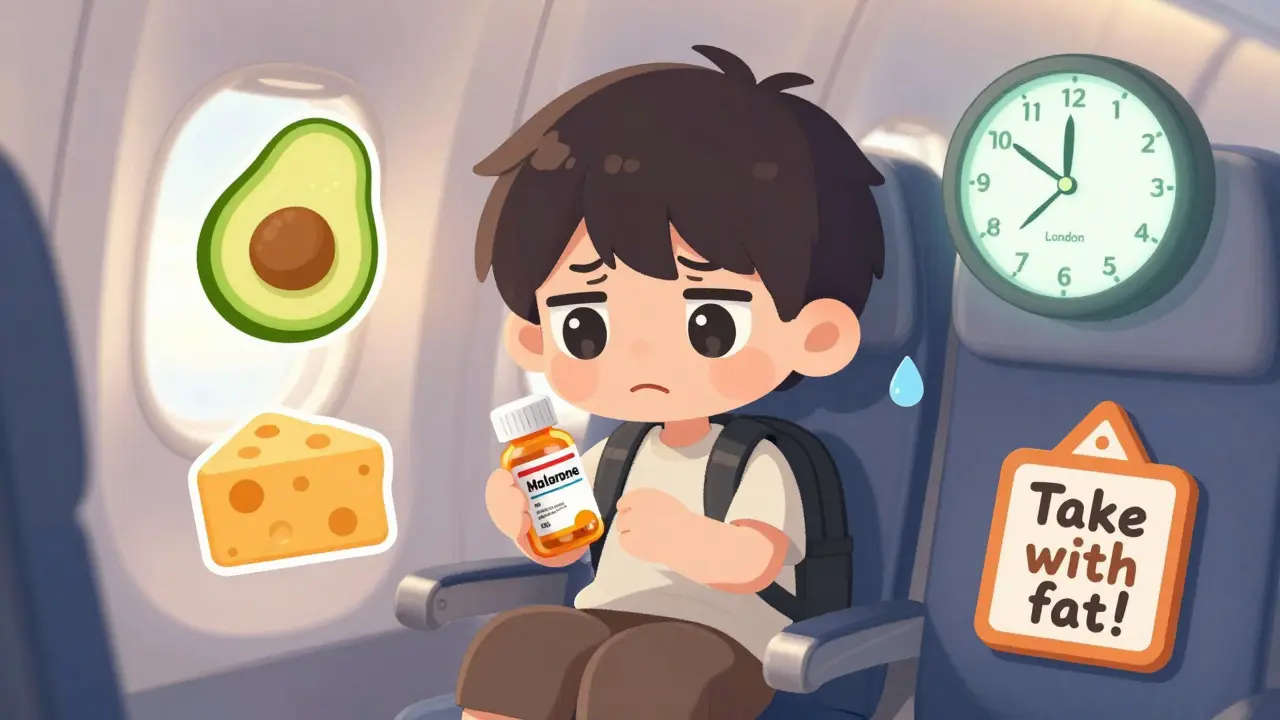
When you’re flying from London to Bangkok, or New York to Cape Town, the biggest health risk isn’t jet lag or dry air-it’s getting the timing of your meds wrong. Most people think antibiotics are the main concern, but the real issue is antimalarials and, for some, antiretrovirals. If you’re taking daily pills to prevent malaria or manage HIV, messing up the schedule across time zones can lead to treatment failure, drug resistance, or even life-threatening illness. This isn’t theoretical. People have ended up in hospitals because they took their malaria pill on an empty stomach during a flight, or skipped a dose because they were too tired to set an alarm. Here’s how to get it right.
Why Timing Matters More Than You Think
Medications like atovaquone-proguanil (Malarone) and artemether-lumefantrine aren’t just taken daily-they need to be taken at the right time, with the right food, in the right rhythm. Your body’s absorption of these drugs changes with your circadian cycle. Take Malarone on an empty stomach during a long flight, and your body absorbs only 20% of the dose. Take it with a fatty meal, and absorption jumps by 300-400%. That’s the difference between protection and infection.
For antiretrovirals, the stakes are even higher. Drugs like dolutegravir can handle a 12-hour delay. But protease inhibitors? Miss your dose by more than 6 hours, and your viral load can spike. One traveler from the UK missed two doses during a 16-hour flight to Australia and saw his HIV viral load jump to 1,200 copies/mL within six weeks. That’s not a fluke-it’s a documented outcome.
Antimalarials: The Three Big Players and How to Time Them
There are three main antimalarials used for prevention. Each has its own rules.
- Atovaquone-proguanil (Malarone): Start 1-2 days before entering a malaria zone. Take it at the same time every day, with food or milk. If you’re flying east (e.g., London to Singapore), shift your dose earlier by 1-2 hours per day for 3 days before departure. If you’re flying west (e.g., New York to London), shift it later. After your trip, keep taking it for 7 days after leaving the risk area. If you miss a dose and were exposed to mosquitoes, you must continue for at least 4 more weeks.
- Chloroquine: Used in areas where malaria hasn’t developed resistance. Take it weekly, starting 1-2 weeks before travel. Dosing is weight-based: 10 mg per kg of body weight on days 1 and 2, then 5 mg/kg on day 3. Stick to your home time zone schedule as long as possible. Adjust only if you’re staying more than 10 days.
- Mefloquine: Taken weekly. It’s the most forgiving for time zone changes-you can delay your dose by up to 10 days without losing protection. But it comes with a catch: 12% of users report anxiety, dizziness, or nightmares. If you’re prone to panic attacks or sleep issues, skip this one.
Artemether-lumefantrine is for treatment, not prevention. If you get sick, you’ll need four tablets right away, then another four 8 hours later, then twice daily for the next two days. And yes-you must eat fat with every dose. No avocado? No banana? No good. This regimen is brutal to follow on a plane with limited meal options.
Antiretrovirals: Forgiveness Windows and Real-World Adjustments
Not all HIV meds are created equal. The key term here is “forgiveness window”-how long you can delay a dose before your virus rebounds.
- Dolutegravir: 12-hour window. You can sleep through a flight and still be safe.
- Raltegravir: 8-hour window. Set two alarms.
- Tenofovir/emtricitabine: 6-hour window. Don’t push it.
- Protease inhibitors (e.g., darunavir): 4-6 hours. Miss this, and you’re at risk.
Experts recommend starting to adjust your dosing schedule 72 hours before departure if you’re crossing more than 8 time zones. Shift your pill time by 1-2 hours per day-no more. Going east? Take your pill earlier each day. Going west? Take it later. This helps your body adjust slowly. Don’t try to jump straight to the destination time. Your liver and your sleep cycle will thank you.
Some travelers use long-acting injectables like cabotegravir/rilpivirine. These are given every 2 months. No daily pills. No time zone headaches. But they’re only available in 17 countries as of mid-2024. If you’re eligible, talk to your doctor before booking your trip.

Tools That Actually Work
Apps like Medisafe (rated 4.7/5 on iOS) let you set alarms for each dose and sync them across time zones. It even reminds you to eat before taking Malarone. But don’t rely on your phone alone. Batteries die. Wi-Fi fails. Carry a printed schedule from your doctor with:
- Your medication name and dose
- Exact times to take it at home
- Adjusted times for your destination
- Food requirements (e.g., “Take with fat”)
The CDC launched a free Malaria Prophylaxis Timing Calculator in February 2024. Just enter your flight details and meds, and it spits out a personalized dosing plan. It reduced timing errors by 63% in a Johns Hopkins trial. Use it.
What Travelers Get Wrong (And How to Avoid It)
Most mistakes aren’t about forgetting. They’re about misunderstanding.
- Mistake: Taking Malarone right after landing, thinking you’re now on local time. Fix: Start your pre-travel dose based on your arrival time in the malaria zone, not your departure time.
- Mistake: Skipping a dose because you’re too tired. Fix: Set alarms on two different devices. Put one in your carry-on, one in your pocket.
- Mistake: Assuming “daily” means “every 24 hours.” Fix: Take it at the same clock time, not the same body-clock time. If you usually take it at 8 PM London time, and you’re now in Bangkok (7 hours ahead), take it at 3 AM Bangkok time-your body still thinks it’s 8 PM.
- Mistake: Not eating fat with artemether-lumefantrine. Fix: Pack peanut butter packets, cheese sticks, or olive oil sachets. Eat them with your pill.
One Reddit user vomited 20 minutes after taking Malarone on an empty stomach during a layover. He had to restart the entire 7-day post-travel course. That’s three extra weeks of pills, stress, and cost.
When to Talk to Your Doctor
You don’t need to wing this. Schedule a pre-travel visit at least 4-6 weeks before departure. Bring your:
- Medication bottles
- Flight itinerary
- List of countries you’re visiting
- Any past issues with side effects
Ask: “What’s my forgiveness window?” and “What should I do if I miss a dose?” Don’t settle for vague answers. Get specifics. If your doctor doesn’t know, ask for a referral to a travel medicine clinic. Many airports now have them.
Corporate travelers: If you’re HIV-positive and your company sends you abroad, your employer should be offering pre-travel health assessments. If they don’t, ask why. Sixty-eight of the Fortune 100 companies now require this.

The Bottom Line
Timing your meds across time zones isn’t about being perfect. It’s about being prepared. You don’t need to be a scientist. You just need to know your drug’s rules, plan ahead, and use tools that work. The difference between success and failure often comes down to one decision: Did you eat with your pill? Did you set the alarm? Did you shift your schedule slowly?
Traveling with chronic meds is doable. Thousands do it every year. But you won’t be one of them if you assume it’s just like taking a vitamin. This is medicine. And medicine has rules.
Frequently Asked Questions
Can I take antimalarials without food if I’m on a flight?
No-not for atovaquone-proguanil (Malarone) or artemether-lumefantrine. These drugs need fat to be absorbed properly. On a flight, ask for a meal with butter, cheese, nuts, or avocado. If none is available, carry peanut butter packets or single-serve olive oil. Taking them on an empty stomach can reduce effectiveness by up to 80%.
What if I miss a dose of Malarone while traveling?
If you miss a dose and were in a malaria zone, take it as soon as you remember. Then continue your regular schedule. But you must keep taking Malarone for at least 4 more weeks after your last dose. The CDC says this is non-negotiable. Skipping this step increases your risk of malaria by 300%.
Is it safe to adjust antiretroviral timing by more than 2 hours per day?
No. Shifting your dose by more than 2 hours per day can disrupt your circadian rhythm and increase side effects like nausea or insomnia. Stick to 1-2 hours per day, even if you’re crossing 10 time zones. It may take 5 days to adjust, but that’s safer than a sudden 10-hour jump.
Do I need to adjust my HIV meds if I’m only flying for 2 days?
If you’re only away for under 48 hours, you can stick to your home time zone schedule. Take your pill at the same clock time as you would at home. For example, if you take it at 8 PM UK time and you’re in New York for 36 hours, take it at 8 PM UK time-even if it’s 3 PM local time. Your body doesn’t need to fully adjust for such a short trip.
Can I use my phone’s alarm app for medication timing?
Yes, but don’t rely on it alone. Phone alarms can fail-batteries die, notifications get silenced, or you forget to turn on location-based alerts. Always have a backup: a printed schedule, a second phone, or a simple watch alarm. The CDC recommends using both digital and physical reminders for high-risk meds.
Are there any new medications that make time zone travel easier?
Yes. Long-acting injectables like cabotegravir/rilpivirine for HIV are given every 2 months, eliminating daily dosing. For malaria, a new single-dose pill called tafenoquine is approved in some countries and only requires one dose before and after travel. But availability is limited. Check with your doctor if you’re eligible.
Next Steps
If you’re planning a trip and take daily medication:
- Check your drug’s forgiveness window (ask your pharmacist or look up the CDC guidelines).
- Use the CDC’s Malaria Prophylaxis Timing Calculator if you’re taking antimalarials.
- Plan your dose shifts 72 hours before departure for time zones over 8 hours apart.
- Carry food that pairs with your meds (nuts, cheese, peanut butter).
- Print your dosing schedule and keep it in your wallet.
- Set two alarms on two devices, 15 minutes apart.
Traveling with meds isn’t about stress. It’s about control. Get the details right, and you’ll be fine. Get them wrong, and you could pay a heavy price.
10 Comments
Rachel Wermager
Let’s be clear: the pharmacokinetics of atovaquone-proguanil are highly food-dependent due to its lipophilic nature and first-pass hepatic metabolism. The 300-400% bioavailability increase with fatty meals isn’t anecdotal-it’s documented in phase III trials (Looareesuwan et al., NEJM 2001). Skipping fat = subtherapeutic plasma concentrations = selective pressure for resistant strains. This isn’t just advice-it’s a public health imperative.
Tom Swinton
Oh my gosh, I just realized-I’ve been taking my Malarone on an empty stomach during flights for THREE YEARS!! I’m so glad I found this post!! I’ve been to Thailand, Kenya, and Peru, and I always thought, ‘It’s just one pill, how bad could it be?’ But now I’m sweating just thinking about it!! I’m going to print this out and tape it to my pill organizer!! I’m even going to buy those little peanut butter packets!! I feel like I’ve been given a second chance at life!! Thank you!!
Leonard Shit
so i took malarone on a flight once and threw up 20 mins later... then i just kept taking it anyway because i didn't want to be the guy who got malaria in siem reap. turns out i didn't get it. maybe the universe likes me? or maybe i'm just lucky. anyway, carry cheese. always carry cheese.
Gabrielle Panchev
Okay, but have you considered that the entire premise of ‘shifting your dose gradually’ is a capitalist construct designed to make you feel like you need to ‘optimize’ your body like a machine? Your circadian rhythm is not a spreadsheet. You don’t need a calculator to take a pill. Just take it when you wake up. Or when you eat. Or when you remember. The body adapts. The parasites adapt. The system is already broken. Stop over-medicalizing travel.
Venkataramanan Viswanathan
As an Indian traveler who has taken chloroquine in Odisha and Mefloquine in Cambodia, I can confirm that cultural context matters. In rural areas, meals are often rice with lentils-low fat. I carried a small tin of ghee in my pocket. It was discreet, effective, and culturally familiar. No peanut butter needed. Also, setting alarms in 24-hour format avoids confusion. Many local pharmacies here still use ‘twice daily’ without specifying AM/PM. Clarity saves lives.
Matt Beck
we’re all just atoms in a cosmic pharmacy, man. 🤔💊 the pill doesn’t care about time zones. your liver does. your soul does. the virus? it’s just waiting. like a cat in the dark. 😼✨ maybe the real answer isn’t in the calculator… it’s in the pause. the breath before you swallow. the quiet moment you choose to care. that’s the medicine. the rest? just packaging.
Molly McLane
For anyone new to this: don’t panic. Start with the CDC calculator. Print the schedule. Put one alarm on your phone, one on a cheap watch. Pack one snack you actually like-dark chocolate, cheese sticks, even a single avocado. You don’t need to be perfect. You just need to be consistent. And if you miss a dose? Don’t guilt-trip yourself. Just reset, and keep going. You’ve got this.
Dana Termini
I’ve been on dolutegravir for 8 years and traveled to 12 countries. I set one alarm at my home time, and when I land, I just wait until that time hits locally-even if it’s 3 AM. No shifting. No stress. My viral load’s been undetectable since day one. Sometimes the simplest thing works best. Don’t overthink it. Just show up for your body.
Isaac Jules
Wow. This post is basically a 2000-word PSA for people who can’t set an alarm. Congratulations. You’ve turned medication adherence into a cult. Next you’ll be telling us to meditate before swallowing our ARVs. 🙄 Look, if you’re that fragile, maybe you shouldn’t be traveling. Or maybe you should just take the damn pill when you remember. No calculator. No peanut butter. No 72-hour prep. Just adulting.
Indra Triawan
I read this and I felt… so much. Like, I’m not just taking pills. I’m fighting time. I’m fighting my body. I’m fighting the universe. I’ve missed doses. I’ve cried in hotel rooms wondering if I’ll live to see my next birthday. This isn’t about science. It’s about survival. And if you’re reading this and you’re still on the fence? Just take the pill. Even if it’s 3 AM. Even if you’re alone. Even if you hate yourself. Take it. For you. For the future you still believe in.