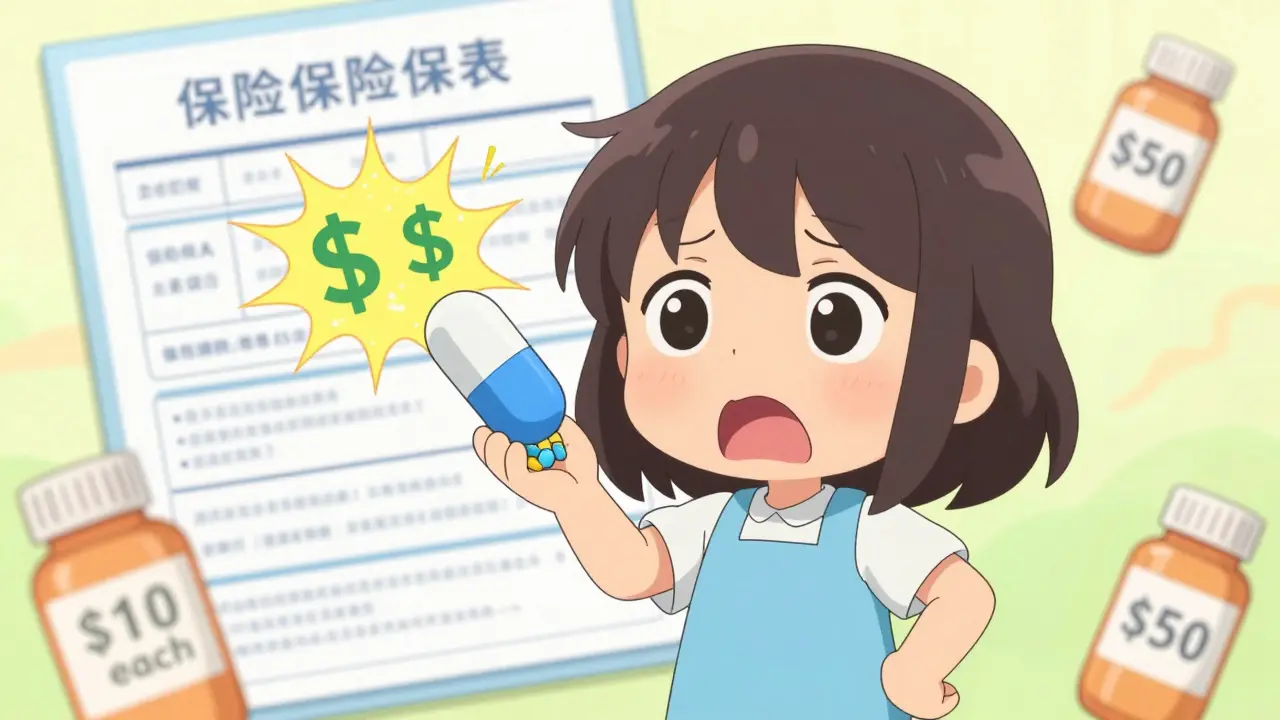
When you’re on multiple medications for high blood pressure, diabetes, or cholesterol, you might notice something odd: your insurance covers two separate pills for $10 each, but the single pill with the same ingredients costs $50. That’s not a mistake. It’s how insurance formularies work - and it can cost you hundreds a year if you don’t understand the difference between generic combination drugs and individual generics.
What Exactly Is a Generic Combination Drug?
A generic combination drug is a single pill that contains two or more active ingredients, all of which are generic versions of brand-name components. For example, instead of taking a generic lisinopril and a generic hydrochlorothiazide separately, you might take a single pill called lisinopril/hydrochlorothiazide. These combinations are common for conditions like hypertension, diabetes, and heart failure because they simplify dosing and improve adherence. The FDA says these combo pills are just as safe and effective as their brand-name versions. But here’s the catch: just because the ingredients are generic doesn’t mean the combination pill is treated the same way by your insurance.How Insurance Tiers Decide What You Pay
Most U.S. insurance plans - including Medicare Part D and private plans - use a tier system to control costs. Here’s how it usually breaks down:- Tier 1: Preferred generics - often $0 to $5 copay
- Tier 2: Non-preferred generics or preferred brands - $10 to $20
- Tier 3: Non-preferred brands - $30 to $50
- Tier 4: Specialty drugs - $100+
Why the Same Ingredients Can Cost So Much More
Let’s say you need two generics: metformin and sitagliptin. Each costs $10 per month as a separate pill. But the combo pill, Janumet XR (generic version), costs $45. That’s not because the ingredients are more expensive - it’s because the combo drug is treated like a single product with its own pricing structure. Insurers sometimes prefer you to take two pills because it gives them more control over costs. If the combo pill isn’t on their preferred list, they’ll make you pay more - or even deny coverage - unless your doctor files a prior authorization request. A 2022 analysis of Medicare Part D plans found that 84% of prescription products covered only generics. But among those, only 62% of combination products were placed in the lowest tier. That means nearly 4 in 10 combo pills are treated like expensive brand-name drugs - even though they’re generic.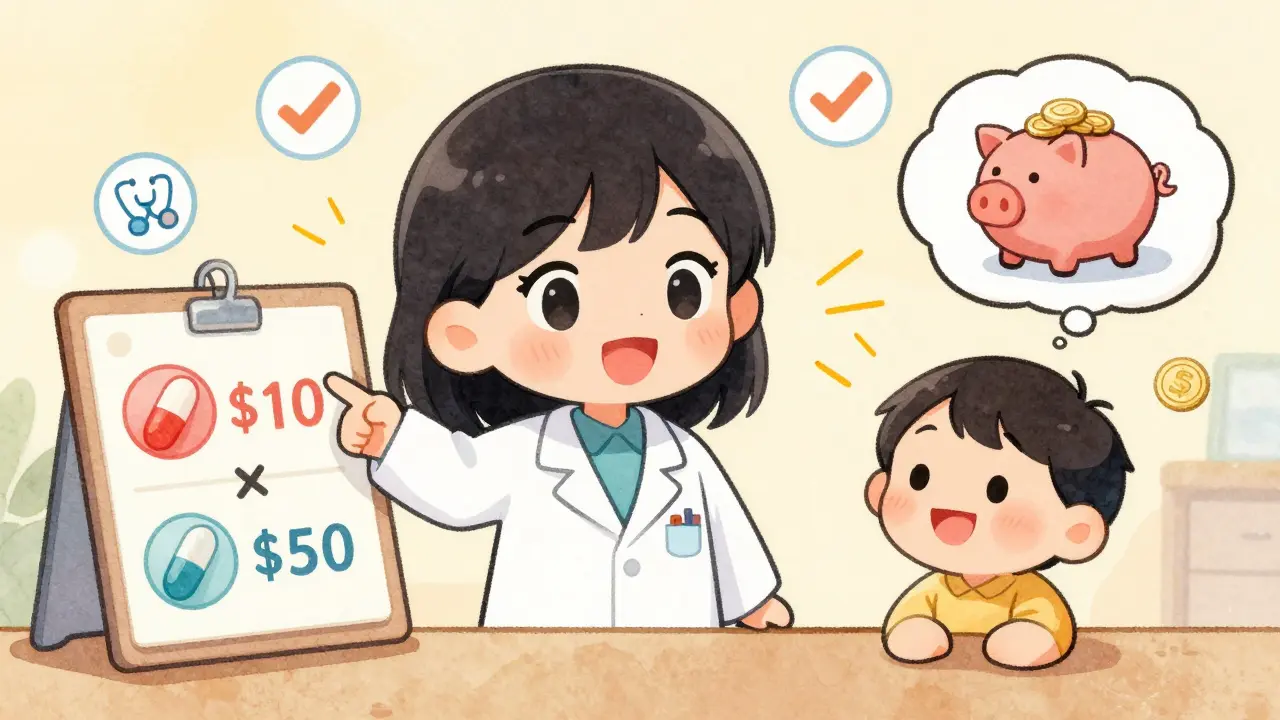
Real Patient Stories: The Mistake
On Reddit, a user named PharmaPatient87 shared how they saved $380 a month by switching from a combo pill to two separate generics. Their plan covered each individual generic for $10, but the combo version cost $50. So instead of one pill, they took two - and paid $20 instead of $50. Their doctor had to write two prescriptions, but the savings were worth it. Another user, SeniorHealth45, had the opposite experience. Their blood pressure combo went generic and dropped from $45 to $7 a month. Why the difference? Because their plan had put the combo on Tier 1 - recognizing it as a cost-saving option. This isn’t random. It depends entirely on your plan’s formulary. And most plans don’t make this easy to find.Why Formularies Are So Confusing
Only 42% of Medicare Part D plans offer clear, easy-to-read formularies online. The rest bury the info in PDFs, use confusing codes, or require you to log in and search by drug name. Even then, you might not see the difference between a combo and individual generics. The average Medicare beneficiary needs help understanding their coverage - 68% say they’ve had to call customer service or ask a family member to figure it out. That’s not just inconvenient. It’s dangerous. People skip doses or stop taking meds because they can’t afford them.What You Can Do: 3 Practical Steps
- Check your plan’s formulary - Use the Medicare Plan Finder or your insurer’s website. Search for each drug individually AND the combo version. Compare copays side by side.
- Ask your pharmacist - Pharmacists see this daily. They can tell you if taking two pills saves money. Many will even print out a cost comparison for you.
- Request a coverage determination - If your combo drug is denied or priced high, your doctor can submit a formal request. Medicare requires a decision within 72 hours (or 24 for urgent cases). You might get approval if you show the combo is medically necessary or cheaper than the alternatives.
The Bigger Picture: Why This Matters
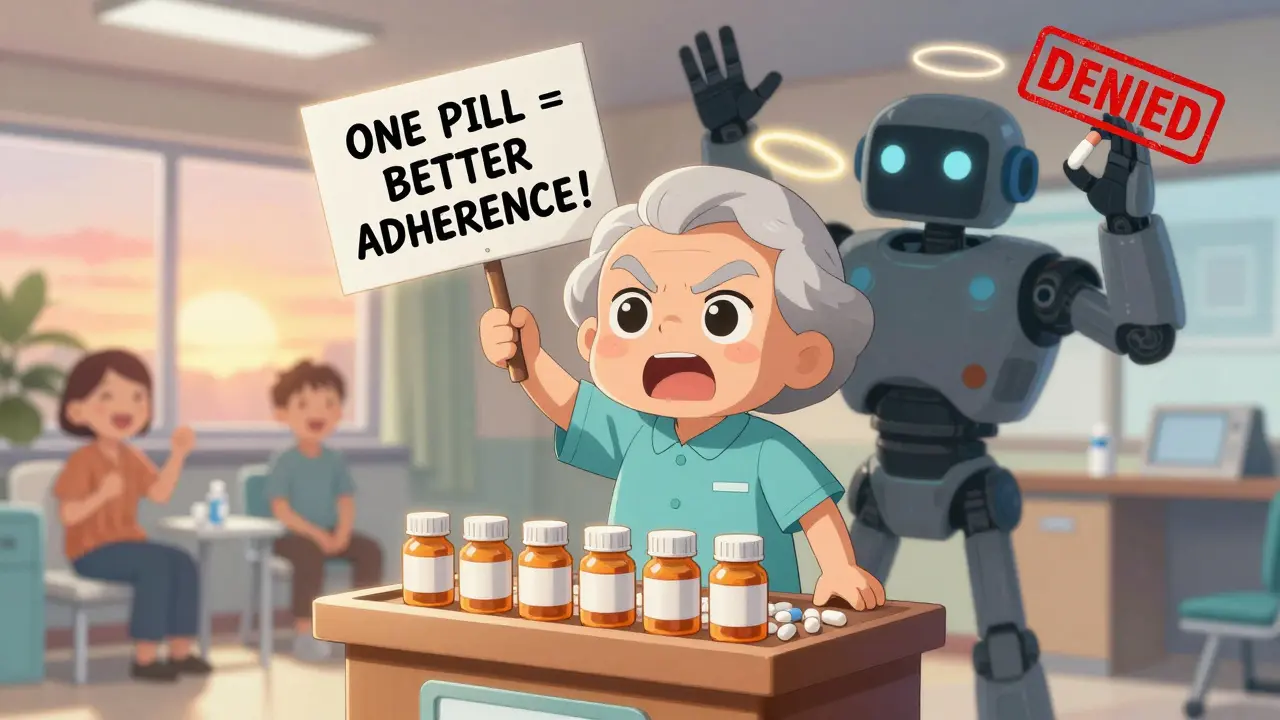
Combination drugs aren’t just about convenience. Studies show patients are 20-30% more likely to stick to their regimen when they take one pill instead of two. That means fewer hospital visits, better blood pressure control, lower risk of stroke or heart attack. But if insurance makes the combo pill unaffordable, patients end up skipping doses - or taking two pills and forgetting one. That defeats the whole purpose. The Inflation Reduction Act, which took effect in 2024, capped out-of-pocket drug costs at $2,000 a year for Medicare Part D. That helps - but only if you’re paying that much. If you’re on a combo drug that costs $50 a month, you’re still paying $600 a year for something that could cost $20.What’s Changing in 2025 and Beyond
The FDA’s Generic Drug User Fee Amendments (GDUFA) III, running through 2027, is speeding up approval of generic combination drugs. More combos will hit the market - and more will be priced competitively. Pharmacy benefit managers (PBMs) like CVS Caremark and OptumRx - who control 80% of the market - are starting to adjust. Some now incentivize combo drugs if they reduce overall costs. But change is slow. Until insurers are required to cover combo drugs at the same tier as their individual components, patients will keep playing a confusing, costly game.Bottom Line: Don’t Assume the Combo Is Better
Just because a drug is generic doesn’t mean your insurance treats it like one. A combination pill might be cheaper - or it might cost three times as much as two separate pills. The only way to know is to check. Talk to your pharmacist. Compare prices. Ask your doctor if splitting the prescription is safe. And don’t be afraid to appeal if your plan won’t cover the most affordable option. You’re not just saving money - you’re protecting your health.Are generic combination drugs as effective as brand-name combos?
Yes. The FDA requires generic combination drugs to be bioequivalent to their brand-name counterparts - meaning they work the same way in your body, with the same dosage, strength, and safety profile. The only difference is the price. Most patients see no change in effectiveness when switching from brand to generic combo.
Why does my insurance cover two separate generics but not the combo pill?
Insurers often prefer separate generics because they’re cheaper to purchase and easier to manage in their formulary. The combo pill may be priced higher by the manufacturer, even if it’s generic. Some plans also use step therapy rules - requiring you to try the individual drugs first before approving the combo.
Can I ask my doctor to prescribe two generics instead of the combo?
Yes - and many patients do this to save money. As long as the individual drugs are safe to take together (which they usually are), your doctor can write two separate prescriptions. Always check with your pharmacist first to ensure there are no interactions or dosing issues.
What if my combo drug is the only generic option available?
If the combo is the only generic version available - and the brand-name version is too expensive - your plan should cover it. If they don’t, file a coverage determination. You can also ask your doctor to document medical necessity, especially if you’ve had trouble taking multiple pills or managing side effects.
Do copay assistance programs work with generic combo drugs?
Usually not - because most manufacturer assistance programs are designed for brand-name drugs. Since generic combos are already low-cost, manufacturers rarely offer copay cards. But if you’re paying high out-of-pocket costs, ask your pharmacist about patient assistance programs through nonprofit organizations or state programs.
15 Comments
Vicky Zhang
Oh my gosh I just found out my blood pressure combo costs $50 a month but the two pills separately are $10 each? I’ve been paying that for a year and never realized. I feel so dumb. I just trusted the pharmacy and my doctor. I switched today and saved $380 a year. Thank you for posting this. I’m telling everyone I know.
Susie Deer
Insurance is rigged. America is the only country that lets corporations charge you more for doing the right thing. Take two pills. End of story.
Andrew Freeman
wait so you mean the combo isnt even cheaper? i thought generic meant cheap. so why does the combo cost more? this makes no sense. my grandma took 7 pills a day and she was fine. why cant i just take 2? i dont care if its a combo. i just want to pay less
says haze
The structural inequity embedded in pharmaceutical formularies reveals a deeper epistemological crisis in American healthcare commodification. The conflation of cost-efficiency with therapeutic efficacy is a neoliberal fallacy. Generic combination drugs are not merely pharmacological artifacts-they are sociopolitical signifiers of institutional neglect. The fact that insurers incentivize fragmentation of regimens over adherence demonstrates a systemic prioritization of profit over patient autonomy. This is not a pricing anomaly. It is a calculated mechanism of control.
Alvin Bregman
my uncle in texas used to take two pills and he lived to 92. i think its fine to take two. the pharmacy said its the same stuff so why not. i dont trust these big companies anyway. just ask your doc and dont overthink it
Sarah -Jane Vincent
THIS IS WHY THEY WANT YOU TO TAKE MULTIPLE PILLS. THEY’RE MAKING YOU DEPENDENT ON THE SYSTEM. THE COMBO IS CHEAPER IF YOU KNOW HOW TO GAME IT. THEY PUT IT IN TIER 4 SO YOU’LL CALL THEM AND THEY’LL MAKE YOU DO A PRIOR AUTH. THEN THEY’LL DENY IT AND YOU’LL GET FRUSTRATED AND STOP TAKING IT. THAT’S HOW THEY CONTROL YOU. I SAW THIS ON A DOCUMENTARY. THEY’RE LYING TO YOU.
Henry Sy
bro i was on lisinopril/hctz combo for 3 years and paid $48 a month. switched to two generics for $8 total. my insurance called me a fraud. i told them to go f themselves. now i take my pills like a boss. no more fancy pills. just two little white ones. life is better. also my blood pressure dropped. coincidence? i think not.
shiv singh
in my country we dont have this problem. medicine is cheap. doctors dont care about money. here in america you are treated like a dollar sign. this is why i hate this system. you think you are free but you are just a slave to insurance. i feel sorry for you. take two pills. its not hard. you are not too lazy for that.
TooAfraid ToSay
why is everyone acting like this is new? this has been happening since 2010. the only reason you didn’t know is because you never looked. the system is designed to confuse you. you think you’re getting help but you’re just being played. wake up. this isn’t about medicine. it’s about power.
Robert Way
i just found out my combo is $50 but two pills are $20. i think i misspelled something. i thought i was getting a deal. i feel so bad. i need to talk to my pharmacist tomorrow. i hope they dont think im dumb
Sarah Triphahn
People who take two pills instead of one are just lazy. They don’t care about adherence. They want the cheapest option, not the best option. This isn’t about money-it’s about discipline. One pill means you’re more likely to take it correctly. Two pills? You’ll forget one. That’s why combo drugs exist. Stop being cheap and start being responsible.
Allison Deming
It is imperative to recognize that the disparity in formulary tiering reflects not merely economic policy, but a profound failure in patient-centered care. The assumption that cost minimization equates to health optimization is dangerously reductive. A patient’s ability to adhere to a regimen is intrinsically linked to cognitive load, physical dexterity, and psychological burden. To penalize patients for preferring simplicity is not fiscal responsibility-it is moral negligence.
Dylan Livingston
Oh sweetie, you think this is bad? Wait till you find out your insulin is $1000 a month and they say ‘just eat less sugar’. I cried in the pharmacy last week. You’re saving $380? That’s a coffee a week. I’m saving $1200 and still getting judged for using a coupon. This system doesn’t care if you live or die. It just wants your data.
Anna Hunger
Thank you for sharing this critical information with clarity and precision. It is essential that patients are empowered with accurate, accessible knowledge regarding their medication options. The distinction between individual generics and combination formulations must be clearly communicated by healthcare providers, pharmacists, and insurers alike. Adherence is not a matter of convenience-it is a matter of clinical outcomes. This post is a valuable public service.
Jason Yan
you know what’s wild? this isn’t even the weirdest thing. i had a friend whose combo drug was cheaper than the individual pills because the insurer had a weird deal with the manufacturer. it’s like a lottery. sometimes the combo wins. sometimes it loses. the only way to win is to check every single time your prescription renews. i keep a spreadsheet. it’s weird but it saved me $600 last year. just don’t assume anything. ask. check. repeat.