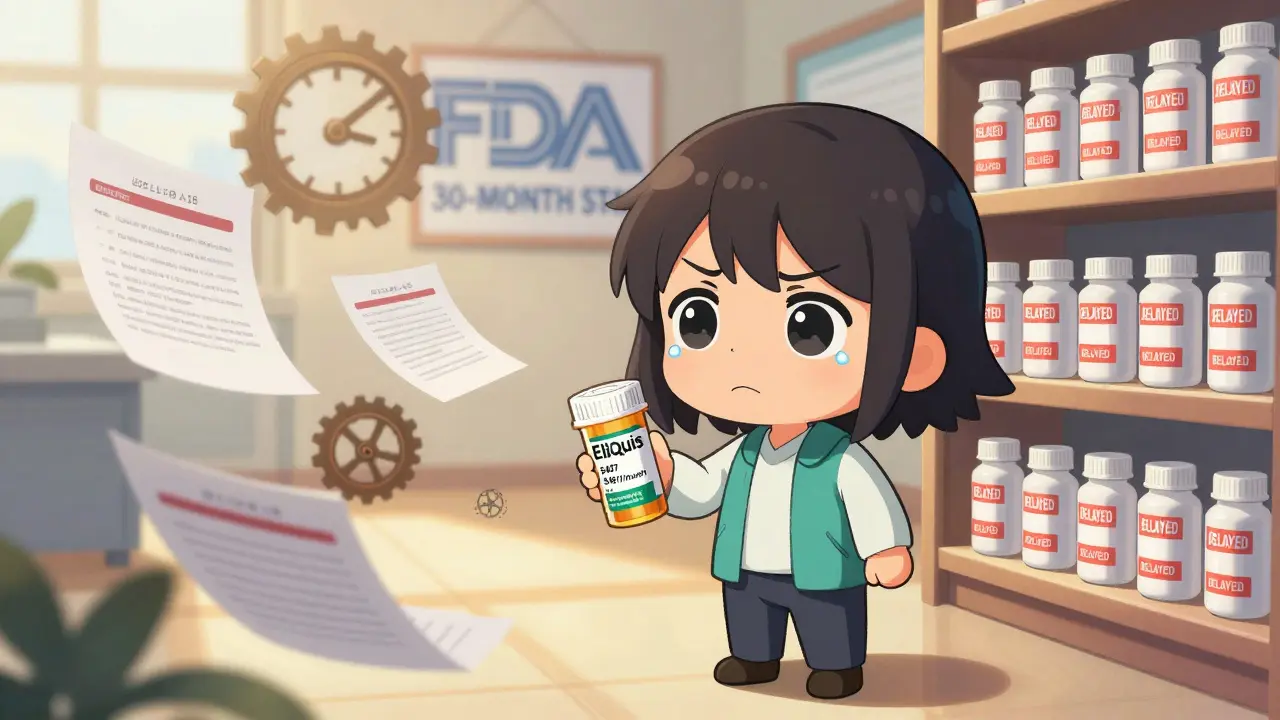
By 2025, hundreds of generic drugs had been approved by the FDA - but still couldn’t be bought. Patients were stuck paying hundreds of dollars a month for brand-name pills while the generic version sat on a shelf, legally cleared but blocked by lawsuits. This isn’t a glitch. It’s the system working exactly as designed - by the brand-name drug companies.
Why Approved Doesn’t Mean Available
The FDA approved 63 first generics in 2025. That sounds like progress. But here’s the catch: the average time between FDA approval and actual market launch jumped to 3.2 years. That’s more than three full years of patients paying full price while generics wait. Why? Because approval isn’t the finish line - it’s just the starting gun for a legal marathon.When a generic company files an Abbreviated New Drug Application (ANDA), they’re required to certify whether they believe the brand’s patents are invalid or won’t be infringed. This is called a Paragraph IV certification. And when they do it? The brand-name company automatically gets a 30-month stay. That’s not a suggestion. It’s a legal pause button. Even if the patent is weak, even if it’s clearly an attempt to extend monopoly time, the clock stops. The generic can’t launch until either the court rules, the patent expires, or 30 months pass. In practice? Most cases drag on for years.
The Patent Thicket Strategy
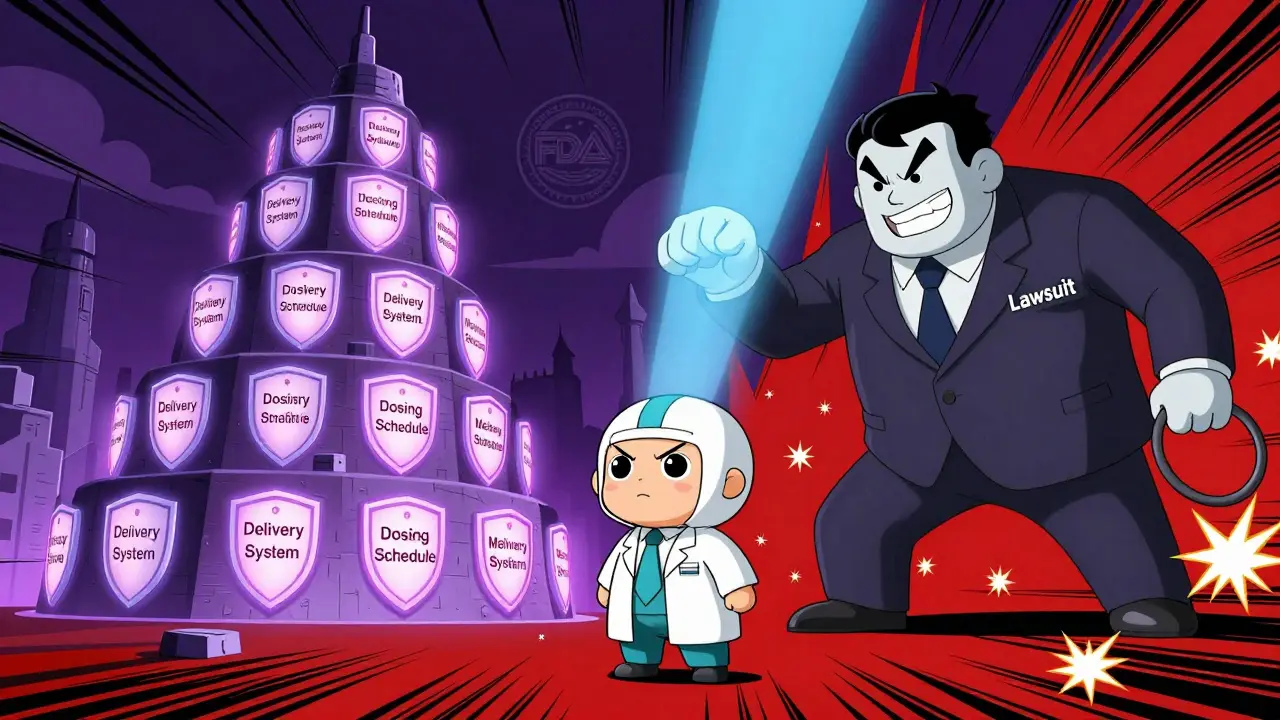
It’s not one patent anymore. It’s dozens.In 2020, the average New Drug Application (NDA) listed 12.3 patents. By 2025, that number had jumped to 14.7. Some drugs now have over 20. These aren’t all about protecting core inventions. Many are secondary - delivery systems, dosing schedules, metabolites - things that don’t change how the drug works, but create legal hurdles.
Take Humira. The original patent expired in 2016. But AbbVie filed over 240 follow-up patents. Each one triggered a new 30-month stay. The result? No biosimilar could enter the U.S. market until late 2023 - nearly seven years after the core patent expired. That’s not innovation. That’s legal lock-in.
According to Drug Patent Watch, 68% of all generic applications in 2024 included Paragraph IV certifications. That means two out of every three generics were challenging patents. And nearly all of them got delayed.
Who’s Getting Hurt?
It’s not just patients. It’s pharmacies, hospitals, and small generic manufacturers.A September 2025 survey by the Association for Accessible Medicines found that 82% of pharmacists fielded questions from patients asking why a drug was approved but not available. The top three? Eliquis, Trulicity, and Steglatro. All had generic versions approved - but none were on shelves. Patients were paying $487 a month for the brand. The generic? Projected at $85.
Hospitals are feeling it too. The American Society of Health-System Pharmacists reported that 78% of pharmacy directors named patent delays as a major contributor to drug shortages - especially for cancer drugs. One oncology injectable, approved in early 2024, still wasn’t available in late 2025. Why? Two new patents filed by the brand company, each restarting the 30-month clock.
And it’s hitting small companies hardest. RBC Capital Markets found that 63% of delayed generics came from manufacturers with annual revenue under $500 million. They can’t afford $12.7 million in legal fees per case. Big players like Teva and Sandoz? They’ve got teams of lawyers. Smaller ones? They fold.
Supply Chain Problems? Yes - But Not the Main Issue
You hear about API shortages. About factories in India or China. About injectables being hard to make. And yes, those matter. A 2025 PMC study found that 37% of delayed generics cited supply chain issues. But here’s the key: patent litigation was the primary cause in 72% of all delays.For complex generics - like inhalers, injectables, or topical gels - the numbers are even starker. 89% of delayed complex generics were held up by patents. Only 63% of simple oral pills faced the same. Why? Because complex drugs are harder to copy. That means brand companies have more leverage to sue. And they do.
How the U.S. Compares to the Rest of the World
Europe doesn’t have this problem.In the EU, the average time between generic approval and market launch is 1.7 years. In the U.S.? 3.2 years. Why? Because Europe doesn’t have a 30-month stay. There’s no automatic legal pause. If a patent is challenged, courts move faster. And patent listings are more tightly controlled.
The U.S. system was built on the Hatch-Waxman Act - a deal meant to balance innovation and access. But over time, it’s been twisted. Brand companies now use it as a shield. The FDA can’t touch it. The agency reviews safety and manufacturing - but has no power over patent disputes. As Dr. Patrizia Cavazzoni, head of the FDA’s drug center, admitted in 2025: "Patent litigation remains outside our regulatory authority."

The Real Cost - And Who Pays
The financial toll is staggering.The top 10 drugs losing exclusivity in 2025 had combined annual sales of $78.3 billion. Without generics, Medicare Part D spent $3.2 billion more than it should have. That’s taxpayer money. That’s out-of-pocket costs for seniors. That’s premiums going up for everyone.
Patients aren’t just paying more. They’re skipping doses. Patients For Affordable Drugs Now documented 412 cases between 2023 and 2025 where people went without their medication because the generic wasn’t available. One woman with diabetes skipped her insulin doses for six months because she couldn’t afford the brand. She ended up in the ER. The cost? $18,000. The generic? $85 a month.
What’s Being Done - And Why It’s Not Enough
There are efforts. But they’re slow.The FDA launched an AI-assisted review system in Q2 2025. It cut review times by 22% - for applications without patent disputes. For the 68% that are litigated? Zero impact.
The FTC filed seven enforcement actions against brand companies for "patent thicketing" between 2024 and 2025. One case, against Jazz Pharmaceuticals over Xyrem, ended with a settlement forcing earlier generic entry. That’s progress. But it’s one case. There are hundreds more.
The CREATES Act, meant to force brand companies to provide samples for testing, stalled in Congress. The FDA’s new draft guidance on accelerated approval might help some drugs - but not those caught in patent litigation.
Generic manufacturers are trying to adapt. They’re now starting patent research 48 to 60 months before expiration. They’re diversifying their API suppliers - from 1.8 on average in 2022 to 3.4 in 2025. But none of this changes the legal wall.
The Future? Unclear
The system is broken. And it’s getting worse.Dr. Aaron Kesselheim from Harvard said it best: "The current patent thicketing strategies have extended monopolies beyond the intended 20-year term by an average of 3.7 years per drug." That’s not innovation. That’s exploitation.
There’s a growing push to limit how many patents can be listed per drug. A McKinsey survey found 67% of industry stakeholders support it. But PhRMA, the drug industry lobby, is fighting back. They say it would "undermine innovation." But innovation doesn’t need 20 patents on a pill that’s been around for 15 years.
For now, patients wait. Pharmacists explain. Hospitals scramble. And the brand companies? They keep collecting billions.
Why does the FDA approve generics but not let them sell?
The FDA approves generics based on safety and effectiveness, but it has no authority over patent disputes. When a generic company challenges a patent with a Paragraph IV certification, the brand company can sue, triggering a 30-month legal stay. During that time, the FDA can’t grant final approval - even if the generic is approved. The system is designed to let courts decide patent validity, not the FDA.
What is a Paragraph IV certification?
A Paragraph IV certification is a legal statement made by a generic drug manufacturer when filing an ANDA. It says they believe one or more of the brand’s patents are invalid or won’t be infringed. This triggers a 30-month stay if the brand sues. It’s the main tool generics use to break monopolies - but also the main reason they get delayed.
Why are oncology drugs delayed the longest?
Oncology drugs often have complex formulations - like injectables - that are harder to copy. Brand companies pile on more patents to protect them. On average, it takes 4.1 years between FDA approval and market launch for cancer generics, compared to 2.3 years for CNS drugs. Many of these drugs also have high profit margins, so brand companies fight harder to keep exclusivity.
Can the FDA shorten these delays?
No, not directly. The FDA can speed up reviews of manufacturing and safety data - and it has, cutting review times by 22% for non-litigated cases. But it can’t touch patent litigation. That’s handled by federal courts. The agency has asked Congress to reform the system, but so far, no major changes have passed.
Are biosimilars facing the same delays?
Yes - even worse. Biosimilars face an even more complex patent landscape. For Humira, over 240 patents were used to delay entry. The average number of patents challenged per biosimilar application rose from 5.2 in 2020 to 9.7 in 2025. While more biosimilars are being approved, patent litigation still blocks most from reaching the market for years.
What’s the difference between authorized and generic generics?
An authorized generic is made by the brand company itself and sold under a generic label - often to maintain market control. In 2020, 28% of branded drugs delayed their own authorized generics. By 2025, that dropped to 12%. Most brand companies now rely on patent litigation instead. So the main barrier today isn’t the brand launching its own generic - it’s suing anyone else who tries.
How much does patent litigation cost generic companies?
The average cost per case rose to $12.7 million in 2025, up from $9.3 million in 2023. That’s not just legal fees - it’s expert witnesses, patent analysts, court filings, and appeals. Many small companies can’t afford it. That’s why the market is dominated by just a few large players.
12 Comments
Denise Jordan
I mean, I get it. Big pharma’s just playing the game. But why are we surprised? This isn’t a bug - it’s the whole damn feature. Patients pay $500 a month so some lawyer can sit in a conference room and argue over whether a pill’s coating is patentable. I’m not mad. I’m just… tired.
Gene Forte
We talk about innovation like it’s sacred, but what’s really sacred is access. If a drug saves lives, why should its availability hinge on a legal chess match? We’ve turned medicine into a monopoly game, and the players aren’t patients - they’re shareholders. Maybe it’s time we stop pretending this system is about health, and start admitting it’s about profit.
Chris Bird
This is why Africa can't get meds. You guys spend billions on lawsuits while people here die because they can't afford $10 pills. You patent a sugar pill and call it innovation. The whole system is rigged.
Tom Bolt
Let me get this straight: The FDA approves a generic, but then the brand company files 20 patents on the color of the pill, the shape of the tablet, and the font on the label - and suddenly, the generic can’t be sold? This isn’t capitalism. This is a hostage situation with a pharmacy counter.
Shourya Tanay
The structural inefficiency here is staggering. The ANDA process was designed to create a bifurcated pathway - regulatory approval vs. IP adjudication - but the asymmetry in resources has created a de facto barrier to entry. Small firms lack the capital to sustain protracted litigation cycles, resulting in market consolidation and reduced competition. The economic externality is not just fiscal - it’s existential for patient access.
Kenneth Zieden-Weber
So let me get this straight - you’re telling me that a company can file a patent on ‘a pill that dissolves in 3.2 seconds instead of 3.1’ and then use that to block generics for three years? And we call this innovation? Bro. If I tried that with my toaster, I’d be in jail. But for Big Pharma? It’s just Tuesday.
David L. Thomas
It’s wild how the system was meant to balance access and innovation, but now it’s just a delay tactic. I’ve seen this with my dad’s diabetes meds - approved in 2023, still not on shelves in 2025. The FDA did their job. The courts? They’re just sitting there sipping coffee.
Bridgette Pulliam
I don’t know how we let this become normal. We have a healthcare system that can approve a drug in 12 weeks but takes 38 months to let it be sold. That’s not regulation. That’s a performance art piece on the cost of greed. And the worst part? No one’s even embarrassed.
Mike Winter
I wonder if the founders of Hatch-Waxman ever imagined this. They wanted to get generics out fast. Now it’s a legal minefield. Maybe we need a new framework - one where patent challenges are fast-tracked, like arbitration. Not courtrooms. Not 30-month stays. Just… fairness.
Randall Walker
I mean... the system is broken. But honestly? I’m not surprised. We let them patent air if it makes money. I read about a guy who got sued for using a blue pill instead of a green one. And now? He’s bankrupt. And we wonder why people skip doses. It’s not ignorance. It’s survival.
Miranda Varn-Harper
It’s quite evident that the current framework is not merely inefficient - it is fundamentally misaligned with public health imperatives. The monetization of patent litigation as a strategic barrier to market entry constitutes a systemic failure of regulatory governance. One must question whether the legal architecture was ever intended to serve the public interest - or merely to preserve private capital.
Alexander Erb
I’ve been watching this for years. The real tragedy? It’s not the lawsuits. It’s the silence. Everyone knows what’s happening. Pharmacists. Doctors. Nurses. Patients. And yet… nothing changes. We just keep paying. And paying. And paying. 😔💊 I just hope someone wakes up before another grandma skips her meds.