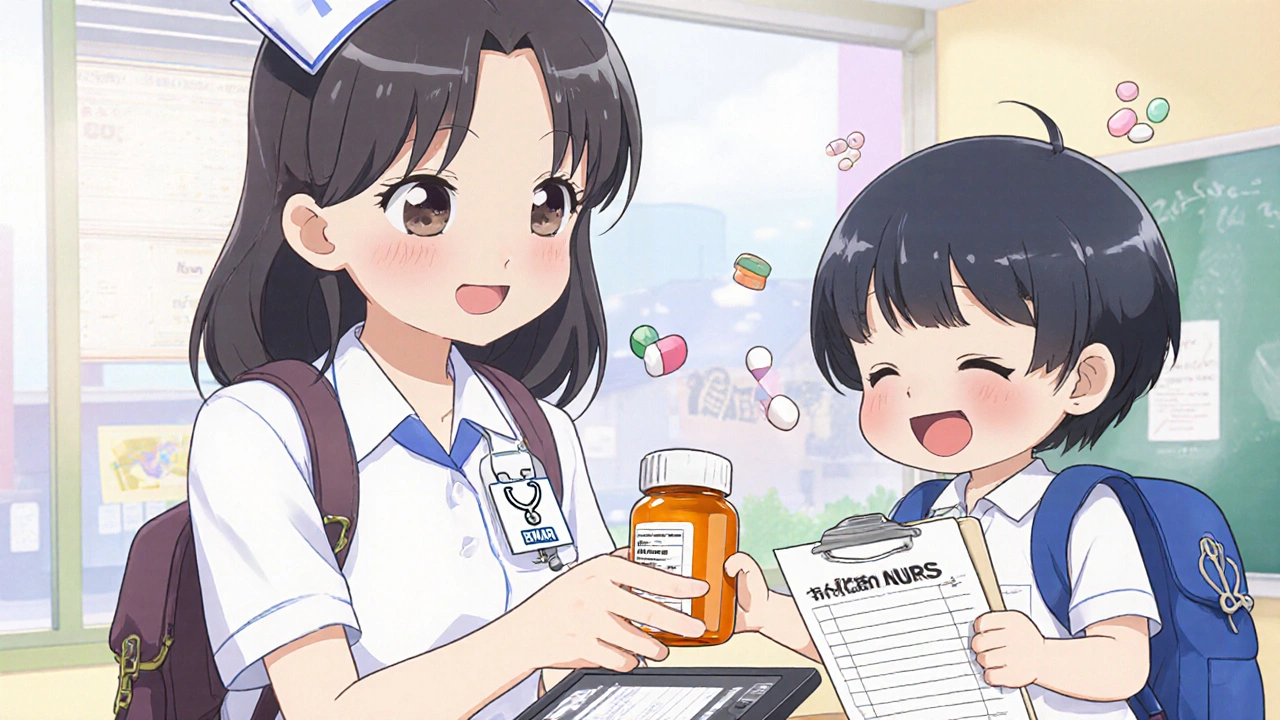
Every morning, thousands of children swallow pills, use inhalers, or get injections before lunch. For many, it’s just part of the day-like brushing teeth or eating lunch. But behind that simple act is a complex system designed to keep them safe. If your child needs medication during school hours, you’re not just handing over a bottle. You’re entering a partnership with the school, the nurse, and your child’s doctor. Get it right, and your child stays healthy. Get it wrong, and the risks are real.
Why School Medication Rules Exist
It’s not about control. It’s about safety. About 40 to 50% of school-aged children take prescription or over-the-counter meds daily-things like asthma inhalers, ADHD pills, insulin, or epinephrine auto-injectors. Without clear rules, mistakes happen. A child gets the wrong dose. The wrong medicine is given. A pill meant for afternoon is given at lunch. These aren’t hypotheticals. Research shows that following strict guidelines cuts medication errors in schools by up to 75%.
The foundation of every safe system is the 5 Rights: right student, right medication, right dose, right route, right time. Schools don’t make these up. They’re based on decades of medical safety standards, updated by the American Academy of Pediatrics in 2024 and adopted by school nurses nationwide.
What Parents Must Do Before the First Day
You can’t just send a pill in a Ziploc bag. Every school requires formal paperwork. This isn’t bureaucracy-it’s legal protection for everyone involved.
- Get a signed Physician/Parent Authorization Form from your child’s doctor. It must include: your child’s full name, medication name, exact dosage (e.g., “5 mg twice daily”), route (oral, inhaler, injection), timing (e.g., “before lunch”), duration (how long it’s needed), side effects to watch for, and any special instructions like “take with food.”
- The doctor’s license number must be on the form. In New York and several other states, this is mandatory. No license number? No medication given.
- Sign the parent consent section. Your signature means you understand the risks and approve the school administering the medicine.
- Submit the form by June 1 if possible. Schools like New York City Public Schools recommend this to avoid gaps in care over summer break.
Don’t assume your child’s doctor will send it. Most won’t. You have to pick it up, fill it out, and bring it in. One missed signature can delay treatment for weeks.
How to Deliver Medication to School
Never let your child carry their own medicine unless the school has approved it. Even then, there are rules.
- All medication must be in the original, unopened, labeled container from the pharmacy. No transfer to pill organizers, small bottles, or snack bags. The label must show your child’s name, the medication name, dosage, and expiration date.
- Deliver it yourself. No sending it with your child, even if they’re 12. Schools require a parent or guardian to hand it directly to the school nurse or designated staff. Bring it during drop-off or a scheduled visit. Allow at least 15 minutes for paperwork and verification.
- Check expiration dates. Expired meds won’t be accepted. If your child’s prescription runs out, bring a new one before the old one expires.
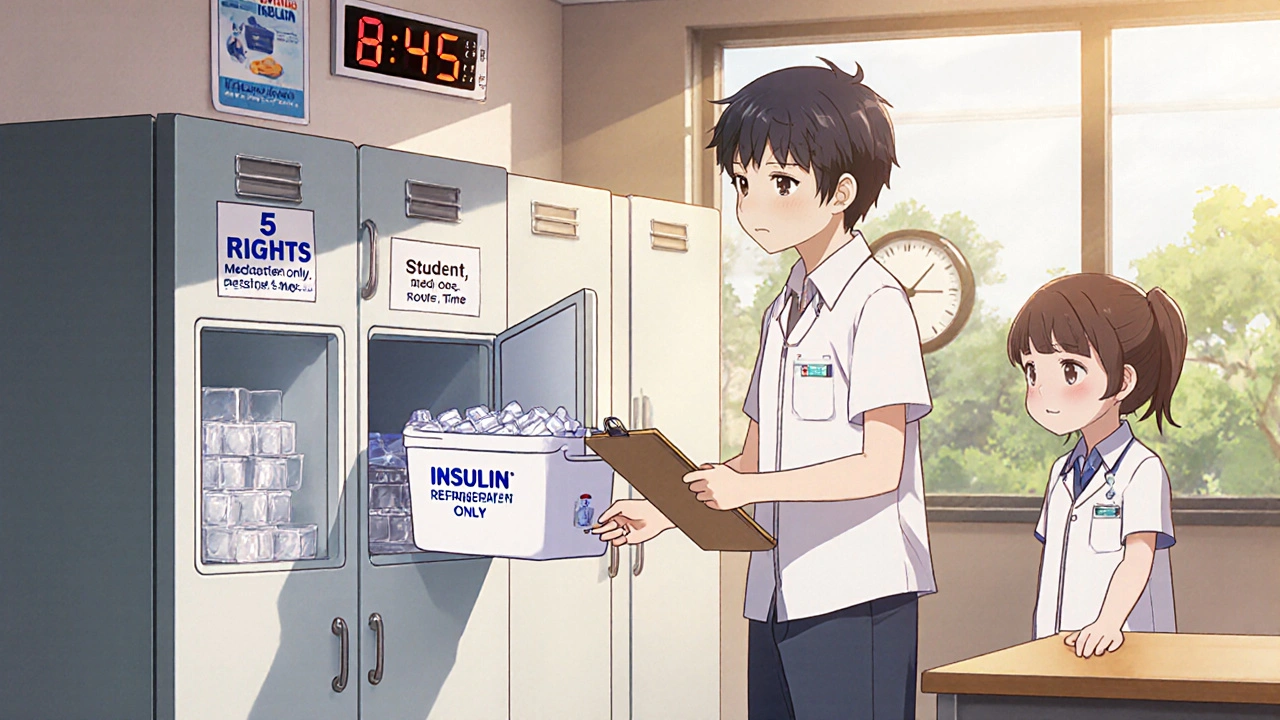
- Refrigerated meds (like insulin or some biologics) must be in a sealed, labeled cooler with ice packs. Schools keep these in locked, dedicated fridges-never next to lunch food. Temperature must stay between 2°C and 8°C (36°F-46°F).
What Happens During the School Day
Once the meds are in, the school nurse or trained staff follow strict procedures.
- Medications are stored in locked cabinets, often with electronic tracking. Most public schools now use electronic medication administration records (eMARs), which cut documentation errors by 57%.
- Staff check the 5 Rights every single time. They verify the student’s ID, match the bottle label to the form, count the dose, and record it digitally or on paper.
- Dosing times are flexible within a 30-minute window. If the order says “10 a.m.,” it can be given between 9:30 a.m. and 10:30 a.m.-unless the doctor says “exactly at 10 a.m.”
- For students with asthma or severe allergies, schools often keep emergency inhalers or epinephrine on hand. But they can only use them if the proper form is signed by both doctor and parent.
Some schools allow older students to self-administer-like teens with asthma using inhalers. But this isn’t automatic. In New York, you need a separate “Self-Medication Release Form” signed by both doctor and parent. In California, the student must demonstrate competency under nurse supervision first.
What to Do When Things Go Wrong
Even with perfect systems, things can slip. Your child might refuse to take their medicine. They might feel sick after taking it. Or you might change the dose at home.
- If your child refuses: The school will contact you immediately. Don’t be surprised. This is standard. They can’t force it.
- If your child has a reaction: Call the school right away. Then call your doctor. Report it to the nurse in writing. Failure to report side effects contributes to 18% of medication errors.
- If you change the medication, dose, or timing at home: Notify the school the same day. Don’t wait. Update the authorization form within 48 hours. Schools rely on what’s on paper. If your home schedule changes but the school doesn’t know, your child could get the wrong dose.
End-of-Year Cleanup
When the school year ends, your job isn’t done.
- Retrieve all unused medication by the last day of school. Frederick County Schools and New York State require parents to pick up meds by August 31. After that, they’re discarded.
- Don’t leave meds behind “just in case.” Schools can’t store them over summer. No exceptions.
- Bring the new prescription for next year before school starts. Don’t wait until September.
This isn’t just about rules. It’s about trust. You’re trusting the school to care for your child. The school is trusting you to give them accurate, complete information. And your child is trusting both of you to get it right.
What’s Changing in 2025
Things are evolving. More kids need mental health meds-ADHD, anxiety, depression. That’s up 23% since 2020. Schools are adapting.
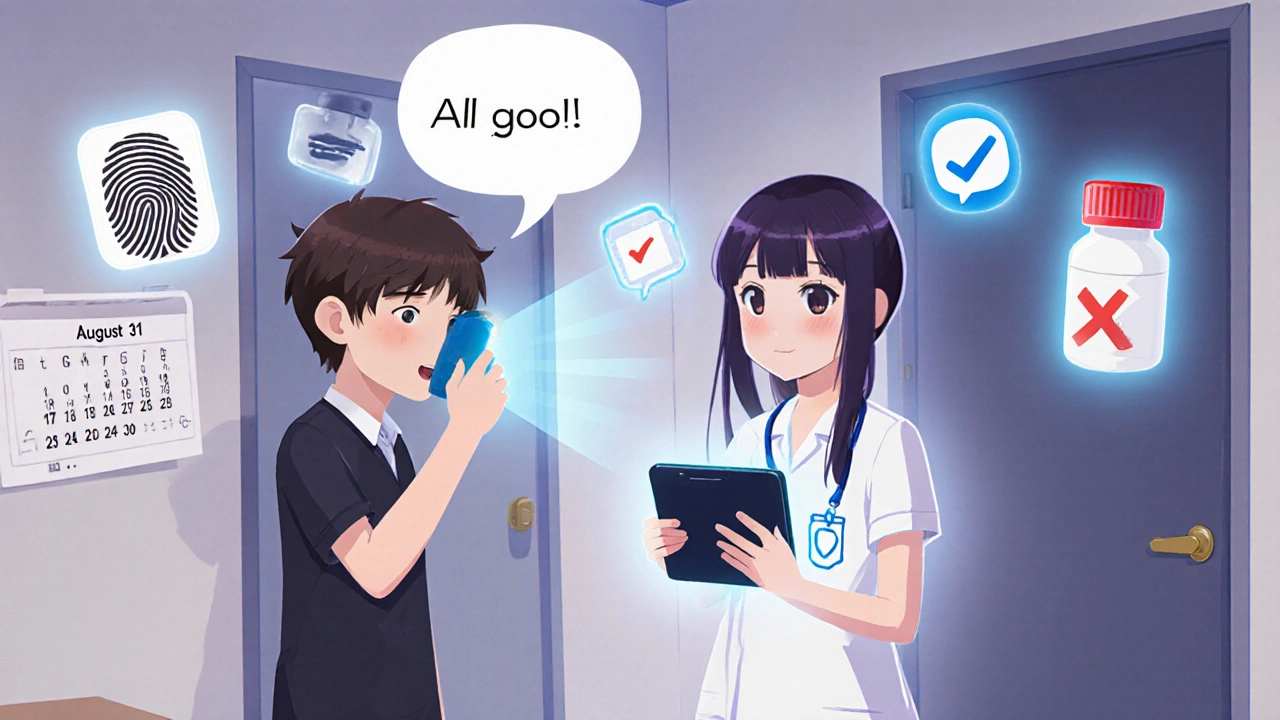
- Some districts are testing apps that send parents a text when their child takes their medicine. Early results show a 27% drop in parent questions.
- By 2026, many states plan to standardize digital forms so you don’t have to fill out different paperwork for every school district.
- By 2028, some schools may use biometric checks-like fingerprint scans-to make sure the right student gets the right medicine.
But the core hasn’t changed. It’s still about clear communication, accurate paperwork, and shared responsibility.
Common Mistakes Parents Make
- Thinking the pharmacy label is enough. It’s not. Schools need the signed form.
- Waiting until the first day of school to bring meds. Delays happen. Plan ahead.
- Not updating the school when the dose changes. Even a small change matters.
- Letting the child carry meds without approval. Even if they’re responsible, it’s against policy.
- Forgetting to pick up meds at the end of the year. They get thrown out. You’ll pay again next fall.
These aren’t minor oversights. They’re the top reasons medication errors happen.
When to Ask for Help
If you’re confused about the forms, call the school nurse. They’ve done this hundreds of times. If your child’s doctor won’t fill out the form, ask for a different provider. Some pediatricians have templates ready. If your school says “we don’t do that,” ask to speak to the district’s school health coordinator. Every district has one.
Your child’s health doesn’t stop when the school bell rings. But with the right steps, you can make sure it’s protected-every single day.
Can my child carry their own medication to school?
Only if the school has approved it with a signed Self-Medication Release Form from both the doctor and parent. Even then, the student must demonstrate they can use it correctly under nurse supervision. Most schools don’t allow it for younger kids, and never for injectables or controlled substances without strict oversight.
What if my child’s medication expires during the school year?
Replace it immediately. Schools cannot give expired medication. Bring the new, properly labeled prescription to the school nurse as soon as you get it. Don’t wait. If your child runs out, they won’t get their dose until the new one is verified and signed off.
Do I need a new form every year?
Yes. Almost all states require annual renewal of medication authorization forms. Even if the medication and dosage haven’t changed, the form must be signed again by both the doctor and parent. Some schools start accepting forms in June for the next school year to avoid delays.
Can the school refuse to give my child their medication?
Yes-if the paperwork is incomplete, the medication is unlabeled, expired, or not delivered by a parent, or if the school lacks trained staff to administer it. Schools are legally protected from liability only when following state and federal guidelines. If your child’s meds are denied, ask for the specific reason and what’s needed to fix it.
What happens if my child has a reaction at school?
The school nurse will follow their emergency protocol, which includes contacting you immediately. They’ll also document the reaction and notify your child’s doctor. You must then update the medication form to include the side effect. Failure to report can lead to future dosing errors. Keep a written record of the incident and any follow-up care.
Are schools required to give over-the-counter meds like ibuprofen?
No. Most schools only give OTC meds if they’re prescribed by a doctor for a specific medical condition. Even then, you need a signed authorization form. Giving a child ibuprofen for a headache without a doctor’s note is against policy in nearly every district. Always check your school’s specific OTC policy.
14 Comments
Asha Jijen
Why so much paperwork? In India we just give the medicine to the teacher and they make sure the kid takes it
reshmi mahi
USA be like: 12 forms, 3 signatures, a cooler with ice packs just to give a kid an Advil 😂
Frances Melendez
You people are ridiculous. This isn't a military operation. Your child is not a chemical weapon. Just trust the school. You're raising paranoid little zombies with all this control freak nonsense.
My kid has asthma and we never filled out a single form. The nurse knew what to do. She's trained. She cares. You don't need a 17-page legal document to keep your kid alive.
Stop treating schools like they're in the business of liability insurance. They're in the business of helping children. You're the ones making it harder.
And don't get me started on the refrigerated insulin cooler. You think the nurse has time to play lab technician? She's managing 300 kids with allergies, diabetes, seizures, and anxiety. You're not special.
Stop turning parenting into a compliance checklist. Your kid doesn't need a legal contract to survive a school day.
Also - why are you even on Reddit if you're this obsessed with bureaucracy? Go file your forms with the county clerk. We're all tired of your performative anxiety.
laura lauraa
Let me just say - as a former school nurse who worked in three districts - this post is not just accurate… it’s UNDERSTATED.
Every. Single. Day. I had parents show up with a Ziploc bag containing three unlabeled pills they got from their cousin’s cousin who “has the same condition.”
I had one mother insist her 10-year-old could “self-administer” Adderall because he “was mature for his age.” He was 10. He was trying to trade it for Pokémon cards.
I had a father bring in expired epinephrine because “it’s still kinda good.” I had to call 911 on him for endangerment.
The 5 Rights exist because children die when they don’t follow them. Not “might die.” Not “could die.” They DO.
And yes - I cried after my third child died from a misadministered insulin dose because the parent forgot to update the form.
So no. I don’t care if it’s “too much paperwork.” Do the paperwork. Or don’t be surprised when your child doesn’t come home.
And yes - I know you think I’m dramatic. But I’ve seen the coroner’s reports. I’ve held the hands of parents who lost their child because they thought “it’s probably fine.”
Do the right thing. Not because it’s policy. Because it’s your child.
marie HUREL
I appreciate how detailed this is. My daughter has epilepsy and we’ve been through this process three times now - different schools, different districts. The one thing that never changes? The nurse always remembers her name. Even when the system is broken, they still show up.
It’s exhausting, yes. But it’s worth it when she takes her meds without crying and goes back to recess like nothing happened.
And honestly? The forms are annoying - but I’d rather fill out 50 pages than have someone guess what her seizure meds are.
Thanks for laying it out so clearly. I’ll share this with my PTA.
Gayle Jenkins
THIS. THIS. THIS.
My son has severe food allergies and we’ve had to fight for his epinephrine to be allowed on campus. One school said “we don’t have a nurse trained for that.” I showed up with a certified EMT who trained their staff for free.
It’s not about control. It’s about competence. And if your school doesn’t have a plan - push. Push harder. Your child’s life is not negotiable.
Also - if your kid’s med expires, don’t wait. Go to the pharmacy at 7 a.m. and hand-deliver it. I did. The nurse hugged me.
You’re not being paranoid. You’re being a parent. And that’s everything.
Elizabeth Choi
Interesting how this post assumes all parents are capable of navigating this system. What about single parents working two jobs? Or undocumented families who fear paperwork? Or families without a pediatrician who accepts insurance?
This isn’t a safety guide. It’s a privilege checklist.
The real problem isn’t parents being lazy. It’s that schools are underfunded, understaffed, and overburdened - and they’re making families carry the weight of systemic failure.
Instead of telling parents to do more, why not fund more nurses? Why not create a national digital form? Why not train teachers to handle basic meds?
Stop blaming the people who are already drowning.
Shubham Semwal
USA = Overregulation Central. In India, the school ayah gives the medicine and everyone’s fine. No forms. No coolers. No drama. Just care.
Why do you need 10 signatures to give a child a pill? You’re not launching a rocket.
Also - why is everyone so scared of kids taking medicine? It’s not heroin. It’s Adderall and inhalers. Chill.
Gaurav Sharma
This is why America is collapsing. A child needs an asthma inhaler - and you need a notary, a license number, a cooler, and a digital signature?
Meanwhile, in my village, the teacher just gives the pill after lunch. No paperwork. No drama. No lawyers.
You’ve turned parenting into a compliance nightmare. And you wonder why kids are anxious?
Jonah Thunderbolt
OMG. I JUST REALIZED. The 5 Rights? That’s literally the same framework used in hospital pharmacy safety protocols. So… we’re treating schools like intensive care units now? 😭
And the eMARs?! I didn’t know schools had electronic medical records. Is there a HIPAA-compliant app for this??
Also - I just submitted my kid’s insulin form. I cried. Not because it was hard - because I realized I’ve been doing this for 5 years and no one ever thanked me.
Thank you for writing this. I’m printing it. Framing it. And hanging it next to my child’s first tooth.
Also - I used 3 emojis in this comment. I’m sorry. I can’t help it. I’m emotionally invested. 🤍🩺👨⚕️
Kaleigh Scroger
Let me tell you about the time I had to drive 45 minutes to the school at 7 a.m. because my son’s ADHD med expired and the pharmacy didn’t have it in stock until noon. The nurse was waiting. She had printed out the form, checked the expiration date, verified the prescription number, and even had a backup dose ready in case I was late.
She didn’t say thank you. She didn’t need to. She does this every day for 200 kids.
And yet - I still get emails from parents asking why the school won’t just let their kid carry their inhaler. Because you don’t know what happens when a 12-year-old loses it in the hallway. Or trades it for candy. Or takes it before gym class because they think it’ll make them run faster.
This isn’t about control. It’s about consequences.
And if you think this is too much - imagine being the nurse who has to explain to a parent why their child didn’t survive because the pill they brought in had no label.
Do the paperwork. It’s not a burden. It’s a lifeline.
Jebari Lewis
As a father of a child with type 1 diabetes, I want to say thank you. Not just for the guide, but for acknowledging that this isn't about rules - it's about trust.
I used to think the school was being difficult. Then I saw the logbook. Every dose. Every time. Signed. Verified. Logged. Even on field trips.
I didn't realize how much care went into this until I saw the nurse stay after hours to train a new aide because my son had a new insulin pump.
It's not bureaucracy. It's love in a clipboard.
And yes - I filled out the forms. Twice. Because I didn't want to risk a typo.
I also made a typo in this comment. Sorry. I'm typing with one hand while holding my daughter's glucose monitor.
Thank you for doing this work.
Rebecca Price
Let’s pause for a moment to honor the school nurses.
They’re not just giving pills. They’re managing anxiety attacks, diabetic lows, allergic reactions, seizures, and behavioral crises - all while being the only adult in the building who knows your child’s medical history.
They don’t get raises. They don’t get headlines. They don’t get thank-you notes.
But they show up. Every. Single. Day.
So yes - fill out the forms. Bring the meds in person. Don’t let your child carry them.
Because behind every regulation is a nurse who’s spent 14 hours in a school with no lunch break, trying to keep your child alive.
Be the parent who makes their job easier.
Not harder.
Frances Melendez
And yet… my daughter’s school just told us they’re no longer giving any meds unless we hire a private nurse to sit in the office with her. Because they’re ‘short-staffed.’
So now I’m paying $80/hour for a nurse to come in for 3 hours a day just so my kid can take her ADHD pill.
Thanks, America.