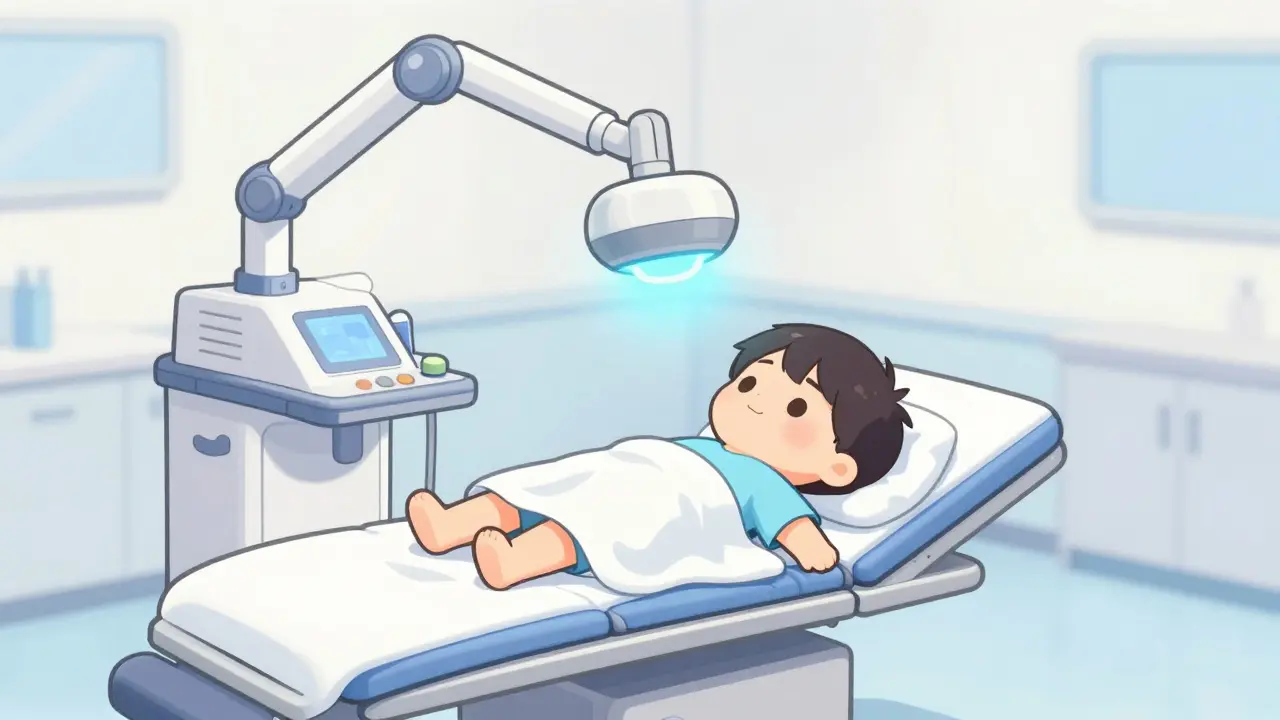
You might have just received a referral for a bone density test, or maybe you're staring at a medical report filled with numbers like "T-score" and "Z-score" and wondering what they actually mean for your health. Bone loss often happens quietly-you don't feel your bones getting thinner until a sudden break occurs. This is why DEXA scan is a specialized medical imaging test that measures bone mineral density (BMD) to diagnose osteoporosis and predict the risk of future fractures. Also known as Dual-energy X-ray Absorptiometry, it is the global gold standard for screening because it's fast, painless, and incredibly accurate.
The Basics: How a DEXA Scan Actually Works
If you've never had one, you can expect a very relaxed experience. You lie flat on a padded table while a scanner arm moves slowly over your body. Unlike a traditional X-ray that uses one beam, this technology uses two different energy levels. One beam is absorbed by soft tissue (like fat and muscle), and the other is absorbed by the bone. By subtracting the soft tissue measurement, the machine gets a crystal-clear picture of your bone mass.
Most clinics focus on the lumbar spine and the hip because these are the most common sites for osteoporotic fractures. In some cases, your doctor might suggest a forearm scan if you've had surgery on your legs or hips. A typical session takes about 10 minutes, and the radiation dose is tiny-comparable to less than two days of the natural background radiation you get just by living on Earth.
Decoding Your Results: T-Scores and Z-Scores
The report you get back isn't just a raw number; it's a comparison. To make sense of your bone health, doctors use two primary metrics: the T-score and the Z-score.
T-score is the most critical number for diagnosis. It compares your bone density to that of a healthy 30-year-old adult of the same sex. Think of it as comparing your current bone strength to "peak bone mass."
Z-score is slightly different. It compares your density to people of your own age, sex, and ethnicity. This is more useful for figuring out if something other than aging-like a vitamin deficiency or a hormonal imbalance-is causing bone loss.
| T-Score Value | Classification | What it Means |
|---|---|---|
| -1.0 or higher | Normal | Your bones are within the healthy range. |
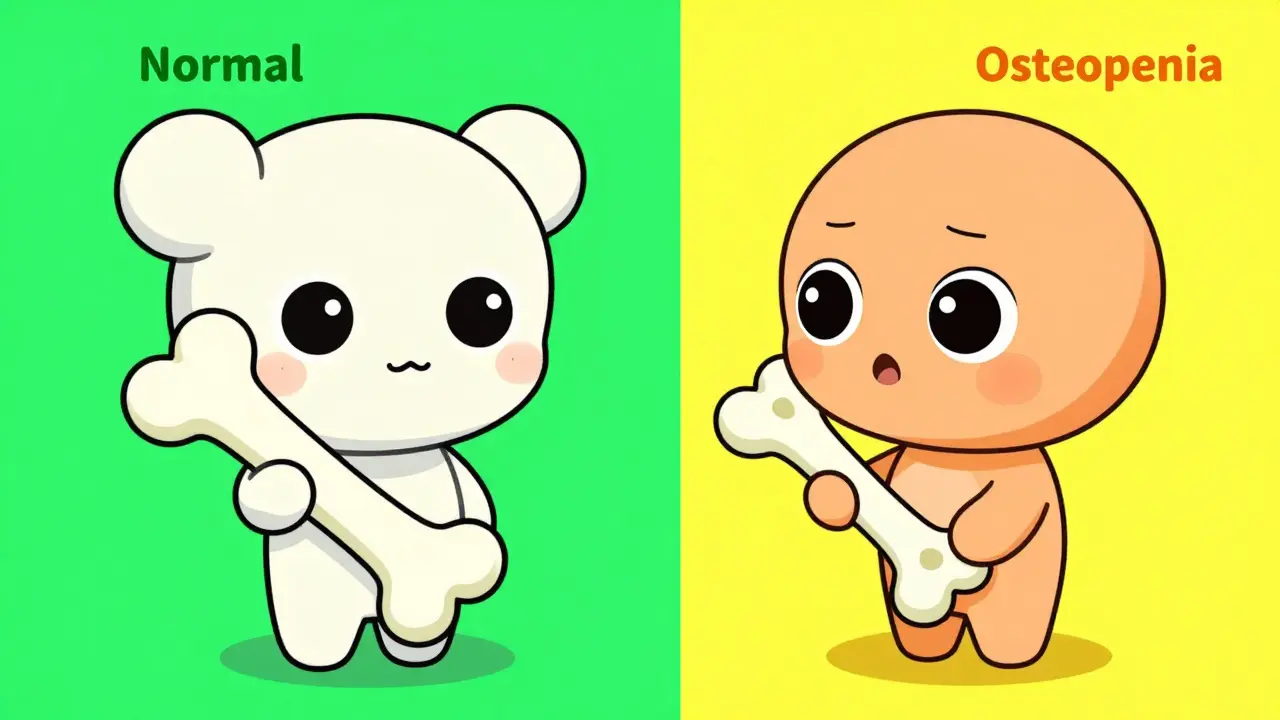
| Between -1.0 and -2.5 | Osteopenia | Bone density is lower than normal; you're at higher risk for osteoporosis. |
| -2.5 or lower | Osteoporosis | Bone density is significantly low, and fracture risk is high. |
Beyond the Numbers: Assessing Your Real Fracture Risk
Here is a crucial point: a T-score doesn't tell the whole story. Someone could have a T-score of -2.6 (diagnostically osteoporosis) but a lower actual risk of breaking a bone than someone with a -2.1 score who has a history of falls or takes certain medications. Bone density is only one piece of the puzzle.
To get a complete picture, doctors often use FRAX is a clinical tool developed by the World Health Organization that combines BMD with other risk factors to calculate the 10-year probability of a major fracture.
FRAX looks at things like your smoking history, alcohol intake, family history of hip fractures, and whether you use corticosteroids (like prednisone). When doctors combine your DEXA results with a FRAX assessment, the predictive accuracy for fractures improves by about 15% to 22% compared to using the scan alone.
Comparing DEXA to Other Bone Tests
You might hear about other tests, such as Quantitative Computed Tomography (QCT) or ultrasound scans. While they have their place, they aren't usually the first choice. QCT provides a 3D image and can distinguish between the outer shell (cortical bone) and the inner spongy part (trabecular bone), but it comes with a much higher radiation dose-sometimes 100 times higher than a DEXA scan.
Quantitative ultrasonography (QUS) is often used in pharmacies or health fairs because it doesn't use radiation at all. However, it's generally used as a "screening" tool to see if you *need* a DEXA scan, rather than as a diagnostic tool, because it lacks the precision required to track treatment progress over time.

Common Hurdles and Accuracy Issues
No test is perfect. There are a few scenarios where a DEXA scan might give a misleading result. For example, if you have severe arthritis in your spine, the extra calcium deposits from bone spurs can actually make your bone density look *higher* than it actually is, potentially masking osteoporosis.
Similarly, if you've had a spinal fusion surgery or have severe aortic calcifications, the machine might misread the density. In these cases, your doctor might rely more on your hip scans or suggest a different imaging approach. This is why it's vital to have a certified technologist-someone with a CBDT certification-handle the positioning, as a slight tilt in the hip can change the reading.
What to Do After Your Results Come In
Finding out you have osteopenia or osteoporosis can be scary, but it's actually a win because it allows you to take action before a break happens. Depending on your score and FRAX risk, your plan might involve:
- Lifestyle Adjustments: Increasing weight-bearing exercises (like walking or light weights) to stimulate bone growth.
- Nutritional Support: Optimizing Calcium and Vitamin D intake, as these are the building blocks of bone.
- Medication: In cases of osteoporosis, medications like bisphosphonates may be prescribed to slow bone loss or build new density.
- Fall Prevention: Removing trip hazards at home and improving balance to prevent the fall that leads to the fracture.
How often do I need a DEXA scan?
It depends on your risk level. For people with normal bone density, a scan every few years may be enough. However, if you are taking medication for osteoporosis or have a diagnosis of osteopenia, your doctor may want a scan every 1 to 2 years to monitor how your bones are responding to treatment.
Does the radiation from a DEXA scan cause cancer?
The radiation dose is extremely low. A typical scan delivers between 0.001 and 0.03 mSv. For perspective, you receive more radiation from a few hours of flying in a commercial airplane or from the natural environment over a couple of days than you do from a single DEXA scan.
Can I have a DEXA scan if I have a metal implant?
Yes, but you must tell the technologist. Metal implants (like a hip replacement or spinal hardware) are very dense and will show up as bright spots. The technologist will usually exclude the area with the implant from the calculation to ensure your T-score isn't artificially inflated.
What is the difference between osteopenia and osteoporosis?
Osteopenia is like a "warning light." It means your bone density is lower than average, but not yet low enough to be called osteoporosis. Osteoporosis is the clinical diagnosis where bone density has dropped to a point where the structural integrity of the bone is compromised, significantly increasing the risk of a fracture from a minor fall.
Is a DEXA scan covered by insurance?
Most commercial insurers and Medicare cover DEXA scans for high-risk groups. Medicare typically covers screening biennially for women 65 and older and men 70 and older. They may also cover it for younger adults who have specific risk factors, such as long-term steroid use or a family history of fractures.
15 Comments
Betty Kawira
Had my first one last year and it's honestly a breeze. Just a heads up for anyone nervous about the 'lying flat' part-if you have a bad back, just tell the tech right away so they can put a small cushion under you. It makes a huge difference for those 10 minutes!
Kali Murray
thanks for the info 🌸 super helpful ✨
Dale Kensok
The reductive nature of these summaries always fails to account for the stochastic variability in bone remodeling cycles. We are essentially talking about a snapshot of a dynamic biological system, yet the T-score is treated as an immutable ontological truth. It's a classic example of quantification bias where the metric is mistaken for the phenomenon itself. The systemic reliance on FRAX, while statistically significant in a cohort, is practically negligible when applied to an idiosyncratic phenotype with atypical cortical porosity. One must wonder if the medical industrial complex prefers the comfort of a standardized coefficient over the nuance of actual pathophysiology. It's essentially a heuristic masquerading as a precise diagnostic tool, lacking the granular resolution to be truly transformative. Truly a pedestrian analysis of a complex endocrine-skeletal interplay.
Trish Perry
It's wild how we only care about our bones once they start failing. We spend our whole lives ignoring the scaffolding that literally holds us up until a number on a page tells us we're fragile. It makes you think about the invisibility of health and how we only define it by the absence of a diagnosis.
lalit adesara
Western medicine is just a business. In India we have ancient wisdom for strength. These scans are just tools to sell you chemicals. Wake up.
Sharon Mathew
Wait, so you're telling me we just trust a machine to tell us if our bones are 'good' or 'bad' based on some random 30-year-old? That is absolutely absurd! Why are we using this outdated standard when everyone's body is different? It's a total joke!
Stephen Johnson
I think there's some value in that comparison, even if it's not perfect. It gives us a baseline to start a conversation with our doctors. The real goal isn't the number, but the steps we take afterward to stay active and mindful of our bodies.
Nigel Gosling
Absolutely typical that we are told to just 'walk more' and 'take vitamins' as if the systemic failure of the healthcare system can be solved by a brisk stroll in the park. The sheer arrogance of suggesting that a few light weights can reverse decades of biological decay is practically comedic. It's a moral failing to present these 'lifestyle adjustments' as a panacea for a clinical condition. We're basically being told to decorate a sinking ship with some calcium supplements. Pure farce!
Abhishek Charan
Actually, the radiation is so low it is basically nothing!!! 😱 Why is everyone so scared of a tiny bit of x-ray? It is literally safer than a flight to New York!!!! ✈️
Ryan Wilson
The whole 'preventing falls' bit is a total circus. They want us to move our coffee tables and rug-tape our floors like we're living in a padded cell. It's a sanitized, corporate approach to aging that treats adults like toddlers who can't walk in a straight line.
Aubrey Johnson
The explanation of Z-scores is logically sound. Most people conflate the two, but the distinction is necessary for an accurate clinical assessment.
Steve Grayson
I've heard the same about the metal implants. My uncle had a hip replacement and his doctor just ignored that side of the scan to get the real number. It seems like a reliable way to handle it.
Thomas Jorquez
its good that the cost is covered by medicare for the elderly. makes it easy to get checked regularly without worryin bout the bill
Kat G
The information regarding arthritis masking bone loss is very important. It explains why some people might be surprised by a fracture despite a decent score.
Angela Cook
Only in America do we have the best technology like DEXA to keep our citizens strong and healthy! We lead the world in medical diagnostics for a reason!