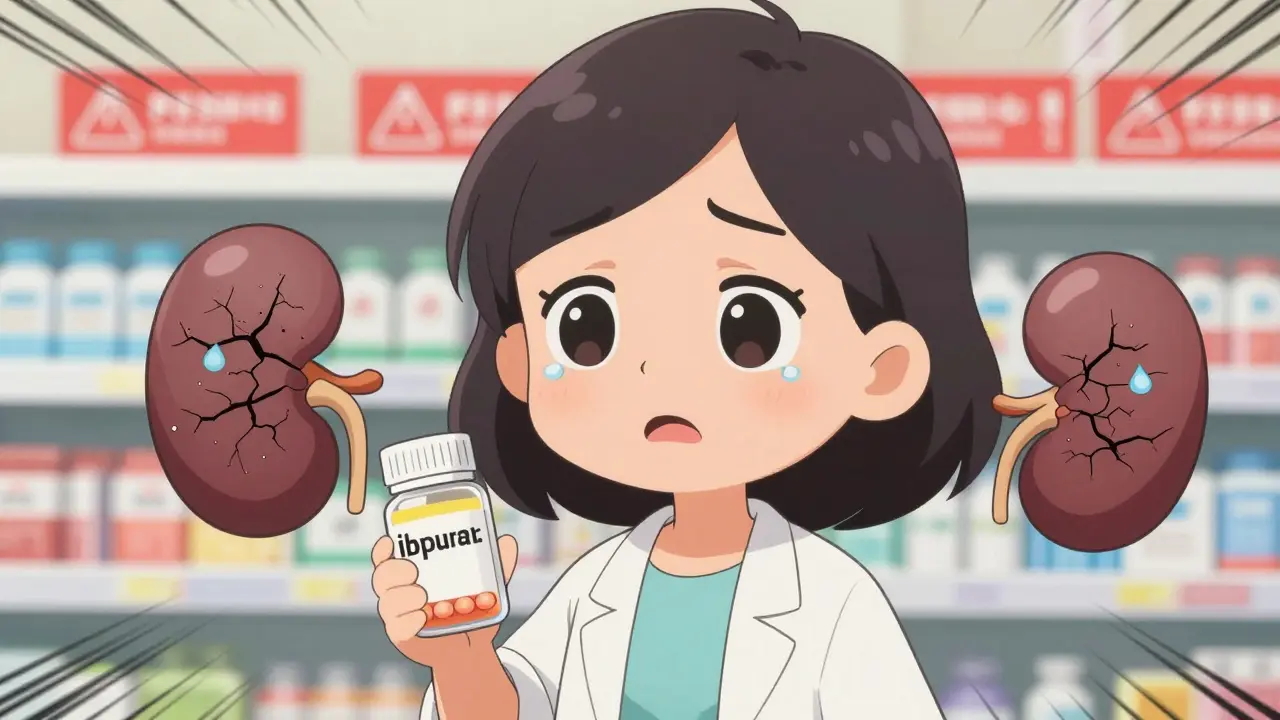
Every year, thousands of people in the U.S. quietly damage their kidneys without realizing it-not from alcohol, not from diabetes, but from something they pick up at the pharmacy: over-the-counter painkillers. NSAID kidney damage is real, silent, and preventable. If you’ve been popping ibuprofen or naproxen for back pain, migraines, or arthritis for months or years, your kidneys might be paying the price-even if you feel fine.
What Exactly Is Analgesic Nephropathy?
Analgesic nephropathy is kidney damage caused by long-term, heavy use of pain medications, especially NSAIDs like ibuprofen, naproxen, and aspirin, and sometimes acetaminophen. It’s not a sudden injury-it’s slow erosion. Your kidneys get damaged over time because these drugs reduce blood flow to them. Think of it like turning down the water pressure to your garden hose for years. Eventually, the roots wither, even if the hose still looks fine.
This condition was first noticed in the 1950s when people took combination painkillers with phenacetin-a now-banned ingredient. Today, phenacetin is gone, but the problem isn’t. The same damage happens with today’s NSAIDs when used too much, too often. The kidneys’ filtering units (nephrons) and the inner tissue (interstitium) slowly scar. This leads to chronic kidney disease, high blood pressure, and in severe cases, kidney failure.
Who’s Most at Risk?
You don’t have to be a drug abuser to get this. The typical patient is a woman over 45, often managing chronic headaches, menstrual pain, or arthritis. Studies show women make up 72% of cases. Why? Many start with one or two pills a day for period pain or tension headaches and slowly increase-sometimes to 6, 8, even 10 pills daily. That’s 2,000-3,000 mg of acetaminophen or 1,200-2,400 mg of ibuprofen a week. That’s way over safe limits.
Other high-risk groups include people with existing high blood pressure, diabetes, or early kidney disease. Even if you don’t have those, if you’ve been taking NSAIDs daily for more than three years, you’re in danger. A 2018 meta-analysis found that combination painkillers (like Excedrin, which has caffeine and acetaminophen) are nearly four times more likely to cause kidney damage than single-ingredient pills.
How Do NSAIDs Actually Hurt Your Kidneys?
NSAIDs block enzymes called COX-1 and COX-2. These enzymes help make prostaglandins-chemicals that keep blood flowing to your kidneys. When you take NSAIDs regularly, your kidneys get less blood. That’s bad enough. But over time, your kidneys also lose their ability to regulate salt and water, leading to fluid retention and high blood pressure. The reduced blood flow causes oxidative stress, which kills kidney cells. Scar tissue builds up. The papillae (tiny structures inside the kidney) start to die. This is called renal papillary necrosis.
Here’s the scary part: you won’t feel it. There’s no sharp pain. No burning. No swelling at first. The first sign is often a routine blood test showing elevated creatinine or a drop in GFR (glomerular filtration rate)-your kidney’s ability to filter waste. By the time you feel tired, swollen, or notice blood in your urine, damage may already be advanced.
How Common Is This?
Analgesic nephropathy causes about 2-3% of all chronic kidney disease cases in the U.S. That’s 15,000-20,000 new cases a year. In Australia, during the peak of phenacetin use, it accounted for 10% of end-stage kidney disease. That number has dropped since phenacetin was banned-but the problem persists because people still overuse NSAIDs.
And it’s not just older adults. A 2023 CDC report found that 41% of American adults exceed recommended NSAID doses. Among people with chronic pain, that number jumps to 67%. Many believe OTC means safe. It doesn’t. The FDA updated NSAID labels in 2020 to warn about kidney risk-but most people never read them.
What Are the Warning Signs?
Early stage: nothing. Just a slightly high creatinine on a blood test.
Mid-stage: fatigue, mild swelling in ankles, high blood pressure that’s hard to control, frequent nighttime urination.
Advanced stage: flank pain, blood in urine, passing tissue (renal papillae), nausea, confusion, shortness of breath. At this point, dialysis or transplant may be needed.
A 2022 study of 142 patients found that 68% were diagnosed only because their doctor ordered a routine blood test. Another 29% came in because they felt unusually tired or puffy. Only 3% had classic pain symptoms.
How Is It Diagnosed?
There’s no single test. Doctors look at:
- History of long-term NSAID or acetaminophen use (6+ pills daily for 3+ years)
- Low-grade protein in urine (less than 3.5 g/day)
- Bland urine sediment (no red blood cells or casts)
- Noncontrast CT scan showing calcified papillae-this is the gold standard, with 97% specificity
- Declining GFR over time
In January 2023, the FDA approved a new point-of-care urine test called NephroCheck that can detect early kidney cell damage before creatinine rises. It’s 92% sensitive and already being used in some nephrology clinics.
Can You Reverse the Damage?
Early detection is everything. If you stop the painkillers and catch it before scarring is severe, your kidneys can stabilize. A 2022 study followed 142 patients who quit NSAIDs after diagnosis. After five years, 73% had no further decline in kidney function. Their GFR stayed steady. Some even improved slightly.
But if you’ve had years of heavy use and your GFR is already below 45, recovery is unlikely. The goal then becomes slowing progression and avoiding dialysis.

What Are Safer Alternatives for Pain Relief?
You don’t have to suffer. There are better ways.
1. Topical NSAIDs
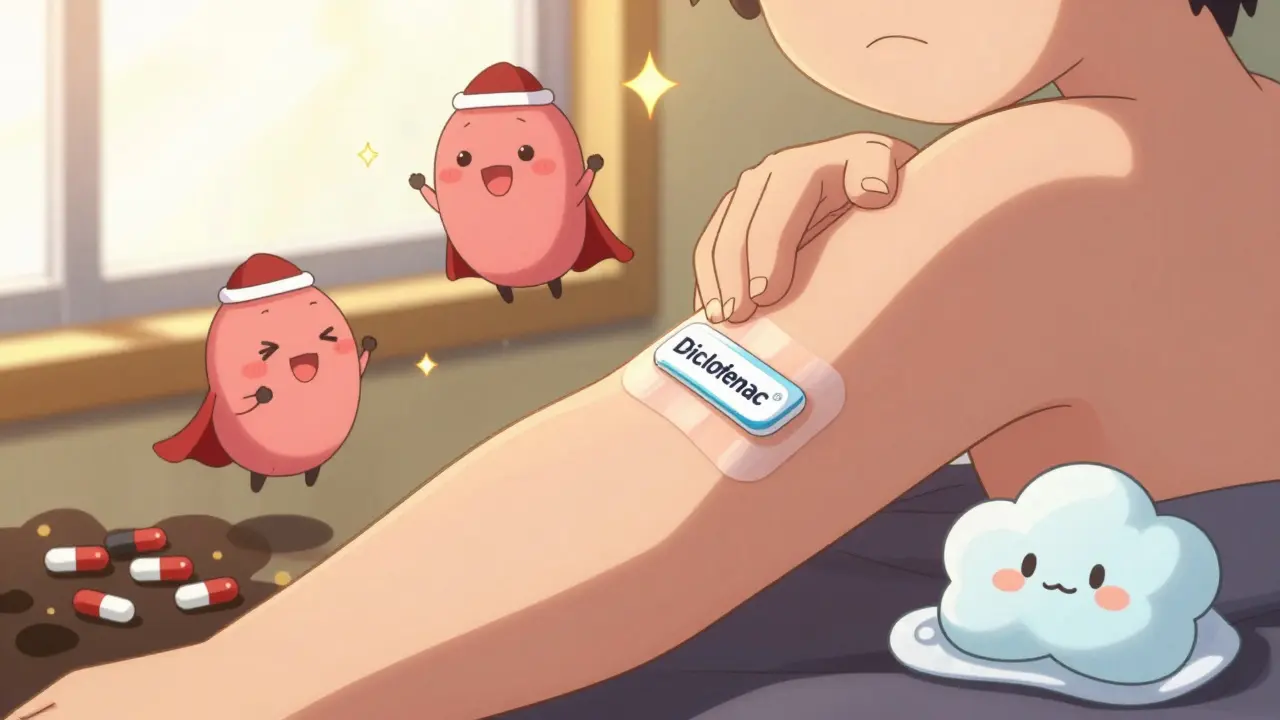
Instead of swallowing pills, use gels or patches. A 2021 study in Arthritis & Rheumatology showed that topical diclofenac gave the same pain relief as oral ibuprofen-but with 90% less drug entering your bloodstream. No kidney risk.
2. Heat Therapy
Heat wraps like ThermaCare reduce osteoarthritis pain by 40-60% without any drugs. The FDA cleared them in 2022 specifically for chronic pain. They’re safe for kidneys and can be used daily.
3. Physical Therapy and Movement
The American College of Rheumatology now recommends trying physical therapy, stretching, or low-impact exercise for 4-6 weeks before even considering NSAIDs. For many, this alone cuts pain by half.
4. Acetaminophen-But With Limits
Acetaminophen is safer for kidneys than NSAIDs-but not risk-free. A 2020 study in Kidney International Reports found that taking more than 4,000 mg daily for five years raised chronic kidney disease risk by 68%. The new FDA limit? 3,000 mg per day max. Never exceed that.
5. Non-Drug Options
- Cognitive behavioral therapy (CBT) for chronic pain
- Yoga and tai chi
- Mindfulness and breathing exercises
- Transcutaneous electrical nerve stimulation (TENS) units
What About CBD or New Drugs?
CBD products are trending, but there’s no solid evidence they’re safe for kidneys long-term. A 2022 JAMA Internal Medicine study found no kidney harm at doses under 1,500 mg/day-but the study lasted only 12 weeks. We don’t know about five years of use.
Prescription CGRP inhibitors (like Aimovig) for migraines are kidney-safe but cost $650/month. They’re not practical for most people.
Research is moving forward. AstraZeneca’s selepressin, a drug that protects kidney blood flow during NSAID use, showed promise in Phase II trials. But it’s years from market.
What Should You Do Right Now?
If you’ve been taking NSAIDs or acetaminophen daily for more than a few months:
- Stop daily use. Don’t go cold turkey if you’re on high doses-talk to your doctor.
- Switch to topical NSAIDs or heat therapy for localized pain.
- Get a blood test: check creatinine and eGFR. Do it now, not next year.
- If your eGFR is below 60, see a nephrologist.
- Never take more than 3,000 mg acetaminophen or 1,200 mg ibuprofen per day.
- Use NSAIDs no more than 3 days a week without consulting your doctor.
The National Kidney Foundation says: if you need NSAIDs for more than 10 days in a row, you need a plan. Not just a bottle.
Why This Matters More Than You Think
Analgesic nephropathy is a preventable disease. It doesn’t happen because you’re careless. It happens because we’ve been told OTC means harmless. But your kidneys don’t care if the bottle says ‘over-the-counter.’ They only care about the dose, the duration, and the frequency.
Every time you pop a pill for a headache, ask: ‘Is this necessary?’ ‘Is there another way?’ ‘Am I treating the pain-or just hiding it?’
Most people who develop this condition didn’t set out to hurt their kidneys. They just wanted to feel better. The tragedy isn’t the disease-it’s that it was avoidable.
Can I still take ibuprofen if I have high blood pressure?
No. NSAIDs like ibuprofen raise blood pressure and reduce kidney blood flow. If you have high blood pressure, even occasional use can make it harder to control. Switch to acetaminophen (under 3,000 mg/day) or non-drug options like heat therapy. Always check with your doctor before taking any painkiller if you have hypertension.
Is Tylenol (acetaminophen) safe for kidneys?
Acetaminophen is safer than NSAIDs for kidneys-but not risk-free. Taking more than 3,000 mg daily for five years increases chronic kidney disease risk by 68%. Stick to the lowest dose needed. Never exceed 3,000 mg per day. Avoid combination products like Excedrin, which contain acetaminophen plus caffeine or aspirin.
How do I know if my kidneys are already damaged?
The only way to know is through blood and urine tests. Look for elevated creatinine, low eGFR (below 60), or protein in urine. You won’t feel symptoms until damage is advanced. If you’ve taken NSAIDs daily for over a year, get tested-even if you feel fine.
Can analgesic nephropathy lead to dialysis?
Yes. If you keep using NSAIDs or acetaminophen heavily and ignore early warning signs, kidney damage can progress to end-stage renal disease. At that point, dialysis or transplant is needed. About 15,000-20,000 new cases of kidney failure each year in the U.S. are linked to long-term painkiller use.
What’s the safest long-term painkiller for kidneys?
There’s no perfect pill. The safest approach is non-drug: heat therapy, physical therapy, yoga, or CBT. If you need medication, topical NSAIDs (like diclofenac gel) are the best choice-they don’t harm kidneys. Acetaminophen under 3,000 mg/day is next safest. Avoid combination pills and daily NSAID use.
How often should I get my kidneys checked if I take painkillers?
If you take NSAIDs or acetaminophen more than twice a week for over a month, get a blood test (creatinine and eGFR) every 6 months. If you have high blood pressure, diabetes, or existing kidney disease, get tested every 3 months. Don’t wait for symptoms.
10 Comments
Kuldipsinh Rathod
I never realized how many of us are silently killing our kidneys with daily ibuprofen. My mom took 2 Advil every night for her arthritis for 15 years-she only found out her GFR was 52 when she had a routine checkup. Scary stuff. I switched her to heat wraps and she’s been better than ever.
SHAKTI BHARDWAJ
OMG I JUST REALIZED I’M A KIDNEY KILLER!! I TAKE 6 EXCEDRIN A WEEK FOR HEADACHES AND I’M ONLY 32!! WHY DOESNT THE PHARMACY PUT A SKULL AND CROSSBONES ON THESE BOTTLES?? I’M GOING TO NEED A TRANSPLANT BY 40 I KNOW IT!!
Matthew Ingersoll
The data here is solid, but the real problem is cultural. In the U.S., pain is seen as something to be erased, not managed. We’ve turned medication into a first resort, not a last one. The fact that 41% of adults exceed safe NSAID doses isn’t ignorance-it’s a symptom of a system that prioritizes quick fixes over sustainable health.
carissa projo
There’s something deeply human about this-how we reach for a pill before we reach for a breath, a stretch, a quiet moment. We’ve forgotten that healing isn’t always about fixing something broken, but about listening to what it’s trying to tell us. Your kidneys aren’t failing because you’re weak-they’re failing because you’ve been screaming at them for years, and no one taught you how to whisper instead.
Try this: next time you feel a headache coming, pause. Drink water. Walk outside for five minutes. Breathe like your life depends on it-because it does. The pill can wait.
josue robert figueroa salazar
OTC doesn’t mean safe. Stop lying to yourself. You’re not special. Your kidneys don’t care how ‘responsible’ you think you are.
david jackson
Let me tell you about my cousin Linda-she took 800 mg of ibuprofen every day for 12 years because her back hurt after working two jobs. She thought she was being tough. She didn’t know her kidneys were slowly turning to stone. One day she passed out at the grocery store. Turned out her creatinine was 5.8. They put her on dialysis three months later. She’s 44. She still blames herself. But here’s the truth: nobody warned her. No doctor. No ad. No pharmacist. Just a bottle with tiny print that no one reads. This isn’t just medical-it’s a societal failure.
jesse chen
Thank you for sharing this. I’ve been taking naproxen for my sciatica for over four years-about 2 pills a day. I just got my bloodwork back last week, and my eGFR was 58. I didn’t even know what that meant. I’m cutting back immediately and starting physical therapy. I wish I’d read this sooner.
Also, I just ordered a topical diclofenac gel-finally something that makes sense. Thank you again for the clarity.
Joanne Smith
Oh, so now we’re supposed to believe that yoga and ‘mindfulness’ are the new magic bullets? Cute. I’ve got three kids, a full-time job, and chronic migraines. You want me to ‘breathe’ through a 10/10 headache while my toddler throws a tantrum? Tell that to the person who can’t afford a $650 migraine drug or a physical therapist. Sometimes, the pill is the only thing keeping me from crying in the bathroom for an hour. Don’t judge the survival tactics of people who aren’t living your life.
Prasanthi Kontemukkala
Joanne, I hear you. It’s not about shaming people for using what works-it’s about expanding the toolbox. Maybe the real answer isn’t ‘yoga or pills,’ but ‘yoga and pills, and also a support system, and also better access to care.’ I work with low-income patients every day. Many can’t afford heat wraps or PT, but they can afford a $5 bottle of Tylenol. The goal isn’t to eliminate medication-it’s to reduce harm, and that starts with education, not guilt.
Also, topical NSAIDs are often covered by Medicaid now. If you’re in the U.S., ask your pharmacist. They might surprise you.
Michael Bond
Just got my eGFR checked. 63. I’ve been taking ibuprofen for migraines since college. Time to change. Thanks for the wake-up call.