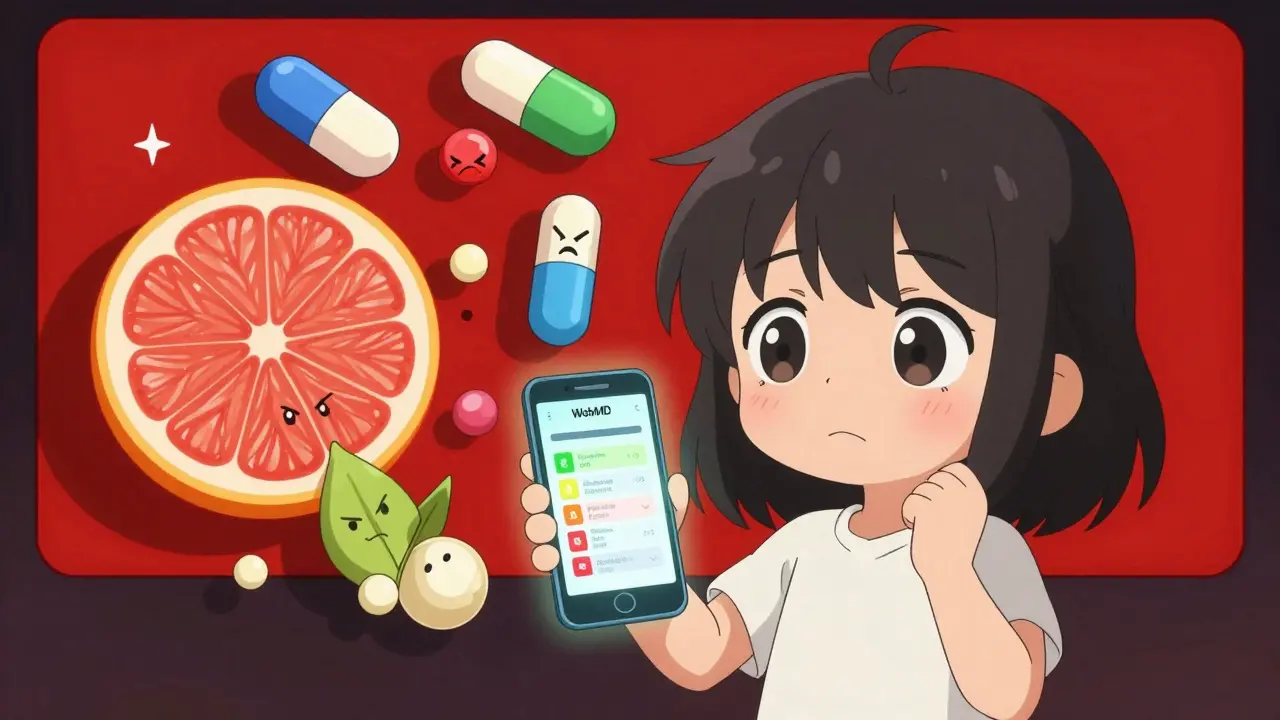
Drug Interaction Simulator
This tool simulates how online drug interaction checkers work. It's for educational purposes only and does not replace professional medical advice.
Type one medication per line (e.g., "Warfarin", "St. John's Wort", "Ibuprofen")
Interaction Results
Simulated ResultResults shown here simulate how public drug interaction checkers work. In reality, these tools have significant limitations.
Tool Limitations
Like real-world checkers, this tool cannot account for:
- Individual patient factors (age, kidney function, genetics)
- Herbal supplements and food interactions beyond basics
- Off-label drug uses
- Real-time clinical context
Next Steps
If you find potential interactions:
- Write down all medications and supplements you take
- Bring this list to your next doctor or pharmacist visit
- Never stop or change medications based on a website alone
- Ask: "Could this hurt me?" and "What should I do?"
This tool was built to educate readers about limitations of public drug interaction checkers. It is not a medical diagnosis tool.
Based on information from the article "Drug Interactions Databases: Using FDA and WebMD Checkers Safely".
Every year in the U.S., over 1.3 million people end up in the emergency room because of bad drug interactions. Many of these cases happen because someone took two medications together - or a pill with grapefruit juice - and didn’t realize the risk. Free online tools like WebMD’s Drug Interaction Checker are popular because they’re easy to use. But here’s the problem: they’re not foolproof. And the FDA doesn’t run them at all.
What You’re Actually Using - And What the FDA Really Does
You might think the FDA runs a public drug interaction checker. They don’t. The FDA’s job is to approve drugs, track side effects after they’re on the market, and issue recalls when something goes wrong. They collect reports through their Adverse Event Reporting System (FAERS), which logged over 2 million reports in 2022 alone. But they don’t give you a tool to check your own meds.
What you’re using is a third-party tool - most likely WebMD’s. It’s free, fast, and shows up first in Google. But it’s not a government system. It’s a commercial health website that makes money from ads. That’s not bad - but it means their goal isn’t clinical accuracy above all. It’s keeping you on the site.
How WebMD’s Checker Works - And Where It Falls Short
WebMD’s tool lets you type in any combination of prescription drugs, over-the-counter meds, vitamins, and supplements. It gives you a color-coded result: green for low risk, yellow for moderate, red for major. It’s simple. That’s why 18.7 million people use it every month.
But here’s what it misses:
- Herbal supplements like St. John’s Wort, turmeric, or garlic pills aren’t fully tracked.
- It doesn’t explain why an interaction happens - no details on liver enzymes, kidney clearance, or protein binding.
- It doesn’t account for your age, weight, kidney function, or genetics. A “moderate” interaction for a healthy 30-year-old could be deadly for a 78-year-old with heart failure.
- Updates lag. New drugs like fedratinib (approved in 2019) weren’t in the system for months. That delay caused real harm.
A 2021 University of Florida study found WebMD missed or misclassified 17% of serotonin syndrome warnings - a potentially fatal reaction. One Reddit user reported WebMD said warfarin and cranberry juice were safe. His INR spiked to 6.2. He almost bled out.
The Real Powerhouse: DrugBank - For Clinicians, Not Consumers
If you’re a pharmacist, doctor, or hospital IT team, you’re probably using DrugBank. It’s not free for heavy use. But it’s the gold standard for accuracy.
Here’s what DrugBank does that WebMD doesn’t:
- Shows exactly which liver enzyme (like CYP3A4 or CYP2D6) is affected.
- Links every interaction to peer-reviewed studies - not just expert opinion.
- Classifies severity with clear definitions: minor (rarely causes issues), moderate (may need monitoring), major (avoid or adjust dose).
- Integrates directly into hospital EHR systems like Epic and Cerner.
Its free version lets you check up to five drugs at once. It’s more complex than WebMD - but if you’re managing five or more medications, you need that depth. A hospital pharmacist in Chicago cut interaction-related admissions by 27% after switching to DrugBank’s API.
But here’s the catch: DrugBank’s enterprise version costs $1,200 a month. Most patients can’t afford it. And its interface isn’t designed for someone who doesn’t know what “pharmacokinetics” means.

Why You Should Never Rely on One Tool
Even the best systems have blind spots. Both WebMD and DrugBank ignore:
- Food-drug interactions beyond grapefruit and dairy. Think: leafy greens with blood thinners, or high-protein meals affecting antibiotic absorption.
- Condition-based risks. NSAIDs like ibuprofen are fine for most people - but dangerous for someone with heart failure or kidney disease.
- Genetic differences. About 30-50% of people have gene variants that change how they metabolize drugs. These aren’t tracked by any public checker.
And both tools fail on off-label uses. The FDA says 21% of prescriptions are for uses not officially approved. If you’re taking a drug for a condition it wasn’t tested for, the interaction database won’t know.
How to Use These Tools Without Getting Hurt
These aren’t magic wands. They’re early-warning systems. Here’s how to use them safely:
- Check everything - including supplements and OTC meds. 40% of serious interactions involve something you bought at the grocery store.
- Don’t trust color codes alone. A “moderate” interaction caused 18% of preventable hospital stays in one 2021 study. That’s not “maybe be careful.” That’s “call your doctor.”
- Use two tools. Run your list on WebMD, then cross-check with Drugs.com or Medscape. If they disagree, stop and ask a professional.
- Look for the “why.” If a tool just says “avoid” without explaining, it’s not helping you understand. Go to DrugBank’s free version or ask your pharmacist for the mechanism.
- Update your list every time you change meds. New prescriptions, new supplements, even a new OTC painkiller - recheck.
What the Experts Say - And What You Should Do
Dr. Richard H. Dana, Chief Pharmacist at Johns Hopkins, says: “WebMD is excellent for patient education but dangerous if used for clinical decision-making without verification.”
Dr. Linda A. Lee from the FDA adds: “No digital tool replaces clinician judgment, but they’re crucial for catching obvious interactions during polypharmacy.”
That’s the sweet spot. Use WebMD to get curious. Use DrugBank if you’re a professional. But always bring the results to your doctor or pharmacist. Don’t let a website make your decision for you.
What’s Coming Next - And Why It Matters
The FDA is pushing for “explainable AI” in drug interaction tools by 2026. That means platforms will have to show their work - not just give you a red flag, but tell you which study, which enzyme, which patient group it’s based on.
Some startups are trying blockchain-based personal interaction records. Others are using AI to predict new interactions before they’re even documented. Google’s Med-PaLM 2 predicted novel interactions with 89% accuracy in 2023 trials.
But here’s the danger: AI hallucinates. Stanford researchers found that large language models invent interactions 22% of the time when not properly grounded in data. That’s not science - that’s fiction.
So stay skeptical. Stay informed. And never stop asking your healthcare provider: “Could this hurt me?”
Frequently Asked Questions
Can I trust WebMD’s drug interaction checker?
WebMD’s checker is useful for spotting obvious risks and starting conversations with your doctor, but it’s not reliable enough to make decisions on your own. It misses many herbal supplements, doesn’t explain why interactions happen, and has been shown to misclassify up to 17% of serious warnings. Always verify with a pharmacist or provider.
Does the FDA have a drug interaction checker?
No, the FDA does not offer a public drug interaction checker. It monitors drug safety through its Adverse Event Reporting System (FAERS), tracks recalls, and sets standards - but it doesn’t provide tools for patients to check their own medications. Any site claiming to be an official FDA checker is misleading.
What’s the difference between WebMD and DrugBank?
WebMD is designed for patients: simple interface, no login, fast results, but limited detail. DrugBank is built for clinicians: deep pharmacological data, citations to research, enzyme pathways, and integration with hospital systems. WebMD is free; DrugBank’s full version costs over $1,000 a month. Use WebMD to get questions, DrugBank to get answers.
Are herbal supplements checked in drug interaction databases?
Most free tools like WebMD only partially cover herbal supplements. St. John’s Wort, ginkgo, and garlic are often included, but many others aren’t. The FDA doesn’t regulate supplements the same way as drugs, so data is sparse. Always assume an herb can interact - and tell your doctor what you’re taking.
Why do some interactions show as “moderate” but still cause hospital visits?
Severity labels are generalizations. A “moderate” interaction means it’s not always dangerous - but for someone with kidney disease, advanced age, or multiple conditions, it can be life-threatening. A 2021 study found moderate interactions caused 18% of preventable hospital admissions. Never ignore a yellow flag - especially if you’re on five or more medications.
Can AI-powered drug interaction tools be trusted?
Some AI tools are highly accurate - Google’s Med-PaLM 2 hit 89% in trials. But others invent interactions that don’t exist. A 2023 Stanford study showed AI hallucinated 22% of predicted interactions without proper data grounding. Always look for tools that cite sources and explain their reasoning. Avoid anything that just says “risk: high” without showing how it got there.
What should I do if I find a dangerous interaction?
Don’t stop taking your medication without talking to your doctor. Instead, write down the interaction, the drugs involved, and your symptoms (if any). Bring this to your pharmacist or prescriber. They can adjust your dose, switch medications, or monitor you more closely. Never self-adjust based on a website result.
Next Steps for Safer Medication Use
If you’re taking three or more medications, start today:
- Make a printed list of everything you take - including doses and times.
- Run it through WebMD and Drugs.com. Note any conflicts.
- Bring that list - and your notes - to your next doctor or pharmacist visit.
- Ask: “Is there anything here that could hurt me?”
- Update your list every time you start, stop, or change a drug.
Medication safety isn’t about finding the perfect app. It’s about being the smartest person in the room when it comes to your own body. Use the tools. But never outsource your judgment to them.
12 Comments
Janette Martens
i just typed in my meds and webmd said it was all good... then my cousin ended up in the er. lol. why do we trust these sites like theyre gospel? they dont even spell "interaction" right half the time.
Marie-Pierre Gonzalez
Thank you for this meticulously researched piece. It is imperative that we, as consumers, recognize the commercial interests underlying seemingly benign tools. I have shared this with my elderly mother, who relies heavily on WebMD for her five daily medications. Her safety is non-negotiable.
Louis Paré
Let's be real - WebMD is a glorified ad farm. The FDA doesn't run it? Shocking. Next you'll tell me the moon landing was faked. These "free" tools exist to keep you scrolling while Big Pharma laughs all the way to the bank. And don't even get me started on "herbal supplements" - they're just sugar pills with fancy Latin names.
Bradly Draper
I didn't know any of this. I just use WebMD because it's easy. Now I'm scared to take anything. What if I'm already hurt and don't know it?
James Hilton
So WebMD is basically the TikTok of drug info? 🤦♂️ Green = you're fine, Red = you're toast, Yellow = "eh, maybe call your grandma?" Meanwhile, DrugBank costs more than my rent. Guess I'm just gonna keep taking my turmeric with my blood thinner and hope for the best. 🙃
Kelsey Youmans
This is an exceptionally well-structured and clinically grounded analysis. The distinction between consumer-facing platforms and professional-grade systems is not merely technical - it is existential. I urge all readers to treat these tools as preliminary indicators, not definitive authorities.
Sydney Lee
You say WebMD "misses" 17% of serotonin warnings? That’s not a flaw - it’s a betrayal. Anyone using WebMD as a diagnostic tool is either dangerously naive or willfully ignorant. And don’t even get me started on the fact that most people don’t know what CYP3A4 is - they think "moderate" means "maybe don’t do it on a Tuesday." Pathetic.
oluwarotimi w alaka
this is all a lie. webmd is a cia project. they want you to think you're safe so you keep taking the pills. the real drug interactions? they're hidden in the water supply. and the FDA? they're just puppets for big pharma. you think your grapefruit juice is the problem? nah. it's the microchips. check your urine.
Debra Cagwin
This is such an important conversation. If you're taking more than three meds, please, please print out your list and take it to your pharmacist. They’re the real heroes here - no ads, no algorithms, just real people who want you to live. You’re not alone in this.
Hakim Bachiri
Okay, so WebMD = trash. DrugBank = $$$ elite club. But here’s the REAL issue - nobody teaches us this stuff in school! We’re just thrown into a pharmacy aisle like it’s a game of Russian roulette. And then we get mad when the system fails? Pathetic. We need mandatory med safety classes. Like, right now. Before someone dies because they trusted a website with a .com.
ANA MARIE VALENZUELA
I'm a nurse. I've seen the results of people trusting WebMD. One guy took melatonin with his antidepressant because it said "low risk." He spent three days in the psych ward. "Low risk" is a lie. "Moderate" is a death sentence waiting for a bad day. Don't be that person.
Gran Badshah
i use webmd because i dont have money for dr. i take 7 pills. i dont know what cyp3a4 is. i just want to live. why you make me feel stupid?