
When you have asthma, your lungs are constantly on edge. Inflammation tightens your airways, making breathing feel like trying to suck air through a straw. Inhaled corticosteroids (ICS) are the most effective tool we have to calm that inflammation. Millions of people rely on them daily-fluticasone, budesonide, mometasone, ciclesonide-and they work. But they’re not harmless. The side effects are real, and if you’re not careful, they can become a bigger problem than the asthma itself.
What Happens When You Use Steroid Inhalers Daily?
Inhaled steroids don’t flood your whole body like oral steroids do. They’re designed to stick to your airways and do their job right where it’s needed. But not all of the medicine stays there. About 10-40% of each puff ends up in your throat and mouth. That’s where trouble starts. The most common side effects are local: oral thrush (a fungal infection that looks like white patches in your mouth), hoarseness, and throat irritation. These aren’t dangerous, but they’re annoying enough that many people stop using their inhalers. And when they stop, their asthma comes back harder. Here’s the hard truth: if you’re not rinsing your mouth after each puff, you’re doubling your risk of thrush. Studies show that people who rinse and spit reduce thrush by more than half. It’s that simple. A quick swish with water, then spit it out-don’t swallow. It takes 10 seconds. That’s all it takes to avoid a lot of discomfort.Systemic Side Effects: The Hidden Risks
The bigger worry isn’t the throat-it’s what happens when the steroid gets into your bloodstream. Even small amounts can build up over time, especially if you’re on a high dose. One of the most serious risks is adrenal suppression. Your body naturally makes cortisol, a hormone that helps you handle stress. When you take steroid medicine for months or years, your body says, “Why bother making our own?” and slows down. If you suddenly stop the inhaler, or get sick, injured, or have surgery, your body might not be able to ramp up cortisol fast enough. That can lead to fatigue, dizziness, low blood pressure, and even life-threatening adrenal crisis. Fluticasone carries the highest risk here. Studies show that at doses above 500 mcg per day, it suppresses cortisol levels nearly three times more than budesonide at the same dose. Ciclesonide and mometasone are much gentler on your adrenal system-less than 5% of the dose gets absorbed. If you’ve been on fluticasone for more than six months and feel constantly tired, ask your doctor about switching. Another hidden danger is bone thinning. If you’re over 65 and on more than 750 mcg per day of beclomethasone equivalent for five years or more, your fracture risk goes up by 31%. That’s not a small number. The same goes for skin: long-term users on high doses have a 34% chance of developing thin, bruise-prone skin. If you notice easy bruising, especially on your arms or legs, it’s not just aging-it could be your inhaler.Who’s at Highest Risk?
Not everyone reacts the same way. Children on standard doses (under 400 mcg/day) might grow a little slower-about 0.7 cm per year-but their final adult height isn’t affected. High doses, though-over 800 mcg/day-can increase cataract risk in kids by more than double. Older adults face different dangers. High-dose ICS raises pneumonia risk by 70% in people over 65. That’s because steroids weaken the immune response in the lungs. If you’re elderly and on a high dose, your doctor should be watching for coughs that won’t go away or fever. Pregnant women need special attention. Budesonide is the safest choice here. It’s been studied for over 15 years in pregnancy and shows no increased risk of birth defects. Fluticasone hasn’t been studied as thoroughly, so it’s not the first pick unless absolutely necessary.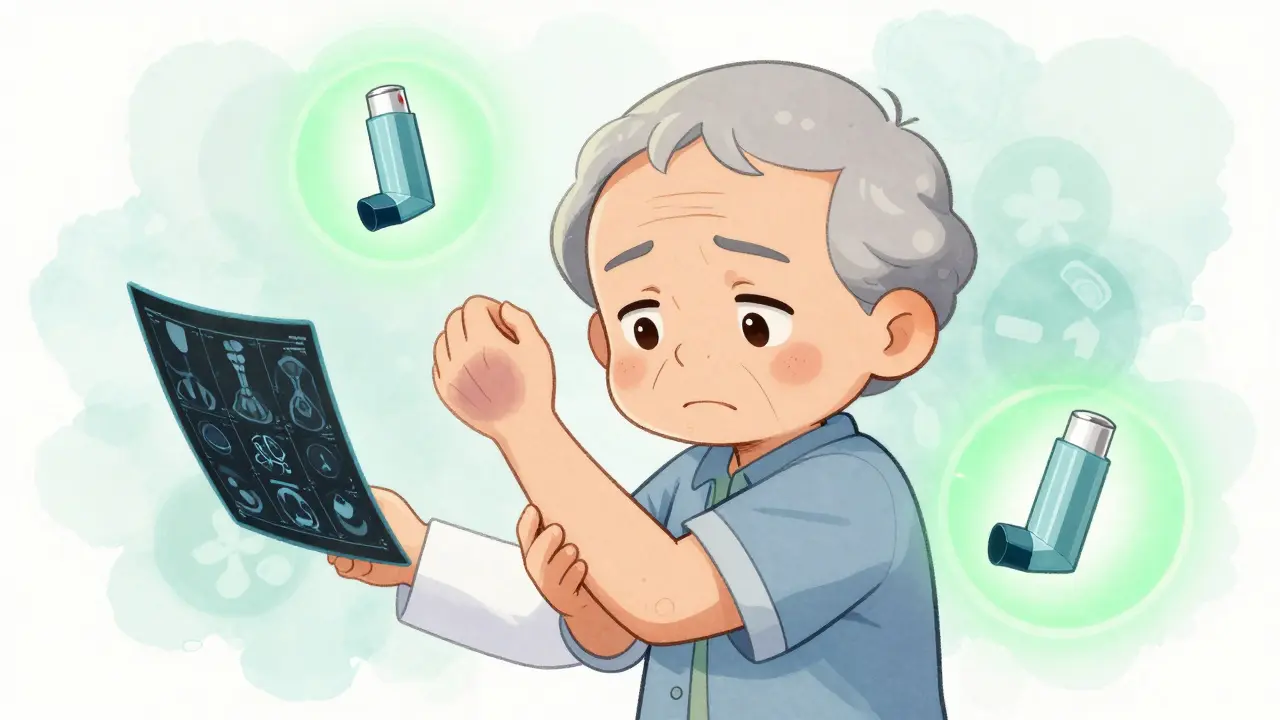
How to Cut Your Risks-For Real
There are four proven ways to protect yourself without giving up control of your asthma. 1. Use a spacer. If you’re using a metered-dose inhaler (the kind that sprays), a spacer is non-negotiable. Without it, up to 80% of the medicine hits your throat. With a spacer, 60-80% reaches your lungs. That means you need less medicine to get the same effect. And less medicine means fewer side effects. Spacers cost less than £5 in the UK. If your pharmacy says they’re “optional,” they’re wrong. 2. Rinse and spit every time. Don’t just rinse. Spit. Swallowing the rinse water defeats the purpose. Do it immediately after each puff. This cuts thrush risk by 50-60% and reduces hoarseness by more than two-thirds. 3. Use the lowest dose that works. Many people stay on high doses long after their asthma is under control. That’s unnecessary. Studies show that 65-75% of systemic side effects can be avoided by stepping down to the minimum effective dose. If you haven’t had an asthma attack in six months, talk to your doctor about reducing your dose. Don’t do it yourself-do it with guidance. 4. Get your technique checked every 3-6 months. A 2021 study found that 72% of people with side effects had never had their inhaler technique reviewed. That’s shocking. You might think you’re using it right, but you’re probably not. The most common mistakes: not breathing in slowly enough, not holding your breath after inhaling, or not coordinating the puff with your breath. A nurse or pharmacist can spot these in under five minutes.Monitoring: What Your Doctor Should Be Checking
Regular check-ins aren’t just about your breathing. They’re about your whole body. - Every 3-6 months: Ask your provider to check for thrush, voice changes, or throat soreness. A quick look in your mouth takes seconds. - Annually: If you’re over 65 and on high-dose ICS, ask for a skin check. Look for thinning skin, easy bruising, or purple stretch marks. - Every 5 years: If you’ve been on more than 750 mcg/day for five years, get a bone density scan (DEXA). Osteoporosis doesn’t show symptoms until you break something. - If you feel tired or dizzy: Ask for a salivary cortisol test. It’s simple, non-invasive, and tells you if your adrenal glands are still working properly.
What’s Coming Next?
The future of asthma treatment is moving away from steroids. New biologic drugs like dupilumab and mepolizumab target specific inflammation pathways without touching your whole immune system. In severe asthma, these drugs have cut ICS use by 70%. That’s huge. Even better, new ultra-low systemic inhalers are in trials. One, called AZD7594, reduced adrenal suppression by 90% compared to fluticasone. It’s not on the market yet, but it’s coming. Smart inhalers are already here. These devices connect to your phone and track whether you’re using your inhaler correctly. They alert you if you’re not using a spacer or if you’re skipping doses. In trials, they improved technique by 92%. You don’t have to wait for these advances. Right now, you can make your current treatment safer.What to Do If You’re Scared to Use Your Inhaler
It’s normal to worry. I’ve talked to patients who stopped their inhaler because they were afraid of side effects-and then ended up in the hospital with a severe asthma attack. That’s the real danger. The goal isn’t to avoid steroids. It’s to use them wisely. For most people, the benefits of controlling asthma far outweigh the risks. But only if you’re using the right dose, the right technique, and the right monitoring. If you’re on a high dose and haven’t had a check-up in over a year, schedule one. Bring your inhaler with you. Ask your doctor: “Is this the lowest dose I can be on? Am I using it right? Should I switch to a gentler steroid?” You’re not alone. Thousands of people manage asthma safely with inhaled steroids every day. The key isn’t fear-it’s knowledge.Do inhaled steroids cause weight gain?
Unlike oral steroids, inhaled corticosteroids rarely cause weight gain. The amount that enters your bloodstream is too small to affect metabolism or appetite. If you’ve gained weight while using your inhaler, it’s more likely due to other factors like reduced activity from asthma symptoms or medications like oral steroids you may have taken in the past. Always discuss unexplained weight changes with your doctor.
Can I stop my steroid inhaler if I feel fine?
No. Even if you feel fine, your airways may still be inflamed. Stopping suddenly can cause your asthma to flare up quickly-sometimes dangerously. Always work with your doctor to gradually reduce your dose only after your asthma has been stable for at least 3-6 months. Never stop on your own.
Are some inhalers safer than others?
Yes. Ciclesonide and mometasone have much lower systemic absorption than fluticasone or beclomethasone. Budesonide is also safer than fluticasone at the same dose. If you’re on a high dose or have side effects, ask your doctor if switching to a gentler steroid is an option. The anti-inflammatory effect is just as strong, but the side effect risk is lower.
How do I know if my inhaler technique is wrong?
Signs of poor technique include frequent throat irritation, hoarseness, or thrush despite rinsing. You might also notice that your inhaler lasts longer than it should-meaning you’re not getting the full dose. If you haven’t had your technique checked in over a year, schedule an appointment. Many pharmacies offer free inhaler reviews.
Should I use a spacer with my dry powder inhaler?
No. Dry powder inhalers (like Turbuhaler or Diskus) don’t need spacers-they’re designed to work without them. Spacers are only for metered-dose inhalers (the aerosol sprays). Using a spacer with a dry powder inhaler can actually block the medicine from reaching your lungs. Check the type of inhaler you have and use the right tools for it.
Is it safe to use inhaled steroids during pregnancy?
Yes, but not all steroids are equal. Budesonide is the preferred choice during pregnancy because it has the most safety data over 15+ years. Fluticasone is less studied and carries a higher risk classification. Uncontrolled asthma during pregnancy is far more dangerous to both mother and baby than the inhaler. Never stop your medication without talking to your OB-GYN and asthma specialist.
12 Comments
Kerry Howarth
Just rinsed and spat after my last puff. Ten seconds. No thrush. No hoarseness. Just clean airways and peace of mind.
Joy F
Let’s be real-pharma’s been selling us a myth that these inhalers are ‘safe.’ They’re not. They’re slow-acting endocrine disruptors wrapped in a blue plastic casing. Your adrenal glands are whispering for help, and you’re ignoring them because ‘it’s just a puff.’ Wake up. The system doesn’t care if you live or die-it cares if you keep buying.
Haley Parizo
Here’s the uncomfortable truth: we’ve outsourced our body’s autonomy to a plastic device. We’ve turned breathing into a ritual of chemical submission. The inhaler doesn’t heal-it suppresses. And suppression, over time, becomes dependency. We don’t treat asthma-we manage its symptoms while quietly eroding our own physiology. Who benefits? Not you. Not me. The corporate balance sheet.
Ian Detrick
You’re not alone in this. I was terrified of my inhaler too-until I learned how to use it right. Spacer? Check. Rinse and spit? Daily. Dose stepped down after six months stable? Done. You don’t have to live in fear. You just have to be smart. And you’re already ahead just by reading this. Keep going.
Angela Fisher
Okay but have you ever wondered why EVERYONE on steroids gets thin skin and weird bruising? It’s not coincidence. It’s the government’s plan. They want us weak. They want us dependent. Spacers? Rinsing? That’s all a distraction. The real solution? Get off all meds. Go vegan. Breathe in the forest. Sunlight heals. Big Pharma doesn’t want you to know that. They’re scared. Look at the ads-they never show the bruising. They never show the adrenal crash. It’s all smoke and mirrors. I’ve been off mine for 3 years. No attacks. No meds. Just pure lung power. 🌿💪
Neela Sharma
My grandmother used to say: ‘The body remembers what the mind forgets.’ I used fluticasone for years. Hoarse voice. White patches. Felt like I was breathing through cotton. Then I got a spacer. Rinsed like my life depended on it. Switched to ciclesonide. Now I laugh, I run, I climb stairs without gasping. It’s not magic. It’s mindfulness. Tiny habits. Big freedom.
Shanahan Crowell
Wait-did you know that 72% of people with side effects never had their technique checked?! That’s insane! I went to my pharmacist last month-she showed me I was puffing too fast, not holding my breath long enough, and skipping the rinse entirely. Changed everything. My throat hasn’t been sore in months. Please, if you’re reading this-go get checked. It’s free. It’s five minutes. It could save your lungs.
Shruti Badhwar
While the emphasis on technique and dose reduction is commendable, one must also consider socioeconomic barriers. Not everyone can afford a spacer. Not everyone has access to a pharmacist who provides free reviews. Not everyone can switch medications due to insurance restrictions. The burden of safety is being placed on the individual, while systemic inequities remain unaddressed. Knowledge is power-but access is justice.
Liam Tanner
My son’s been on budesonide since he was 5. We use a spacer. We rinse. We track his dose. He’s 14 now-no growth delay, no thrush, no bruises. He plays soccer. He sleeps through the night. It’s not about avoiding steroids-it’s about mastering them. You can have control without compromise.
Palesa Makuru
Ugh, I just read this and now I’m paranoid. Like… what if I’ve been swallowing the rinse this whole time? I thought it was fine because I ‘swallowed it on purpose’ to ‘help the medicine work.’ Wait-NO. No no no. I just vomited a little in my mouth thinking about it. I need to go rinse right now. And get a spacer. And maybe call my doctor. And maybe change my name. And move to a cabin. And breathe only through my nose. And stop using all electronics. And…
Hank Pannell
Adrenal suppression is the silent epidemic no one talks about. The cortisol axis isn’t just a hormone pathway-it’s your body’s central stress regulator. Chronic low-dose ICS exposure, especially fluticasone, induces HPA axis downregulation. Salivary cortisol testing is underutilized because clinicians assume ‘it’s just an inhaler.’ But physiology doesn’t care about labels. If you’re fatigued, dizzy, or hypotensive, don’t chalk it up to ‘stress.’ Test your cortisol. Ask for a DEXA. Advocate for yourself. Your body is not a machine to be dosed-it’s a dynamic system to be respected.
Sarah Little
Did you know that the FDA doesn’t require manufacturers to test long-term adrenal effects for ICS? It’s classified as ‘local’ so they don’t need full systemic safety data. That’s why we’re all just guessing. The studies you cited? Mostly funded by pharma. Who’s watching the watchers? I’m not saying don’t use them-I’m saying we’re flying blind. And someone needs to be held accountable.