
Every year, millions of people miss doses of their medications-not because they don’t care, but because life gets in the way. A medication adherence rate of just 50% is the norm for chronic conditions like high blood pressure, diabetes, or thyroid disease. That means half the people taking pills every day aren’t taking them right. And it’s not just about forgetting. It’s about complexity, confusion, and routines that don’t fit real life.
The good news? You don’t need to be perfect. You just need a system that works for you. The goal isn’t to follow a doctor’s schedule like a robot. It’s to make taking your meds as automatic as brushing your teeth. And that’s possible-even if you’re juggling five different pills, have a busy job, or forget things easily.
Start with the simplest thing: Tie it to something you already do
One of the most proven ways to remember your meds is to link them to a daily habit you never skip. Brushing your teeth? Eating breakfast? Feeding your pet? These are anchors. Stanford Medicine found that 78% of people improved their adherence when they paired their pills with a routine like this. Why? Because habits stick. Your brain doesn’t have to think about it. It just happens.
Let’s say you take a pill in the morning. If you always brush your teeth right after waking up, put your pill next to your toothbrush. Do it before you turn on the shower. No extra effort. No alarm. Just a natural sequence: wake up → grab toothbrush → take pill → brush.
Same for evening doses. If you always sit down to watch TV at 8 p.m., make that your pill time. Put the bottle on the coffee table. No one forgets to sit down for their favorite show.
Use a pill organizer-no tech required
Pill organizers aren’t fancy. They’re simple. A weekly box with compartments for morning, afternoon, evening, and bedtime. You fill it once a week. Done. The American Heart Association found that using one reduces missed doses by up to 25%. For people on four or more medications, that jump can be as high as 35%.
Here’s how to do it right:
- Fill it on Friday night after dinner. That’s when 68% of people find it easiest to remember.
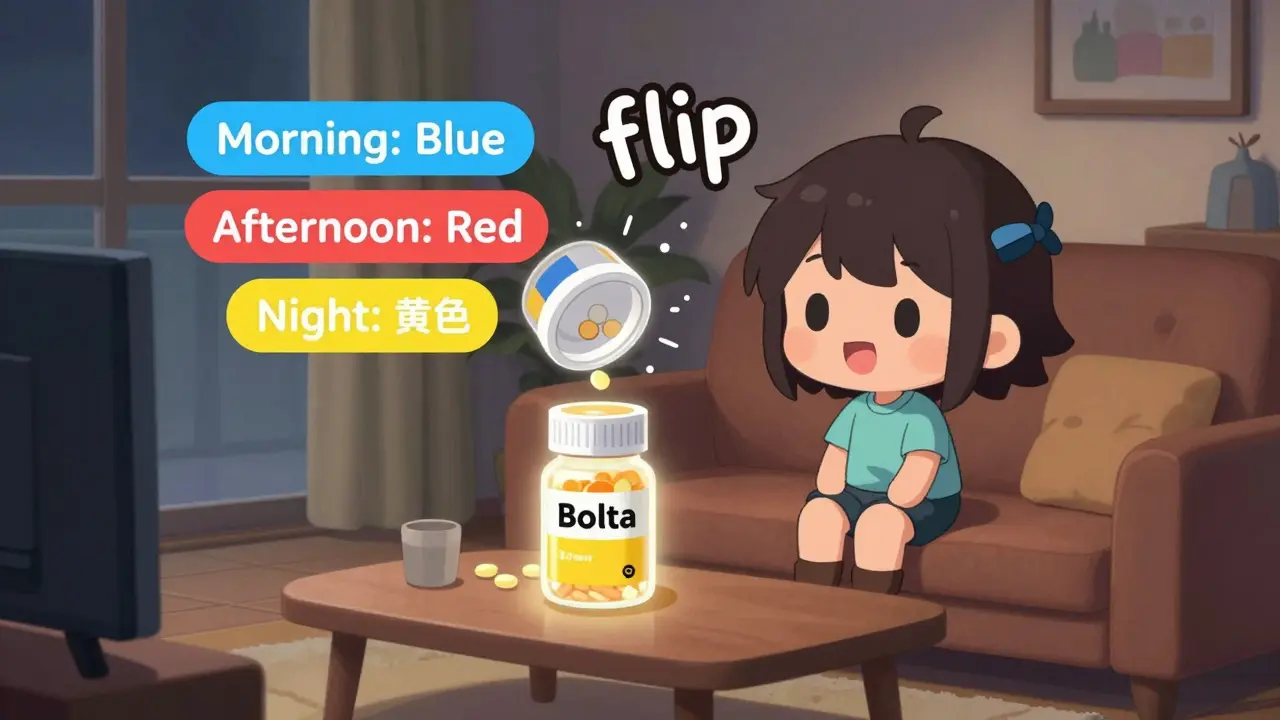
- Use colored labels: blue for morning, red for afternoon, yellow for night. Studies show this improves correct dosing by 28%.
- Keep it visible. On the counter, not in the back of a cabinet.
- If you miss a dose, don’t panic. Just put it back in the next day’s slot. No double-dosing.
Some people worry about looking “old” using a pillbox. But here’s the truth: people who use them stick to their meds longer. And they’re less likely to end up in the hospital.
Forget alarms? Try the flip bottle trick
Smartphone alarms work for some. A 2020 MedStar Health study showed 63% of people aged 50-75 improved adherence with phone reminders. But for others? They silence them. They forget to set them. Or they just don’t trust tech.
There’s a low-tech fix that works surprisingly well: the flip bottle method. After you take your pill, turn the bottle upside down. It’s visual. It’s tactile. You can’t miss it. ProMedica’s clinical data showed this cuts double-dosing by 22% and improves consistency by 18%.
It’s perfect for people with memory issues, or those who don’t want to fiddle with apps. No batteries. No updates. Just a bottle and a flip.
Track it with a simple calendar
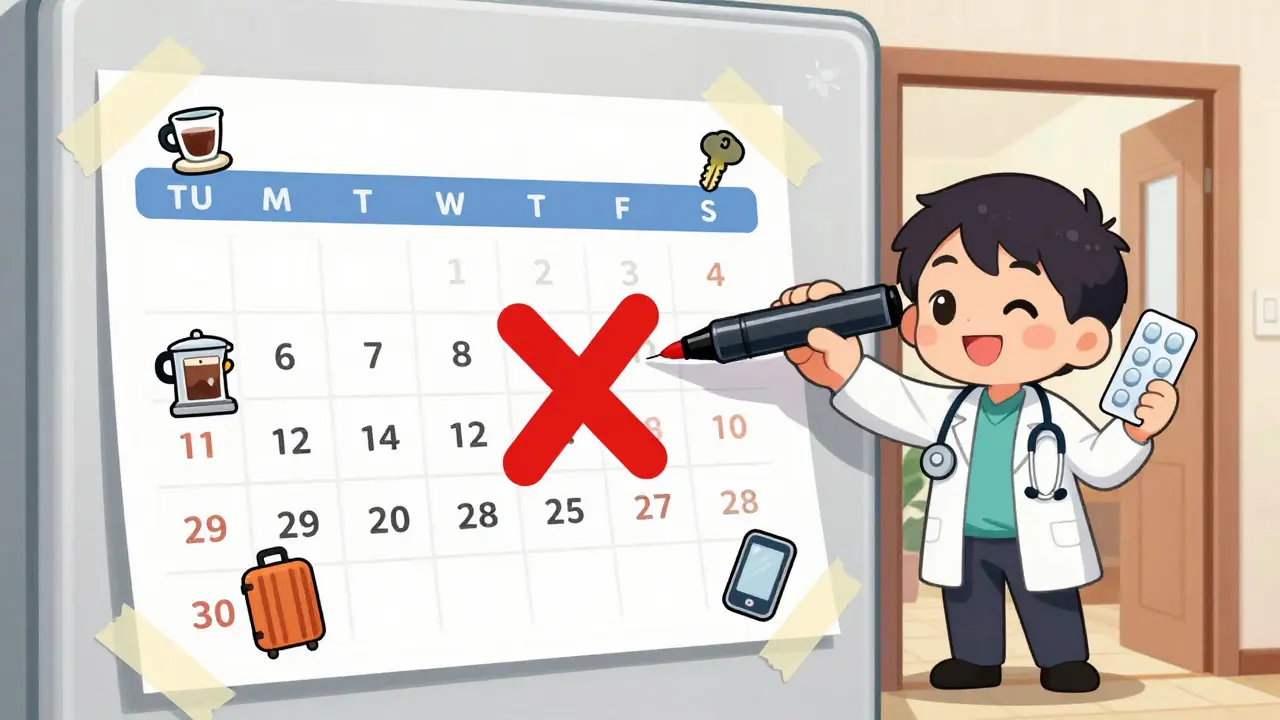
Marking off days on a calendar isn’t just for kids. A 2011 study in the PMC journal found that people who checked off each dose reduced missed pills by 32%. Why? Because seeing progress builds momentum. It’s not about perfection-it’s about streaks.
Here’s how to make it stick:
- Print out a monthly calendar. Tape it to the fridge or bathroom mirror.
- Use a thick marker. Big X’s are harder to ignore than tiny checkmarks.
- Don’t skip days. If you miss one, just mark it with a different color. No guilt. Just honesty.
AdventHealth’s survey of 5,000 patients found that 76% who used this method maintained 90%+ adherence. That’s not luck. It’s feedback. Your brain likes seeing progress.
Simplify your regimen
Doctors often prescribe multiple doses because they’re following guidelines. But you don’t have to take them all at the same time. The most successful routines are the simplest ones.
Dr. Robert L. Page II, a top medication specialist, says: “Reducing daily doses from three to one cuts complexity by 40%.” That’s huge. If you’re taking four pills in the morning and three at night, talk to your doctor. Ask: “Can any of these be combined? Can any be taken once a day instead of twice?”
Many medications can be safely adjusted. A 2022 MedStar Health study showed that 30-50% of patients on complex regimens could reduce their daily doses without losing effectiveness. You won’t know unless you ask.
Know what trips you up
Not all missed doses are accidents. Sometimes, people skip pills on purpose. ProMedica’s 2022 analysis found that 49% of patients stopped taking meds because of side effects-dry mouth, dizziness, fatigue. They didn’t tell their doctor. They just quit.
That’s dangerous. Side effects are fixable. A different time of day. A lower dose. A new pill. But only if you speak up.
Travel is another big disruptor. 63% of patients miss doses when they’re on the road. Solution? Pack a small pill organizer with a week’s supply. Keep it in your carry-on. Never check it. Bring your doctor’s contact info in case you lose it.
Don’t go it alone
One of the most underrated tools? A buddy. A friend, spouse, or neighbor who checks in. A 2023 Reddit thread from r/ChronicIllness showed that 68% of users who had a “medication partner” cut missed doses to under 5%. One user said, “Filling my organizer every Friday night became my ritual. My sister calls me to make sure I did it. It changed everything.”
But it has to be real. If your partner forgets, or moves away, or gets too busy, the system breaks. That’s why it’s better as a backup-not your only tool.
What if you still forget?
Some people have memory issues. Some are overwhelmed. Some just have chaotic lives. That’s okay. You don’t need to be perfect. You need to be consistent.
Here’s a quick checklist for stubborn cases:
- Use a weekly pill organizer + flip bottle combo.
- Set one phone alarm (not five).
- Put your meds where you’ll see them every day-next to your coffee maker, your keys, or your wallet.
- Fill your organizer on Friday night. Make it a ritual.
- Call your pharmacy. Ask if they offer a blister pack with pre-filled doses.
And if you’re still struggling? Talk to your pharmacist. They see this every day. They can help you simplify, switch brands, or find a free program that sends you reminders by text or mail.
It’s not about willpower
Medication adherence isn’t about being disciplined. It’s about design. Your brain doesn’t remember a list of pills. It remembers habits, cues, and routines.
Stop trying to remember. Start building systems. Put your pills where you’ll see them. Link them to things you already do. Track your progress. Simplify when you can. Ask for help.
And remember: every dose you take is a step toward fewer hospital visits, fewer complications, and more control over your health. You don’t need to be perfect. You just need to show up.
9 Comments
Sophia Nelson
I tried all this stuff. Pill organizer? Yeah, I filled it once. Then I forgot where I put it. Flip bottle? I flipped it so hard the cap flew off and landed in my cat’s food. Now I just leave the bottle on the counter and hope for the best. At least I’m not overdosing. Probably.
Skilken Awe
Let me guess-you’re one of those people who think ‘habit stacking’ is a revolutionary concept. Newsflash: this is just behavioral conditioning repackaged with a wellness influencer aesthetic. The real issue is pharmaceutical capitalism forcing polypharmacy on elderly populations while ignoring root causes. But sure, keep flipping your bottles and calling it ‘adherence.’
andres az
You know who really benefits from all this? The pill manufacturers. They design complex regimens because it keeps you dependent. And the ‘flip bottle trick’? That’s not a solution-it’s a Band-Aid on a bullet wound. They don’t want you to simplify. They want you to keep buying. Look up the 2018 FDA whistleblower reports. This whole system is rigged.
Steve DESTIVELLE
The human condition is fundamentally fragmented by the demands of modernity and the illusion of linear time. To reduce medication adherence to behavioral hacks like pill organizers or coffee maker placement is to mistake symptom for cause. We are not machines that can be calibrated with cues. We are beings caught in a web of alienation where even the act of swallowing a pill becomes an existential gesture. The real adherence is not to the regimen but to the quiet rebellion of continuing to exist despite the weight of it all.
Stephon Devereux
I’ve been a pharmacist for 18 years and let me tell you-this post nails it. People think they need willpower. They don’t. They need design. I had a 79-year-old woman who missed doses for years until I told her to put her meds next to her slippers. She put them on every morning. Took her pills. Then walked to the mailbox. Changed her life. No apps. No alarms. Just slippers. If you’re struggling, stop overthinking. Start stacking. And talk to your pharmacist. We’re not here to judge. We’re here to help you live.
steve sunio
this post is sooo basic like why are we even here. you think people dont know to use pillboxes? the real problem is the system. insurance wont cover the good ones. doctors dont care. and half the time the meds make you feel worse so why bother. also i typoed but you get it. lol.
athmaja biju
This is why America is falling apart. You treat medicine like a chore to be optimized with cute hacks. In India, we don’t need pill organizers. We have family. We have community. We have elders who remind you. We don’t need to ‘flip bottles’ or ‘track streaks.’ We have responsibility. You Americans turn healthcare into a productivity app. It’s pathetic.
Carla McKinney
I appreciate the effort, but this feels dangerously simplistic. You’re implying that if someone misses doses, it’s because they didn’t ‘stack habits’ right. What about depression? Trauma? Financial hardship? The fact that 49% skip meds due to side effects isn’t a ‘habit problem’-it’s a systemic failure. This post reads like a corporate wellness pamphlet. No one who’s actually struggling needs another checklist.
Ojus Save
flip bottle trick actually works. i tried it after my grandpa died from a double dose. now i flip every time. no alarms. no apps. just a bottle and a habit. also i put mine next to my phone charger. if i’m charging my phone, i take my pill. it’s dumb. but it works.