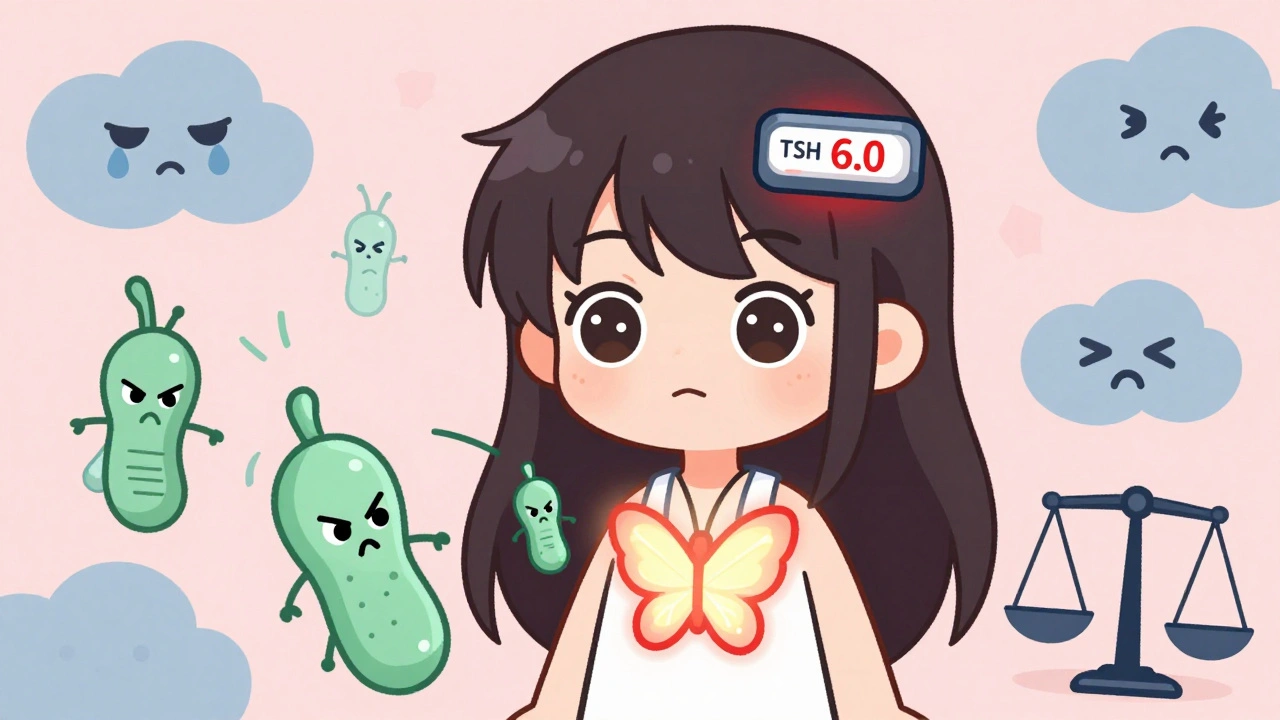
Hashimoto’s thyroiditis isn’t just a lab result. For millions of people-mostly women-it’s a constant balancing act between fatigue, weight gain, brain fog, and the quiet, relentless attack of their own immune system on the thyroid gland. First described in 1912 by Japanese doctor Hakaru Hashimoto, this condition is the leading cause of hypothyroidism in places like the U.S. and U.K., accounting for about 90% of all cases. It’s not rare. It’s not mysterious. And if you’ve been told your TSH is "normal" but still feel awful, you’re not imagining it.
How Your Immune System Turns Against Your Thyroid
Your thyroid is a small butterfly-shaped gland at the base of your neck. It makes hormones that control your metabolism, energy, temperature, and even your mood. In Hashimoto’s, your immune system mistakes thyroid tissue for a threat and starts producing antibodies-mainly thyroid peroxidase antibodies (TPOAb)-that slowly destroy it. This isn’t an overnight event. It can take years. Many people have elevated antibodies for a long time before their thyroid function drops enough to show up on blood tests.
Why does this happen? No one knows for sure. Genetics play a role. So do environmental triggers like stress, viral infections, or nutrient deficiencies. Women are five to ten times more likely to develop it than men, and it often shows up after pregnancy, during perimenopause, or in people with other autoimmune conditions like type 1 diabetes or celiac disease.
Why TSH Is the Most Important Number
When doctors suspect Hashimoto’s, they don’t start with fancy scans or biopsies. They start with one simple blood test: TSH, or thyroid-stimulating hormone. This isn’t just a number-it’s your body’s alarm system. TSH is made by your pituitary gland and tells your thyroid, "Make more hormones." When your thyroid slows down, your pituitary panics and pumps out more TSH. So a high TSH means your thyroid isn’t keeping up.
Here’s what the numbers mean:
- TSH above 4.5 mIU/L usually triggers further testing for free T4 and TPOAb.
- High TSH + low free T4 = confirmed hypothyroidism.
- High TSH + normal free T4 = subclinical hypothyroidism-your thyroid is struggling but still holding on.
- Elevated TPOAb confirms the autoimmune cause.
Once diagnosed, the goal isn’t to get TSH "in the normal range." It’s to get it to the right range for you. The standard reference range is 0.4-4.0 mIU/L, but that’s based on population averages. For many people, feeling their best happens when TSH is between 0.5 and 2.5. The American Thyroid Association and the American Association of Clinical Endocrinologists both agree: TSH is the best, and often the only, test you need to monitor treatment.
Levothyroxine: The Standard Treatment
If your thyroid can’t keep up, you’ll need to replace its hormones. That’s where levothyroxine (LT4) comes in. It’s a synthetic version of T4, the main hormone your thyroid makes. Brands like Synthroid and Levoxyl are common, but most people take generics-they’re just as effective if you stick with the same batch.
Dosing isn’t one-size-fits-all. Doctors usually start with 1.4-1.8 mcg per kilogram of body weight. For a 70kg adult, that’s roughly 100 mcg/day. But if you’re older, have heart disease, or are just starting with mild symptoms, they might begin with 25-50 mcg to avoid overloading your system.
Here’s the catch: levothyroxine takes time to work. It has a half-life of about seven days. That means your body needs six to eight weeks to fully adjust to a new dose. This is why your doctor won’t change your dose every month. Rushing it doesn’t help. In fact, frequent changes can make symptoms worse.

When and How Often to Test TSH
Timing matters. If you start levothyroxine, your first TSH test should be at 6-8 weeks. That’s the sweet spot-long enough for your body to stabilize, short enough to catch problems early. After that, retest 6-8 weeks after any dose change. Once you’re stable, annual testing is usually enough.
But there are exceptions:
- Pregnancy: TSH needs to be checked every 4 weeks until week 20. The target TSH in the first trimester drops to 0.1-2.5 mIU/L because your baby depends on your thyroid hormones early on.
- Weight changes over 10%: Gaining or losing significant weight changes how your body processes the medication.
- Starting or stopping other meds: Iron, calcium, PPIs (like omeprazole), estrogen pills, and even soy can interfere with levothyroxine absorption.
- Persistent symptoms: If you’re still tired, gaining weight, or depressed despite a "normal" TSH, talk to your doctor about targeting the lower end of the range (0.5-2.0 mIU/L). Some people just feel better there.
And no-you don’t need to test your antibody levels again. Once you know you have Hashimoto’s, those numbers don’t change how you’re treated. The ATA says it clearly: monitoring antibodies is unnecessary.
What Symptoms Tell You (Even When TSH Looks Fine)
TSH is the gold standard, but it’s not the whole story. Many patients report symptoms long before their TSH climbs above 4.5. Fatigue. Cold hands. Dry skin. Constipation. Brain fog. Depression. These aren’t "just stress." They’re signs your thyroid isn’t doing its job.
On the flip side, if your TSH drops below 0.4, you might feel anxious, jittery, have heart palpitations, or lose weight unintentionally. That’s a sign you’re getting too much levothyroxine. Too much can strain your heart and weaken your bones over time.
One 2023 study in JAMA Internal Medicine found that people with a specific gene variation (DIO2 polymorphism) had much better symptom control when their TSH was kept in the lower half of normal (0.4-2.0). This hints that future treatment may be personalized-not just by TSH, but by genetics.

What Doesn’t Work (And Why)
There’s a lot of noise online about Hashimoto’s. You’ll hear about selenium, iodine, gluten-free diets, or T3 supplements as "cures." Let’s be clear:
- Gluten-free diets might help if you also have celiac disease-but for most people with Hashimoto’s, cutting gluten doesn’t lower antibodies or improve thyroid function.
- Iodine supplements can actually make Hashimoto’s worse. Too much iodine can trigger more immune attacks on the thyroid.
- T3 (Cytomel) combination therapy sounds logical-why not replace both T4 and T3? But the 2022 Cochrane Review found no consistent benefit over T4 alone. Most patients don’t feel better on T3, and it increases the risk of heart problems.
- Home TSH tests like ThyroChek are now FDA-approved, but labs still recommend professional testing. Home tests aren’t reliable at low TSH levels, and misreading them can lead to dangerous dose changes.
Stick to the evidence. Levothyroxine + TSH monitoring is the standard for a reason. It’s safe, effective, and backed by decades of research.
Living With Hashimoto’s: Real Talk
Most people find their dose within 3-6 months. But it’s not uncommon to need 3-5 adjustments before you feel right. That’s normal. Don’t give up. Don’t blame yourself. Your body is adjusting to a new chemical balance, and that takes time.
Take your pill on an empty stomach-ideally 30-60 minutes before breakfast. Avoid coffee, calcium, or iron for at least four hours after. Keep a symptom journal. Note energy levels, sleep, weight, and mood. Bring it to your appointments. It helps your doctor see patterns your blood test might miss.
And remember: you’re not alone. Around 4% of U.S. adults have Hashimoto’s-that’s nearly 10 million people. In the U.K., the numbers are similar. You’re part of a large, growing community. Support groups on Reddit or local thyroid networks can help, but always cross-check advice with your doctor.
Hashimoto’s isn’t a death sentence. It’s a manageable condition. With the right dose of levothyroxine and smart TSH monitoring, most people live full, energetic lives. The key isn’t perfection-it’s consistency. Test. Adjust. Wait. Repeat. And don’t let anyone tell you your symptoms aren’t real. They are. And they matter.
Can Hashimoto’s be cured?
No, Hashimoto’s thyroiditis cannot be cured. It’s a lifelong autoimmune condition. But it can be effectively managed with daily levothyroxine medication and regular TSH monitoring. Once the right dose is found, most people experience full symptom relief and live normally without complications.
Why does my TSH keep changing even though I take my pill every day?
Even with perfect adherence, TSH can fluctuate due to weight changes, other medications (like iron or PPIs), pregnancy, or even seasonal variations in vitamin D. Levothyroxine absorption is sensitive to what you eat and when you take it. Small changes in timing or diet can affect how much your body absorbs, which shifts your TSH. That’s why dose adjustments are often needed-especially in the first year.
Should I take my thyroid medication at night instead of in the morning?
Some studies suggest taking levothyroxine at bedtime may improve absorption for some people, especially if they struggle with morning stomach upset or inconsistent eating habits. But the key is consistency-take it the same way every day, whether morning or night, on an empty stomach. Switching back and forth can cause TSH instability. Talk to your doctor before changing your routine.
Is it safe to stop levothyroxine if I feel fine?
No. Stopping levothyroxine-even if you feel fine-will cause your TSH to rise again, and your symptoms will return. Your thyroid has been damaged by your immune system and can no longer produce enough hormone on its own. Without replacement, you risk fatigue, high cholesterol, heart problems, and even myxedema coma in severe cases. This is not a condition you can outgrow.
Do I need to avoid soy and cruciferous vegetables?
No, you don’t need to avoid soy or cruciferous vegetables like broccoli, kale, or cabbage. These foods contain compounds that can interfere with thyroid hormone absorption-if eaten in massive amounts right before or after your pill. Normal dietary intake is perfectly safe. Just don’t eat a big bowl of soybeans or raw kale right after taking your medication. Space them out by a few hours.
Can Hashimoto’s lead to thyroid cancer?
Hashimoto’s itself does not cause thyroid cancer. However, people with Hashimoto’s are more likely to develop thyroid nodules, and a small percentage of those nodules can be cancerous. That’s why doctors may recommend an ultrasound if you have a visible or palpable lump in your neck. But the vast majority of nodules in Hashimoto’s patients are benign. Regular monitoring and imaging only when needed are the best approaches.
What Comes Next?
If you’ve just been diagnosed, give yourself time. It’s normal to feel overwhelmed. The next step is simple: get your baseline TSH and TPOAb tested, start levothyroxine at the right dose, and wait six weeks. Then test again. Track your symptoms. Be patient. Your body isn’t broken-it’s just out of balance. And with the right treatment, it will find its rhythm again.
For those who’ve been on levothyroxine for years but still feel off: don’t assume it’s just aging. Ask your doctor to check your TSH again. Ask if targeting the lower end of normal might help. Bring your symptom log. You deserve to feel well-not just "not sick."
Hashimoto’s isn’t the end of your story. It’s just a chapter. And with the right understanding of TSH monitoring and consistent treatment, you can write the rest of it-strong, steady, and in control.
12 Comments
Sheldon Bird
This is the most clear, practical breakdown of Hashimoto’s I’ve ever read. Seriously, if your doctor only looks at TSH and says 'you're fine,' walk out. You deserve better. 🙌
Jade Hovet
i’ve been on levothyroxine for 3 years and still get brain fog sometimes… but now i know it’s not just me! ty for this!! 🙏❤️
Michael Gardner
Funny how the medical industry pushes TSH as gospel when we all know it’s just a proxy. What about free T3? Reverse T3? The real issue is that labs don’t want to admit the system is broken.
John Fred
The TSH-centric model works because it’s cost-effective and evidence-based. Adding free T3/T4 testing without clinical indication just increases costs and anxiety. Stick to the protocol-it’s not perfect, but it’s proven.
Jennifer Taylor
I’ve been told my TSH is normal but I feel like I’m dying. Then I found out my doctor was using a 0.4–5.0 range. Meanwhile, my friend’s endo uses 0.5–2.5 and she’s finally sleeping through the night. This system is rigged.
Shelby Ume
To anyone newly diagnosed: your symptoms are valid. Your pain is real. You are not lazy. You are not broken. You are simply a body trying to heal in a system that doesn’t always listen. I’ve been there. You’ve got this. 💪
Harriet Wollaston
I was misdiagnosed with depression for 5 years. Turned out my TSH was 6.8. Once I got on levothyroxine, my therapist said I was a different person. This isn’t just about hormones-it’s about your whole life.
nithin Kuntumadugu
lol they want you to take levothyroxine forever but dont tell you about glyphosate and fluoride in the water that’s destroying everyone’s thyroids. Big Pharma loves you. 💀
Willie Onst
I moved from the US to Thailand and noticed my energy improved after switching to a diet with less processed food and more fermented stuff. Not a cure, but maybe part of the puzzle. We’re all different.
Richard Ayres
I appreciate the emphasis on evidence-based care. While lifestyle changes can support well-being, they don’t replace hormone replacement. The real danger is when people abandon proven treatment for unproven trends. Patience and science win.
Ronan Lansbury
The fact that the ATA says antibody testing is unnecessary is laughable. If you're truly invested in autoimmune health, you'd monitor inflammation markers, vitamin D, gut permeability, and epigenetic triggers. This is medicine for the masses, not the mindful.
Karen Mccullouch
I stopped taking my pill for a week just to prove I could. Guess what? I turned into a zombie. Now I take it religiously. Don’t be stupid. This isn’t a suggestion-it’s survival.