
When your muscles start failing you - when climbing stairs feels like scaling a wall, or lifting your arms to brush your hair becomes impossible - it’s easy to blame aging, laziness, or a bad workout. But for some people, this isn’t just fatigue. It’s dermatomyositis or polymyositis, two rare autoimmune diseases where the body attacks its own muscle tissue. These aren’t just muscle aches. They’re chronic, systemic conditions that can change your life overnight. And the good news? With the right approach, many people regain strength, mobility, and control.
What Exactly Are Dermatomyositis and Polymyositis?
Both dermatomyositis (DM) and polymyositis (PM) fall under a group called inflammatory myopathies. They’re autoimmune diseases, meaning your immune system - the very thing meant to protect you - turns on your muscles. In polymyositis, the attack is focused on the muscle fibers themselves. In dermatomyositis, it’s the same muscle damage, but with one key difference: a visible rash.
The rash in dermatomyositis isn’t just any skin irritation. It’s distinctive. A purplish-red patch on the eyelids - called a heliotrope rash - is one of the clearest signs. You might also see red, scaly bumps over your knuckles, elbows, or knees. These aren’t random. They’re warning signs that the immune system is active. In fact, about 100% of dermatomyositis patients develop some form of skin involvement. Polymyositis? No rash. Just weakness.
Both conditions cause symmetrical, progressive weakness in the muscles closest to your trunk: shoulders, hips, thighs, neck. You might notice you can’t get up from a chair without using your hands. Or you drop things because your arms feel too heavy. It’s not sudden. It creeps in over weeks or months. Many people ignore it at first, thinking they’re just out of shape.
How Do Doctors Diagnose These Conditions?
Diagnosis isn’t quick. On average, it takes 3 to 6 months from when symptoms start to when someone gets a confirmed diagnosis. Why? Because the symptoms overlap with so many other things - fibromyalgia, thyroid disease, even lupus. About 30% of cases are misdiagnosed at first.
The first step is usually a blood test. Doctors check for creatine phosphokinase (CPK), an enzyme that leaks into the blood when muscle is damaged. In active disease, CPK levels can be 5 to 10 times higher than normal (normal range: 10-120 U/L). Elevated CPK doesn’t prove DM or PM - but it’s a red flag.
Next comes an MRI. It shows swelling and inflammation in the muscles. Then, an electromyography (EMG) test. This measures electrical activity in the muscle. In both conditions, you’ll see short, low-amplitude signals and spontaneous firing - signs of muscle irritation.
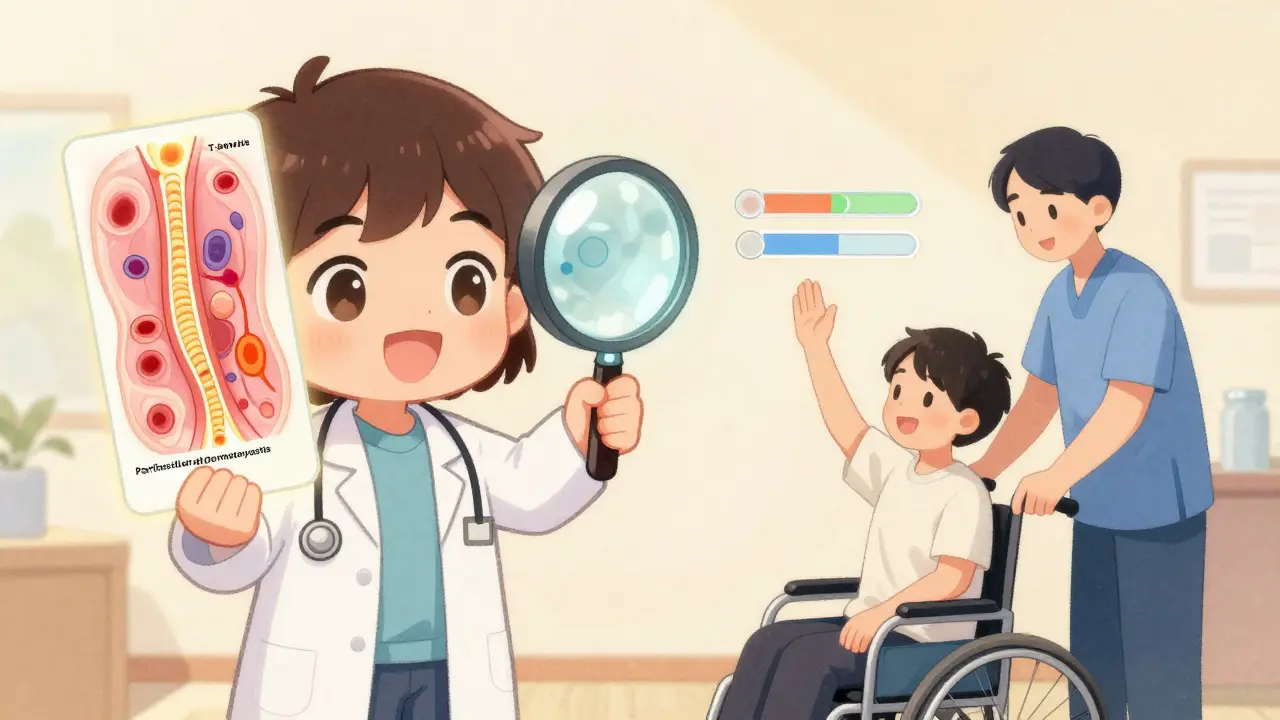
But the real gold standard? A muscle biopsy. This is where you see the difference. In polymyositis, immune cells (T cells) invade the muscle fibers, clustering around non-dead fibers. In dermatomyositis, the damage is more around blood vessels, with a pattern called perifascicular atrophy - where muscle fibers at the edges of muscle bundles shrink. These aren’t just details. They’re diagnostic.
And there’s another layer: autoantibodies. Since June 2023, new classification guidelines from EULAR now include myositis-specific antibodies (MSAs) as key diagnostic markers. Finding an anti-Mi-2 antibody, for example, strongly points to dermatomyositis. This is helping doctors cut diagnosis time by 30-40%.
Why the Skin Matters - and Why It’s Dangerous
The rash in dermatomyositis isn’t just cosmetic. It’s a signal of deeper trouble. About 20% of adults with dermatomyositis have an underlying cancer - often ovarian, lung, or colon cancer. That’s why every new DM diagnosis comes with a full cancer screen: chest X-ray, mammogram, pelvic ultrasound, colonoscopy, blood tests for tumor markers. It’s not paranoia. It’s standard care.
And it’s not just skin and muscle. Dermatomyositis often affects the lungs. Between 30% and 40% of patients develop interstitial lung disease - scarring in the lung tissue that makes breathing harder. This can be silent at first. That’s why lung function tests are part of every DM workup.
Polymyositis doesn’t usually cause lung or skin problems. But it can still be serious. Swallowing difficulties (dysphagia) happen in 15-30% of patients. The muscles that control swallowing get weak, leading to choking or silent aspiration. That’s why speech therapists often get involved early.
What’s the Treatment? It’s Not Just Steroids
There’s no cure. But there is control. And the earlier you start, the better your chances.
Corticosteroids - like prednisone - are the first-line treatment. You’ll typically start at 1 mg per kilogram of body weight daily. For most adults, that’s 40-60 mg a day. The goal? Bring inflammation down fast. Within 4-8 weeks, you should see muscle strength improve and CPK levels drop by at least half.
But steroids come with a heavy price. Long-term use causes osteoporosis in 30-50% of patients. It spikes blood sugar, leading to diabetes in 15-30%. It causes weight gain, insomnia, mood swings, and cataracts. That’s why doctors don’t keep you on high doses forever. They taper slowly - often over a year.
That’s where second-line drugs come in. If steroids aren’t enough, or side effects are too much, doctors add immunosuppressants:
- Methotrexate: Often the go-to second drug. It helps reduce steroid dose.
- Azathioprine: Slower to work, but good for long-term maintenance.
- Mycophenolate mofetil: Especially useful if you have lung involvement.
- IVIG (intravenous immunoglobulin): A blood product that helps calm the immune system. It’s especially effective in stubborn dermatomyositis cases.
And then there’s rituximab. Originally a cancer drug, it targets B cells - the immune cells that make antibodies. In refractory dermatomyositis, studies show a 60-70% response rate. It’s not FDA-approved for this use, but it’s used off-label with real success.
Newer options are showing up fast. JAK inhibitors like tofacitinib - used in rheumatoid arthritis - reduced skin rashes by 65% and improved muscle strength by 52% in a 2023 trial. Abatacept, a drug that blocks T-cell activation, is being tested for polymyositis. Early results show 40% of patients reach minimal disease activity in 6 months.
Physical Therapy Isn’t Optional - It’s Essential
Rest won’t fix this. In fact, too much rest makes muscles weaker. That’s why physical therapy starts within two weeks of diagnosis.
The goal isn’t to push through pain. It’s to rebuild slowly. Low-resistance exercises - cycling, swimming, light weight machines - help maintain strength without triggering more inflammation. A 2022 report from the Hospital for Special Surgery found that patients who stuck with a tailored rehab program improved their functional capacity by 35-45% in six months.
And it’s not just about movement. Swallowing therapy, breathing exercises, and balance training are all part of the plan. One patient on a myositis forum said, “I went from needing help to stand up to walking 2 miles a day - all because my PT didn’t give up on me.”
What Patients Actually Experience
Behind the numbers are real people. A 2022 survey of 1,247 patients found:
- 68% had severe fatigue that limited daily tasks.
- 52% struggled with stairs or rising from chairs.
- 37% had trouble swallowing.
- 41% had moderate to severe steroid side effects - especially weight gain (82%) and insomnia (67%).
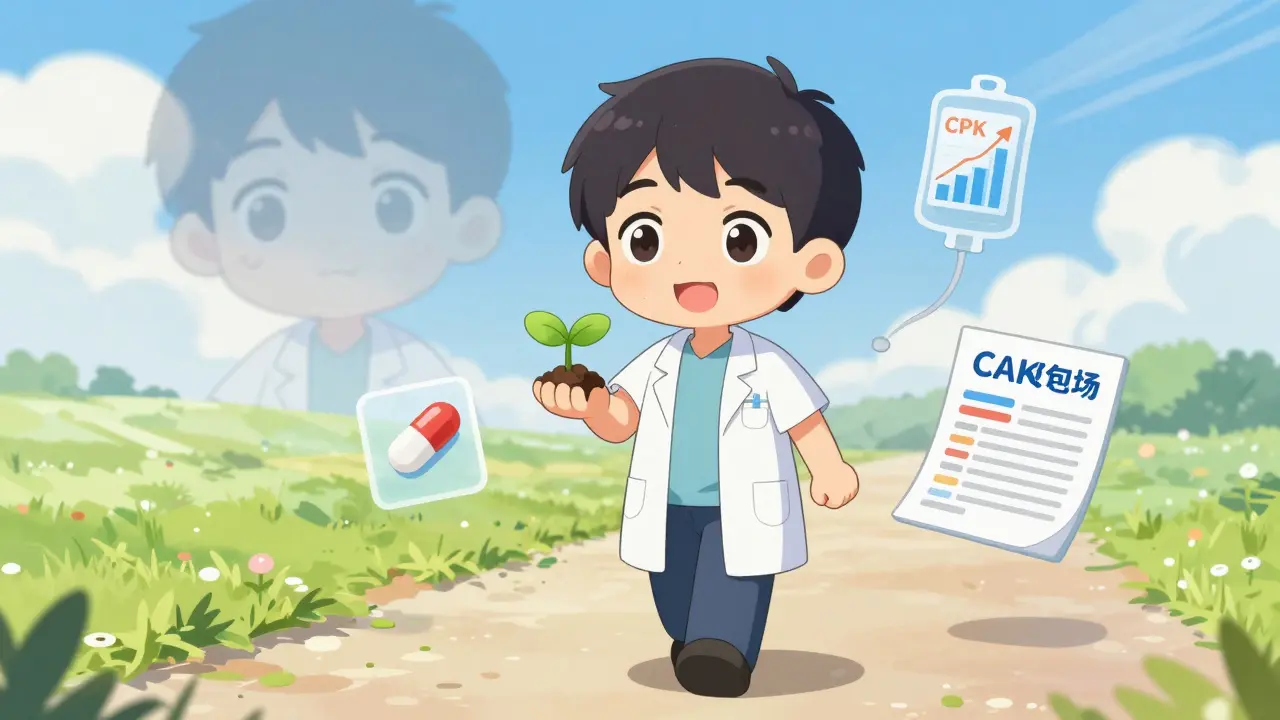
But there’s hope. Of those who stuck with treatment and rehab, 74% saw major improvements. One Reddit user shared: “After 9 months of prednisone alone, my CPK was 8,200. Add methotrexate? Four months later, it was 450. I cut my steroid dose from 40mg to 10mg. I’m back to playing with my kids.”
Diagnosis delays are brutal. One patient said it took 2.3 years and 4.7 doctors before someone got it right. That’s why specialists stress: if you have unexplained muscle weakness + rash, don’t wait. Go to a rheumatologist.
Prognosis: It’s Better Than Ever
Twenty years ago, 10-year survival for dermatomyositis was around 50%. Now? Over 80%. For polymyositis? Up from 55% to 85%. Why? Early diagnosis. Better drugs. Aggressive rehab. And more awareness.
The biggest factor? Timing. Dr. Lisa Christopher-Stine from Johns Hopkins says, “Early aggressive treatment within the first six months correlates with significantly better outcomes. Eighty percent of patients achieve remission or low disease activity if treated fast.”
That’s why the message is clear: don’t ignore weakness. Don’t brush off a rash. If your muscles are failing and you can’t explain why - get tested.
What’s Still Missing
Despite progress, gaps remain. Only three drugs are FDA-approved for dermatomyositis - none for polymyositis. Most treatments are used off-label. Insurance often delays coverage for second-line drugs - an average of 17.3 days per request. And there’s a shortage of rheumatologists. In the U.S., there’s roughly one specialist for every 10,000 people with autoimmune diseases.
Research is growing. The global myositis treatment market is projected to hit $2.1 billion by 2029. But funding for rare disease trials is still low - only 15% of rare autoimmune trials focus on myositis.
What patients need most isn’t just better drugs. It’s faster diagnosis. Better access. And doctors who listen.
Can dermatomyositis and polymyositis be cured?
There is no cure for either condition. But with early, aggressive treatment, most patients achieve remission or low disease activity. Many regain nearly full muscle function and live normal lives. The goal isn’t elimination - it’s control.
Is dermatomyositis contagious?
No. Dermatomyositis is an autoimmune disease, not an infection. You can’t catch it from someone else. It’s caused by a malfunction in your own immune system, not a virus or bacteria.
Can children get dermatomyositis?
Yes. Dermatomyositis has a bimodal age pattern - it affects adults (40-60 years) and children (5-15 years). Pediatric cases often have more severe skin involvement and calcinosis (calcium deposits under the skin). Treatment is similar but uses lower doses and closer monitoring.
Why does my doctor want to do a cancer screen if I have dermatomyositis?
About 20% of adults with dermatomyositis develop cancer within a few years of diagnosis - often ovarian, lung, or colon cancer. The inflammation may be triggered by an undetected tumor. Screening isn’t about fear - it’s about catching cancer early, when it’s most treatable.
How long does it take to see improvement after starting treatment?
Most patients start feeling better in 4-8 weeks. Blood tests (like CPK) should drop by at least 50% in that time. Full muscle strength recovery can take 6-12 months. Patience and consistency matter more than speed.
Can I exercise with polymyositis or dermatomyositis?
Yes - but carefully. Low-impact, low-resistance exercise helps prevent muscle loss and improves function. Avoid high-intensity workouts or heavy lifting during flare-ups. A physical therapist can design a safe plan. Studies show structured rehab improves mobility by 35-45% in six months.
What are the biggest side effects of prednisone for these conditions?
Weight gain (reported by 82% of those with side effects), insomnia, mood swings, high blood sugar, osteoporosis, and cataracts are the most common. Doctors usually prescribe calcium, vitamin D, and bone-density scans to prevent fractures. Tapering off slowly reduces long-term damage.
Is there a genetic link to dermatomyositis or polymyositis?
No direct inheritance pattern exists, but certain genes (like HLA-DR3) increase susceptibility. Having a family member with an autoimmune disease raises your risk slightly. It’s not passed down like a trait - more like a predisposition.
14 Comments
Davis teo
I had dermatomyositis for 3 years before anyone took me seriously. They thought I was just lazy. I couldn't lift my coffee mug. My kid had to feed me. Then one rheumatologist looked at my eyelids and said, 'That's not eczema.' Game changer. Now I'm on IVIG and I can hug my daughter without crying. 🥲
Jeremy Williams
The diagnostic delay is staggering. In my clinical experience across three teaching hospitals, the average time from symptom onset to confirmed diagnosis exceeds 18 months. This is not merely a failure of patient advocacy-it reflects systemic gaps in rheumatology training and primary care awareness. Urgent curriculum reform is required.
Maddi Barnes
So let me get this straight 😅 You're telling me that a rash on your eyelids is basically your body screaming 'HEY I'M FIGHTING A TUMOR'? And we're just now figuring out that this isn't 'just a skin thing'? I mean, I got a sunburn last summer and thought I was dying. Meanwhile, people are getting cancer alerts from their eyebrows. Wild. Also-can we talk about how 82% of people on prednisone gain weight? That's not a side effect. That's a full-body remodel. 🍕🍰
Benjamin Fox
All this talk about IVIG and rituximab and JAK inhibitors but no one talks about the real issue-why the hell is the FDA letting pharmaceutical companies get away with not approving drugs for polymyositis? This is a war on American patients. We need to defund the NIH and give the money to private labs. Make America strong again. 💪🇺🇸
Jana Eiffel
The epistemological rupture between clinical observation and diagnostic classification in inflammatory myopathies remains profoundly undertheorized. While biomarkers such as anti-Mi-2 and perifascicular atrophy offer heuristic utility, they risk reifying phenomenological experience into reductive pathological taxonomy. One must interrogate the ontological status of 'weakness' itself-is it a symptom, a sign, or a social construct mediated through biomedical hegemony?
aine power
Prednisone is a disaster. IVIG is a scam. Physical therapy is the only thing that works. Done.
Laura B
I’m so glad you mentioned the lung involvement. My mom had DM and we didn’t catch her ILD until she was in respiratory distress. Now she’s on mycophenolate and does breathing exercises daily. It’s not glamorous, but it’s life-saving. If you have DM, please, please get a pulmonary function test. Even if you feel fine.
Robin bremer
so like i went to my doc cuz i couldnt lift my arms and he said 'maybe u need more protein' 🤡 i ended up in the hospital 3 months later with a 9000 cpk and a cancer scare. i lost 20lbs in 6 weeks. if u think its just 'being tired' u r part of the problem. #myositisawareness
Hariom Sharma
This is so important! In India, we have almost no rheumatologists in small towns. My cousin had this for 4 years and was told she had 'nervous weakness'. Now she’s on treatment and walking again. Please spread this info. It’s not just a 'Western disease'. We need awareness everywhere. 🙏
Nina Catherine
I just started methotrexate last month and honestly? My hands don't feel like bricks anymore. I can hold my cat without crying. I know it's slow but I'm so grateful for every tiny win. Also-side note: if you're on steroids, try sleeping with your legs elevated. It helps with the swelling. 💕
Taylor Mead
I used to think physical therapy was just stretching. Then I did it for myositis and realized it’s like relearning how to be human. Every rep is a victory. I started with 2 lbs dumbbells and now I can carry groceries. Don’t underestimate the power of slow, steady movement. You’re not broken-you’re rebuilding.
Amrit N
i read this whole thing in one go. honestly tho i didnt know dm could be linked to cancer. that part freaked me out. but also kinda gave me hope? like if u catch it early u can beat it. my aunt had it and she’s 70 and still hikes. so yeah. keep going.
Courtney Hain
Let me tell you what they’re not telling you. The whole 'autoimmune' thing? It’s a cover-up. The real cause is 5G radiation + glyphosate in vaccines. The government doesn’t want you to know that DM is caused by bioweapons testing on civilians. That’s why they push 'steroids'-to keep you docile while they monitor your biomarkers. I’ve seen the leaked documents. Anti-Mi-2? That’s not an antibody-it’s a tracking chip. Wake up. 🛑📡
Robert Shiu
To anyone reading this who’s scared or alone: you’re not. I’ve been where you are. I thought I’d never play with my kids again. Now I’m hiking. It took 14 months. It was brutal. But every time I felt like giving up, I remembered: this isn’t the end of your story. It’s the chapter where you learn how strong you really are. You’ve got this. I believe in you. 💙