
Every year, millions of Americans take generic drugs because they’re cheaper, just as effective, and approved by the FDA. But what happens when a safety issue pops up? If you’re on a generic version of a medication, do you get the same warning as someone taking the brand-name version? The answer isn’t simple - and it’s something patients, doctors, and pharmacists need to understand.
How FDA Safety Alerts Work
The FDA tracks drug safety through a system called MedWatch is the FDA’s program for collecting and analyzing reports of adverse events from patients, doctors, and drug manufacturers. It’s been running since 1993 and covers everything from prescription pills to over-the-counter pain relievers. When a problem is found - like liver damage, heart rhythm issues, or dangerous interactions - the FDA issues a safety alert.
These alerts show up on the FDA’s website, in emails to healthcare providers, and sometimes in press releases. They might say a drug needs a stronger warning label, should be pulled from the market, or requires special monitoring. But here’s the catch: not all drug makers can update their labels the same way.
The Brand vs. Generic Labeling Gap
Brand-name drug companies can change their warning labels on their own using a process called Changes Being Effected (CBE-0) is a regulatory pathway that allows manufacturers to update safety information immediately without waiting for FDA approval. If new data comes out showing a risk, they can send out a revised label right away. The FDA reviews it later, but the warning goes out fast.
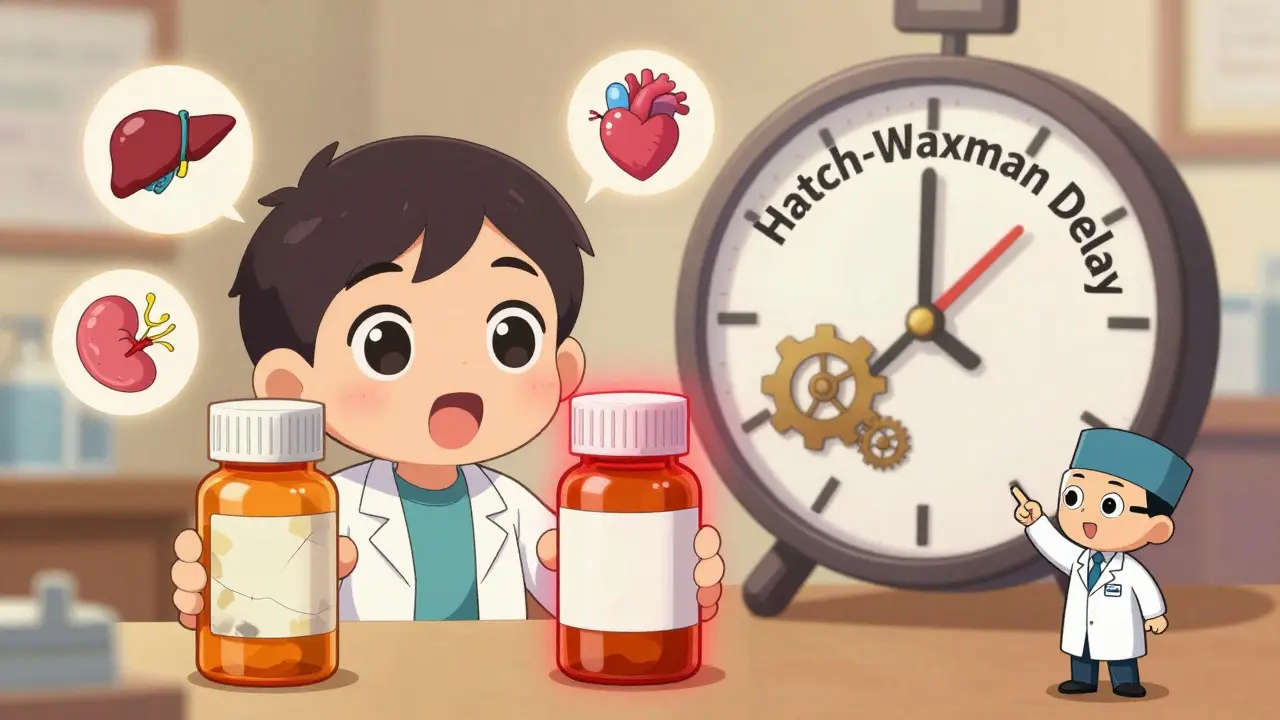
Generic drug makers? They can’t do that. Under rules set by the Hatch-Waxman Act of 1984 is a federal law that created the modern pathway for approving generic drugs while protecting brand-name drug patents, generic manufacturers must copy the exact same label as the brand-name drug - even if new safety data emerges. They can’t change it unless the brand-name company updates first, and then the FDA approves the change for generics too.
This creates a dangerous delay. Let’s say a brand-name drug gets a new warning about a rare but serious side effect. Patients taking the generic version won’t see that update for months - maybe over a year. And during that time, they’re still taking the same medicine, unaware of the risk.
Why This Matters for Patients
More than 90% of prescriptions filled in the U.S. are for generic drugs. Insurance companies almost always require you to take the generic unless your doctor says otherwise. That’s because generics cost 80-85% less than brand-name versions. But if you’re on a generic, you’re stuck with outdated safety info.
Imagine you’re taking a generic version of a blood pressure medication. Your doctor hears about a new study linking it to kidney damage. They update your records. But your pharmacy still gives you the same pill with the old label. The FDA hasn’t approved the label change for generics yet. You keep taking it. No one tells you the risk. That’s not hypothetical - it’s happened.
Consumer groups argue this isn’t fair. In 2022, 27 health organizations told the FDA: "Patients deserve up-to-date safety information no matter which version of the drug they take." They want the FDA to let generic manufacturers use the CBE-0 process too.
What the Industry Says
The generic drug industry pushes back. They say if they’re forced to update labels on their own, they’ll face a flood of lawsuits. If a patient gets hurt after a label change, who’s liable? The generic maker? The brand? The FDA? Legal experts say brand-name companies are already being sued for not updating warnings fast enough. Adding that pressure to generic makers could make them quit the market entirely.
David Gaugh of the Generic Pharmaceutical Association warns that the proposed change could "drive competitors out of the market." He argues it goes against the spirit of the Hatch-Waxman Act - which was meant to encourage competition, not create legal nightmares.
Where the FDA Stands Today
The FDA proposed letting generic manufacturers update labels in 2013. It’s been under review ever since. As of late 2024, no final rule has been passed. The agency is still weighing the risks: patient safety vs. market stability.
Meanwhile, the FDA’s Office of Generic Drugs is the division within the Center for Drug Evaluation and Research that oversees approval and postmarket monitoring of generic medications keeps watching for trouble. They monitor the FDA Adverse Event Reporting System (FAERS) is a database that collects voluntary reports of side effects and medication errors from healthcare providers and consumers every month. In 2019-2020, they tracked the first generic version of Rexulti - a psychiatric drug - and found no safety signals in its first year.
They also pay attention to excipients are inactive ingredients in medications like colors, flavors, preservatives, and fillers that can affect how a drug works or how safe it is. Even though generics must match the active ingredient exactly, they can differ in things like coatings, dyes, or preservatives. For some patients - especially those with allergies or sensitivities - these differences matter. The FDA’s Dr. Xin Fu has studied how excipients in generic ophthalmic and injectable drugs can alter safety profiles.
What You Can Do
You can’t change the rules. But you can protect yourself:
- Always ask your pharmacist: "Is this the same version I’ve taken before?" If it looks different, ask why.
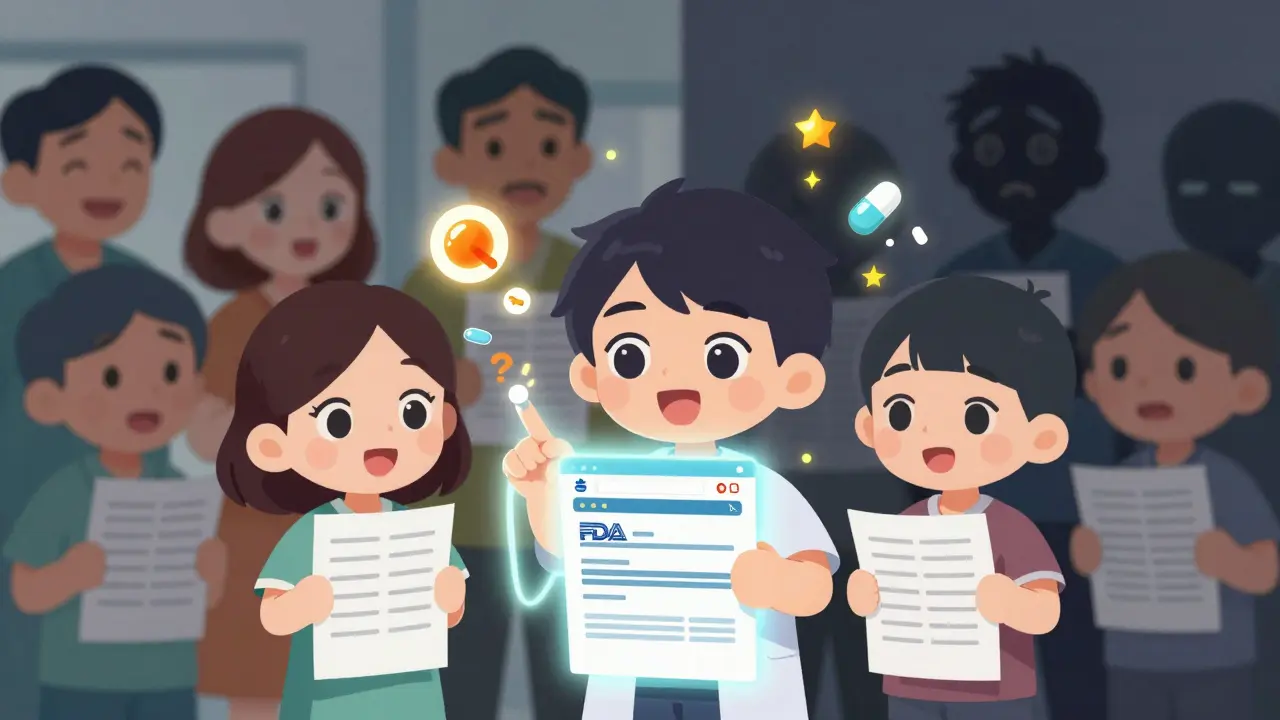
- Sign up for FDA MedWatch alerts for your medications. You’ll get emails when safety updates happen.
- Check the FDA’s Drug Safety and Availability page monthly. It’s updated regularly.
- If you have a reaction, report it. Even if it’s "minor." The more reports, the faster the FDA sees a pattern.
- Keep a list of all your meds - brand and generic - and share it with every doctor you see.
What’s Next?
The debate isn’t over. As more complex generics hit the market - like long-acting injectables, patches, and inhalers - the need for better safety tracking grows. These aren’t simple pills. Their delivery systems matter. A change in a preservative or coating can affect absorption, especially in older adults or people with kidney issues.
Some experts think the FDA will eventually let generics update labels. Others believe Congress will need to step in. Either way, the current system leaves patients vulnerable. And until it changes, you’re the only one who can watch out for yourself.
Can I trust that a generic drug is as safe as the brand-name version?
Yes, in terms of active ingredients and overall effectiveness. The FDA requires generics to match the brand-name drug in strength, dosage, how fast it works, and how well it’s absorbed. But safety warnings can be outdated because generic manufacturers can’t update labels independently. So while the drug works the same, you might not know about new risks.
Why don’t generic manufacturers update their own labels?
Because of the Hatch-Waxman Act of 1984. It lets generics copy the brand’s label exactly. Only brand-name makers can use the CBE-0 process to change labels quickly. Generics must wait for the brand to update, then get FDA approval - which can take over a year. This rule was meant to reduce costs and speed up generic approval, but it’s now seen as a safety gap.
How do I know if my generic drug has a new safety warning?
You won’t always know unless you check. The pharmacy won’t notify you. Your doctor might not either. Sign up for FDA MedWatch alerts. Visit the FDA’s Drug Safety page monthly. And if your pill looks different - size, color, shape - ask your pharmacist if the label changed.
Are there any drugs where generics are more risky?
Yes - especially complex ones. Ophthalmic (eye), otic (ear), and injectable generics must match the brand’s excipients exactly. But even small changes in preservatives or stabilizers can affect how the drug works in sensitive populations like children or elderly patients. Drugs with extended-release formulas or transdermal patches are harder to replicate perfectly and need extra monitoring.
What’s being done to fix this?
The FDA proposed letting generic manufacturers use the CBE-0 process in 2013. It’s still under review. Consumer groups support it. Generic drug makers oppose it, fearing lawsuits. Until a rule is finalized, patients remain at risk of receiving outdated safety information.
Final Thought
Generic drugs saved the U.S. healthcare system hundreds of billions of dollars. But safety shouldn’t be a cost-cutting trade-off. If a drug is approved, it’s because it works. But if a warning is missing, it’s because the system is broken. Until the rules change, stay informed - because no one else will do it for you.
9 Comments
LiV Beau
Okay but like… I just got my generic blood pressure med last week and it’s a different color 😅 I thought it was a mistake until I checked the label. Now I’m paranoid every time I refill. Signed up for MedWatch alerts-wish I’d done it years ago. Seriously, why does this even happen? We’re literally trusting our lives to pills with outdated warnings.
Adam Kleinberg
The FDA is in bed with Big Pharma and this is just another way to keep generics cheap while we all die slowly from unmarked side effects. They don’t want you to know that the excipients in generics are often toxic industrial byproducts. I read a study once-wait no actually I saw a YouTube video-anyway they use formaldehyde in some fillers. You’re not getting a ‘safe’ drug. You’re getting a bargain-bin chemical cocktail.
Denise Jordan
I mean… I take generics because I’m broke. I don’t care if the label’s outdated. If it works, it works. I’ve been on this one for 3 years and I’m not dead yet. Also why is everyone so dramatic? It’s a pill. Not a nuclear bomb.
Gene Forte
Every person deserves accurate information about what they’re putting into their body. It’s not about cost-it’s about dignity. If we allow a system where safety updates are delayed because of legal loopholes, we’re not just cutting corners-we’re cutting lives short. This isn’t just policy. It’s ethics. And ethics shouldn’t be negotiable when human health is on the line.
Chris Bird
Nigeria has no generic drug problem. We just don’t have enough drugs at all. You guys are arguing about labels while we’re arguing about whether the pharmacy has any pills left. This is a first-world problem. Stop complaining and get a job.
Bridgette Pulliam
I’ve been a pharmacist for 18 years. I’ve seen patients take generics for decades without issue. But I’ve also seen the ones who had reactions because the excipient changed-especially elderly folks with allergies. The system isn’t broken because generics are unsafe-it’s broken because we treat patients like numbers, not people. If the FDA allowed generic makers to update labels, it wouldn’t cost more. It would just be the right thing to do.
Mike Winter
It’s ironic, isn’t it? The Hatch-Waxman Act was designed to increase access, yet it’s now a barrier to safety. The law was written for simple oral tablets, not complex transdermal patches or injectables with precise excipient tolerances. We’ve outgrown the framework. The FDA’s delay feels less like caution and more like institutional inertia. Perhaps it’s time to ask: who benefits from the status quo? And is that really who we want to protect?
Randall Walker
So… let me get this straight. The brand-name company can update the label, but the generic makers can’t? So if I take the generic, I’m basically signing a waiver that says ‘I accept outdated risk info’? That’s not a loophole. That’s a trap. And the FDA is the warden. 🤡
Miranda Varn-Harper
I am deeply concerned by this systemic failure. The FDA’s current regulatory posture is not only inconsistent with the principle of informed consent, it is fundamentally incompatible with the ethical obligations of medical practice. This is not merely a policy issue-it is a moral failing of monumental proportions.