
You trust that the pill in your hand works. You expect it to be just as effective and safe as the brand-name version you might have taken years ago. For most people, this is true. Generic drugs save billions of dollars annually by offering lower prices without sacrificing performance. But behind that low price tag lies a complex global supply chain where things can-and do-go wrong. When they do, the consequences range from minor inefficacy to life-threatening health risks.
We are not talking about rare anomalies anymore. We are looking at systemic issues within manufacturing plants that produce the majority of our medications. From hidden impurities to outright data fraud, the problems are technical, regulatory, and human. Understanding these issues isn't just for pharmacists; it’s essential for anyone who relies on modern medicine. Here is what is really happening inside those factories and why it matters to you.
The Global Supply Chain Gap
To understand the quality issues, you first need to look at where your medicine comes from. The United States does not manufacture most of its own active pharmaceutical ingredients (APIs). According to the FDA’s 2022 Drug Shortage Report, roughly 80% of APIs and 40% of finished dosage forms come from foreign facilities. China and India dominate this space, supplying the raw materials and often the final pills themselves.
This globalization creates a massive oversight challenge. The Food and Drug Administration (FDA) has limited resources and faces significant logistical hurdles when inspecting facilities abroad. In 2016, the Government Accountability Office reported that the FDA had never inspected nearly 1,000 of the almost 3,000 foreign facilities exporting drug ingredients to the US. Even today, Dr. Ameet Nathwani, Chief Medical Officer at Sanofi, noted in a 2022 meeting that the FDA inspects only 13% of foreign facilities annually, despite overseeing 73% of finished drug products manufactured overseas.
The inspection process itself differs drastically between domestic and foreign sites. US facilities face unannounced inspections, keeping them on their toes. Foreign facilities, however, often receive advance notice due to diplomatic protocols and visa requirements. This allows plants time to clean up, hide discrepancies, or stage operations to look compliant. It is a fundamental flaw in the current monitoring system.
The Nitrosamine Scare: A Case Study in Failure
If you want a concrete example of how manufacturing flaws impact patients, look no further than the 2018 valsartan recall. Valsartan is a common medication used to treat high blood pressure. During routine testing, regulators discovered dangerous levels of N-nitrosodimethylamine (NDMA), a probable human carcinogen, in many generic versions of the drug.
The source? Manufacturing processes in plants primarily located in China and India. The chemical formed as an unintended byproduct during the synthesis of the active ingredient. The fallout was severe. The FDA issued recalls affecting approximately 2.1 million patients across 22 countries. Between June 2018 and October 2019, there were 28 voluntary recalls linked to this single issue. This wasn't just a bad batch; it was a failure to identify and control Critical Quality Attributes (CQAs) during the production design phase.
This incident highlighted a broader truth: nitrosamine impurities are not unique to valsartan. They have since been found in other drug classes, forcing manufacturers worldwide to re-evaluate their chemical processes. It proved that cost-cutting measures in raw material sourcing or process validation could lead to toxic outcomes.
Data Integrity and Fraud
Perhaps more alarming than accidental chemical reactions is intentional deception. Data integrity-the accuracy, completeness, and consistency of data-is the backbone of pharmaceutical quality assurance. If the data is fake, the quality controls are meaningless.
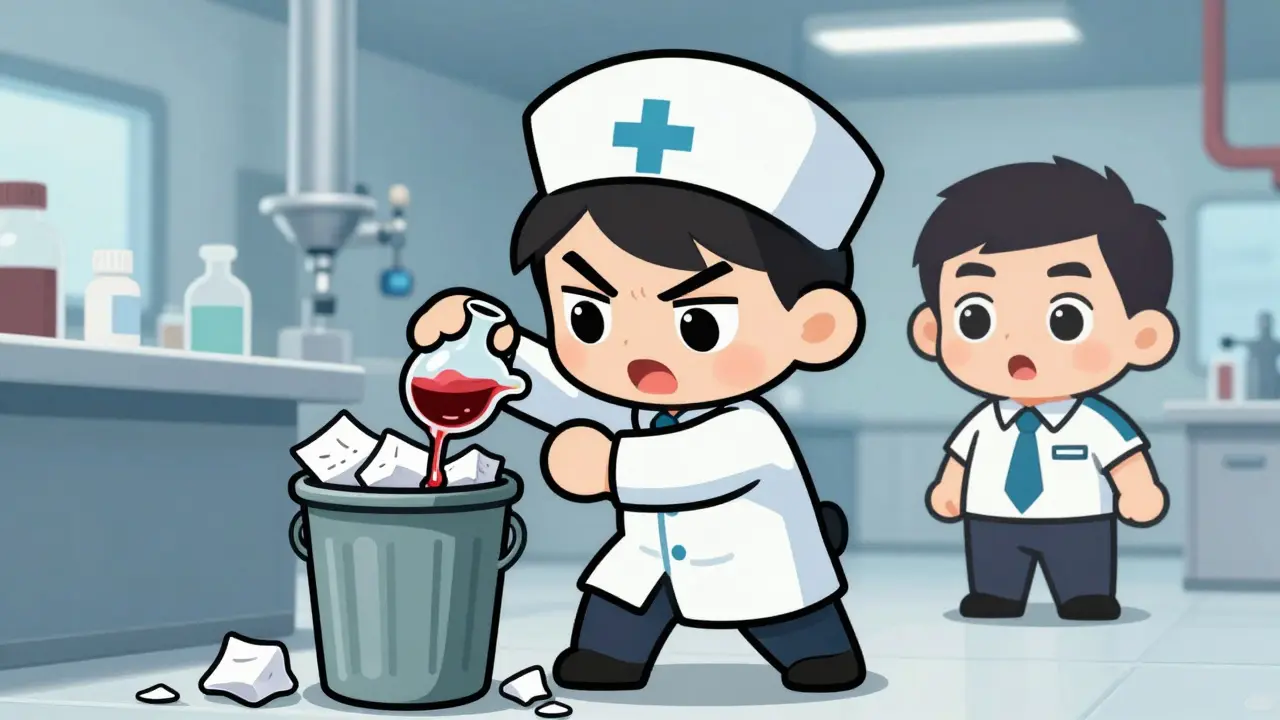
FDA inspection reports from 2022-2023 reveal shocking instances of fraud. At an Intas Pharmaceuticals facility in Gujarat, India, inspectors observed an employee pouring acid into a trash can full of documents related to testing and quality control. Why destroy records? To hide failures. If a test shows a batch doesn't meet specifications, destroying the evidence makes it look like the batch passed. This specific incident led to Warning Letter WL-2022-107.
Such practices are not isolated. Poor data integrity practices account for 24.8% of FDA Form 483 observations (official notices of deficiencies). Common issues include inadequate password protection, lack of audit trails, and improper electronic record management. When companies manipulate data, they bypass safety checks, releasing substandard or unsafe drugs into the market.
| Region | Average Form 483 Observations per Inspection | Inspection Notice Type | Primary Deficiency Areas |
|---|---|---|---|
| United States | Baseline (Reference) | Unannounced | Documentation, Staff Training |
| China | 28.6% higher than US | Announced (Advance Notice) | Data Integrity, Analytical Methods |
| India | 19.3% higher than US | Announced (Advance Notice) | Cleanliness, Process Validation |
Bioequivalence and Therapeutic Failure
A generic drug must be "bioequivalent" to its brand-name counterpart. This means it must deliver the same amount of active ingredient into the bloodstream over the same period. However, achieving this is harder than it sounds, especially for Narrow Therapeutic Index (NTI) drugs. These are medications where a small difference in dose can cause serious side effects or treatment failure, such as tacrolimus (used in transplant patients) or warfarin (a blood thinner).
Research published in JAMA Internal Medicine by Dr. Aaron Kesselheim showed that 15.2% of generic drugs on the FDA Watch List demonstrated therapeutic inequivalence. Specifically, generic tacrolimus capsules showed 28.4% higher variability in blood concentration levels compared to the brand-name version. For a transplant patient, this variability could mean organ rejection.
User feedback supports these findings. A 2022 survey by the American Society of Health-System Pharmacists (ASHP) found that 67.3% of hospital pharmacists reported at least one therapeutic failure with generic drugs in the previous year. Patient reviews on Drugs.com for generic valsartan manufactured by Zhejiang Huahai Pharmaceutical averaged 3.2 stars, with nearly 29% of reviewers citing "ineffective" results. When bioequivalence fails, the promise of generics breaks down.
Economic Pressures and Quality Trade-offs
Why do these problems persist? Money. The global generic drug market was valued at $422.7 billion in 2022, but it is a race to the bottom. Average generic drug prices declined by 18.3% annually between 2018 and 2022. To maintain profit margins, manufacturers cut costs. Where? Often in quality control.
The Generic Pharmaceutical Association reported that manufacturers reduced quality control budgets by 22.7% on average during this period. Implementing robust systems like Quality by Design (QbD)-which builds quality into the product from the start-costs millions. LGM Pharma estimated initial implementation costs at $2.7 million per facility, taking 18-24 months to fully integrate. With intense pricing pressure, many smaller players skip these investments.
Regulatory compliance costs are also rising. FDA user fees for generic applications jumped 62.9% from 2018 to 2023. While this funds better oversight, it also squeezes manufacturers. The result is a landscape where only the largest, well-funded companies can afford top-tier quality systems, while others risk cutting corners.
What Is Being Done?
Regulators are waking up to the severity of these issues. The FDA issued 147 warning letters for cGMP (Current Good Manufacturing Practices) violations in fiscal year 2022, a 28.5% increase from the previous year. Crucially, 63.2% of these targeted foreign facilities.
New strategies are emerging:
- Enhanced Inspections: The 2022 User Fee Reauthorization allocated $56.7 million specifically for foreign inspection capabilities, aiming to increase annual inspections from 1,200 to 1,800 by 2027.
- Risk-Based Scheduling: The FDA’s 2023-2027 Strategic Plan prioritizes facilities with higher risk profiles, increasing inspections of high-risk products by 35%.
- EMA Unannounced Inspections: Since January 2023, the European Medicines Agency has conducted unannounced inspections at all foreign facilities supplying the EU, leading to a 41.2% increase in critical findings compared to announced visits.
Industry experts predict that manufacturers investing in advanced quality systems will capture 65% of the market share by 2027. Those who fail to address quality issues face a 40% higher risk of market exit. The era of unchecked generic manufacturing is ending, replaced by a stricter, data-driven approach to safety.
Are generic drugs less effective than brand-name drugs?
For most simple generics, yes, they are equally effective. However, studies show that for certain complex drugs, particularly Narrow Therapeutic Index (NTI) medications like tacrolimus, some generic versions may have higher variability in blood concentration, potentially leading to therapeutic failure. Overall, about 15% of generics on the FDA Watch List have shown signs of inequivalence.
Why are foreign manufacturing plants harder to regulate?
Foreign plants are harder to regulate due to logistical barriers, including visa requirements and diplomatic protocols that require advance notice for inspections. This allows facilities time to prepare or hide deficiencies. Additionally, the sheer volume of imports means the FDA cannot inspect every facility regularly, relying instead on self-reported data which may be inaccurate.
What caused the 2018 valsartan recall?
The recall was caused by the presence of NDMA, a probable carcinogen, in generic valsartan medications. This impurity formed as an unintended byproduct during the manufacturing process in several plants, primarily in China and India. The issue affected millions of patients and led to widespread recalls across 22 countries.
How does data integrity affect drug safety?
Data integrity ensures that test results accurately reflect the quality of the drug. When companies falsify data or destroy records of failed tests, they release unsafe or ineffective batches into the market. Poor data integrity is cited in nearly 25% of FDA inspection deficiencies, making it a major contributor to quality failures.
What is Quality by Design (QbD)?
Quality by Design (QbD) is a systematic approach to development that begins with predefined objectives and emphasizes product and process understanding. Instead of testing quality at the end, QbD builds it into the manufacturing process from the start. While it requires significant investment ($2.7 million per facility), it significantly reduces the risk of quality failures.
11 Comments
Erin Livengood
It is a fascinating, albeit terrifying, tapestry of human ingenuity and negligence we are weaving here. The idea that the very substances meant to heal us are subject to such capricious global winds is deeply unsettling. We place our trust in these small pills, believing them to be anchors in the storm of illness, yet they are adrift in a sea of regulatory loopholes and economic desperation. It makes one wonder if the pursuit of profit has truly eclipsed the Hippocratic oath on an industrial scale.
Daniella Renzon
I really appreciate this deep dive into the supply chain issues. It’s scary but good to know what’s going on behind the scenes so we can stay informed.
Aditya Singh
As someone working in the pharma sector in India, I can confirm that the pressure to cut costs while maintaining GMP standards is immense. The QbD implementation costs mentioned are real barriers for smaller MSMEs who lack the capital reserves of multinational giants. However, it is not all doom and gloom; many Indian firms are now leading in API quality due to strict internal audits driven by EU-FDA joint inspections. The narrative often overlooks the rapid technological upgrades happening in hubs like Hyderabad and Ahmedabad, where automation is reducing human error significantly. We must acknowledge the systemic challenges without demonizing entire regions, as quality varies wildly between individual facilities rather than national borders.
shreya sinha
It is morally reprehensible that individuals would prioritize financial gain over the sanctity of human life, particularly when the vulnerable populations are those who rely on affordable generic medications for their survival. The destruction of data records, as cited in the Intas Pharmaceuticals case, represents a profound ethical failure that transcends mere regulatory non-compliance and enters the realm of criminal negligence. One must question the moral compass of executives who authorize such practices, knowing full well that the consequences could include therapeutic failure or even death for patients who trust in the efficacy of their prescribed treatments. This systemic corruption within the manufacturing process demands not only stricter legal penalties but also a fundamental restructuring of corporate accountability mechanisms to ensure that no entity can evade responsibility for compromising public health through deceitful operational protocols.
Lee Coates
Typical. :P We outsource everything to countries with zero oversight and then act surprised when shit hits the fan. Bring manufacturing back home, pay American workers, and stop relying on foreign entities that don't give a damn about our safety. It's basic patriotism, folks. ;)
Brett Webster
While the sentiment about domestic production is understandable, the economic reality is complex. Re-shoring API production would likely increase drug prices significantly, potentially making them unaffordable for many. The key issue isn't just location, but enforcement. The FDA needs more resources for unannounced inspections globally, regardless of where the plant is located. Data integrity is the core problem, and that requires rigorous auditing protocols that are currently underfunded.
Miranda River
Ugh, another article trying to scare you with big words. Like, yeah, sure, maybe some pills are bad, but do you really think your local pharmacy is handing out poison? Probably not. People just need to relax and stop reading too much into every little study. Most generics work fine, honestly. Stop crying about it.
Sherry Wheeler
The stakes are incredibly high! Imagine being a transplant patient, fighting for your life, only to have your medication vary in potency because a factory cut corners to save a few dollars. It is absolutely heart-wrenching to think about the anxiety these patients must feel. We cannot let greed dictate our health outcomes. We need transparency, we need action, and we need to hold these corporations accountable for every single pill that leaves their facility. Our lives depend on it!
Cecilia McGuinness
i mean its kinda wild how much money is involved. like why cant we just make better rules instead of letting companies cheat? feels like a lose lose situation for everyone except the rich execs lol
Brandon Brodsky
Oh, please. Spare me the dramatics. You think switching to a brand name will magically solve your existential dread? The system is broken, but acting like you're a victim of a grand conspiracy is just lazy thinking. Read the actual studies before you start panicking about NDMA levels. It's statistically insignificant for most people, but sure, keep screaming about 'toxic outcomes' for clicks.
Talilla Bailey
It is imperative that we address the structural deficiencies in regulatory oversight without resorting to hyperbolic rhetoric. The data presented clearly indicates a correlation between advance notice of inspections and higher rates of non-compliance, particularly in foreign facilities. Therefore, the proposed shift towards unannounced inspections and risk-based scheduling is not merely an administrative adjustment but a critical necessity for public safety. Stakeholders must recognize that cost-cutting measures in quality control are unsustainable and pose significant liabilities. We must advocate for policies that enforce stringent data integrity standards across all jurisdictions, ensuring that the efficacy and safety of pharmaceutical products remain uncompromised by economic pressures.