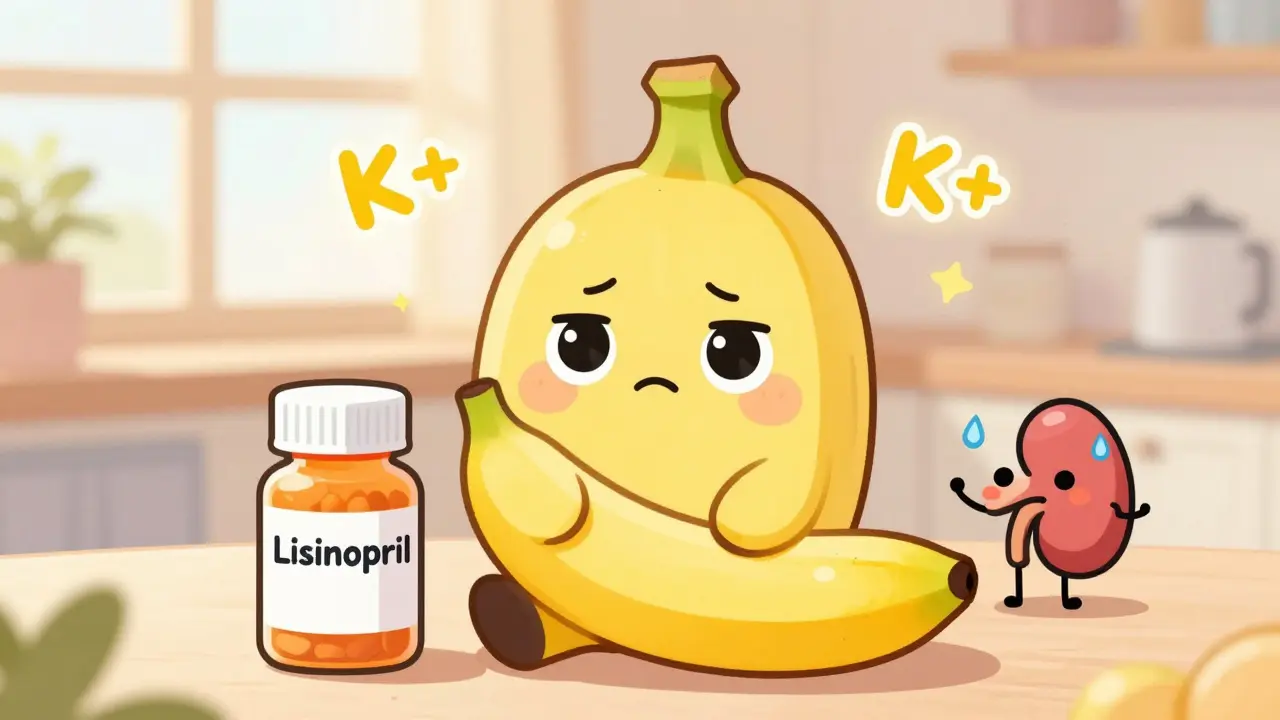
When you're managing high blood pressure, what you eat can be just as important as the pills you take. But here's the catch: some of the healthiest foods on the planet - like bananas, spinach, and sweet potatoes - can quietly clash with your blood pressure meds. This isn't about avoiding good food. It's about understanding how potassium, a mineral your body needs to function, can turn from a helper into a hazard when mixed with certain medications.
Why Potassium Matters for Blood Pressure
Potassium isn't just another nutrient. It's a natural counterbalance to sodium. When you eat more potassium, your kidneys flush out extra salt, which helps lower blood pressure. Studies show that getting enough potassium can drop systolic pressure by over 5 mm Hg - that’s about the same as some first-line medications. The American Heart Association recommends 3,500 to 5,000 mg per day. Most people get less than half that. The average American eats only 2,400 mg daily, which contributes to higher rates of hypertension.But here’s what many don’t realize: potassium doesn’t work the same way for everyone. If you're on certain blood pressure drugs, your body holds onto potassium instead of flushing it out. That’s great if you’re low. Dangerous if you’re not.
Which Blood Pressure Medications Interact with Potassium?
Not all blood pressure meds play nice with potassium. The big three are:- ACE inhibitors - like lisinopril, enalapril
- ARBs - like losartan, valsartan
- Potassium-sparing diuretics - like spironolactone, eplerenone
These drugs are commonly prescribed because they protect the heart and kidneys. But they also reduce how much potassium your body gets rid of. Combine them with a high-potassium diet, and your blood levels can creep up - slowly, silently, and dangerously.
Hyperkalemia - high potassium in the blood - doesn’t always cause symptoms. When it does, you might feel weak, have tingling in your hands or feet, or notice your heart skipping beats. Severe cases (above 6.0 mmol/L) can trigger life-threatening heart rhythms. In 2021, a European Heart Journal review found that 11.3% of elderly patients on ACE inhibitors developed hyperkalemia when eating potassium-rich foods.
High-Potassium Foods: What’s Safe and What’s Risky
You don’t need to give up healthy foods. But you do need to know which ones pack the most potassium - and how much you’re consuming.Here’s what’s high:
- 1 medium banana = 422 mg
- 1 medium sweet potato = 542 mg
- 1 cup cooked spinach = 839 mg
- 1 avocado = 975 mg
- 1 cup coconut water = 600 mg
- 3 oz salmon = 534 mg
- 1 cup white beans = 1,000 mg
And here’s what’s lower, if you need to cut back:
- 1 cup blueberries = 114 mg
- 1 apple = 195 mg
- 1 cup cabbage = 170 mg
- 1 egg = 63 mg
- 1 cup rice = 50 mg
People on spironolactone often think they need to avoid bananas completely. But it’s not about elimination - it’s about balance. One Reddit user, u/HypertensionWarrior, shared that switching from three bananas a day to blueberries dropped their potassium from 5.4 to 4.8 mmol/L - safely in range.
Supplements and Salt Substitutes: Hidden Dangers
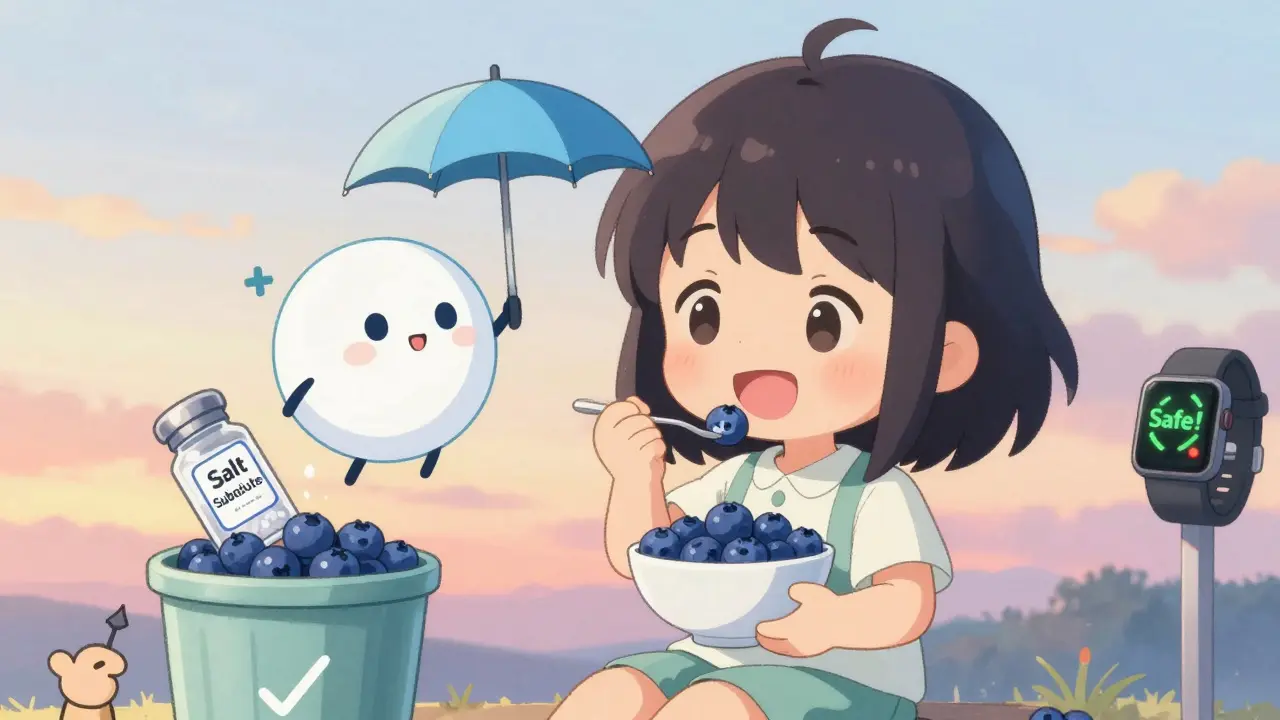
Don’t reach for potassium pills unless your doctor tells you to. Supplements can spike levels fast. A 2017 study in Kidney International found that patients with kidney disease who took 40 mmol of potassium chloride daily had an 11% chance of developing dangerous hyperkalemia.Even salt substitutes are risky. Many brands replace sodium with potassium chloride. One quarter-teaspoon can contain 250-700 mg of potassium. If you’re already on an ACE inhibitor, that’s like adding a mini-dose of potassium every time you season your food. The 2020 Hypertension journal meta-analysis showed these substitutes raise serum potassium by 0.3-0.5 mmol/L on average - enough to push someone over the edge.
Dr. Matthew Weir, writing in JAMA Internal Medicine, warns that potassium supplements increase mortality risk by 1.8 times in people with stage 3-4 kidney disease. If you have kidney problems, avoid them entirely unless closely monitored.
Who’s at Highest Risk?
Not everyone needs to worry. But some groups are more vulnerable:- People over 65 - kidneys slow down with age
- Those with chronic kidney disease (eGFR under 60)
- Diabetics - often have kidney changes early
- Black Americans - studies show 22% have low potassium intake vs. 14% nationally, but also higher rates of kidney disease
One 2019 study found that 28% of people with reduced kidney function developed hyperkalemia when eating high-potassium diets. That’s why monitoring is non-negotiable.
How to Stay Safe: Practical Steps
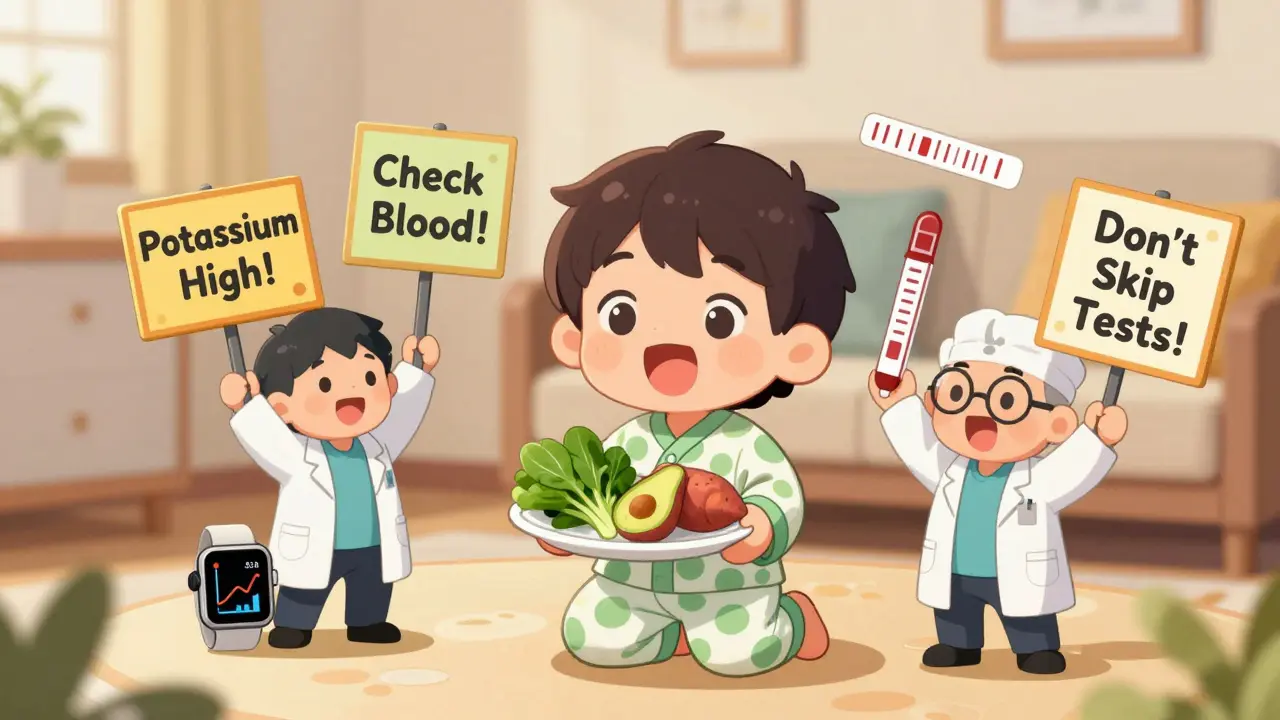
You don’t have to guess. Here’s what works:- Get a baseline blood test - Ask your doctor to check your serum potassium before making dietary changes.
- Test again after 2 and 4 weeks - This is the standard window to see how your body responds.
- Track your intake - Apps like Cronometer or the National Kidney Foundation’s “Potassium Counts” help you log meals and potassium levels. Over 285,000 people have downloaded the app.
- Know your numbers - Normal is 3.5-5.0 mmol/L. Anything above 5.0 needs attention. Above 6.0 is an emergency.
- Time your meds - Some doctors recommend taking ACE inhibitors at least 2 hours before or after a high-potassium meal to avoid spikes in absorption.
Patients who followed these steps saw a 63% success rate in lowering systolic blood pressure by 5+ mm Hg within eight weeks, according to a 2022 PatientsLikeMe analysis.
What Your Doctor Should Be Doing
You shouldn’t have to figure this out alone. The American Society of Hypertension says doctors should spend 30-45 minutes educating patients on potassium interactions. Yet, only 38% of U.S. patients get specific guidance on medication-food interactions, even though 72% get general dietary advice.Doctors are now required to include potassium warnings on ACE inhibitor and ARB packaging thanks to FDA guidelines from 2021. The European Medicines Agency goes further - it mandates regular potassium checks for anyone on these drugs.
And new tools are coming. In 2024, Omron’s HeartGuide smartwatch will start tracking potassium trends in real time - a $2.1 billion market is emerging around continuous monitoring.
The Bigger Picture
This isn’t just about avoiding danger. It’s about maximizing benefit. Potassium lowers blood pressure better in people eating high-sodium diets - and most Americans do. Dr. Paul Whelton, lead author of the 2017 AHA guidelines, says potassium can cut systolic pressure by up to 7.2 mm Hg in those cases.But here’s the paradox: the same foods that help lower blood pressure can also raise risk if you’re on the wrong meds. That’s why blanket advice like “eat more bananas” fails. Personalization is key.
The FDA approved patiromer (Veltassa) in 2023 - a potassium binder that lets patients keep eating healthy foods while staying safe on RAAS inhibitors. Clinical trials showed 89% of patients maintained normal potassium levels with it, compared to 67% without.
Future research, like the POTASSIU-2 trial launching in 2024, will test personalized potassium targets based on kidney function and medication type. This isn’t science fiction - it’s the next step in precision medicine.
Final Takeaway
High-potassium foods aren’t the enemy. But they’re not harmless, either. If you’re on ACE inhibitors, ARBs, or potassium-sparing diuretics:- Don’t panic - you can still eat avocado, spinach, and sweet potatoes.
- Do get your blood potassium checked before and after changing your diet.
- Don’t take potassium supplements unless your doctor says so.
- Watch out for salt substitutes - they’re often loaded with potassium.
- Use a food tracker to stay aware of your daily intake.
The goal isn’t to eat less healthy food. It’s to eat smart. With the right knowledge and monitoring, you can get the blood pressure benefits of potassium without risking your heart.
Can I still eat bananas if I’m on lisinopril?
Yes - but not in large amounts. One banana a day is usually fine for people with normal kidney function. Three or more daily, especially with lisinopril, can raise potassium levels into the danger zone. If you’re unsure, get a blood test. One patient reduced their potassium from 5.4 to 4.8 mmol/L by switching from three bananas to blueberries.
Is potassium from food safer than supplements?
Absolutely. Food-based potassium is absorbed slowly and comes with fiber, water, and other nutrients that help your body manage it. Supplements deliver a concentrated dose that can overwhelm your system - especially if you have kidney issues. Studies show hyperkalemia is far more common with potassium chloride pills than with whole foods.
What are the signs of high potassium?
Early signs include muscle weakness, tingling in hands or feet, nausea, and irregular heartbeat. Many people feel nothing until levels are dangerously high. That’s why regular blood tests are critical - symptoms often appear too late. If you suddenly feel weak or your heart is fluttering, get checked immediately.
Do I need to stop eating spinach if I’m on blood pressure meds?
No. Spinach is packed with nutrients and low in sodium. One cup cooked has 839 mg of potassium - that’s a lot, but not necessarily dangerous. The key is consistency. If you eat spinach every day, your doctor should monitor your potassium. If you only have it once a week, it’s unlikely to cause issues. Balance matters more than elimination.
How often should I get my potassium checked?
If you’re starting a new potassium-rich diet or a new blood pressure medication, get tested at baseline, then at 2 weeks and 4 weeks. After that, every 3-6 months is standard for those on ACE inhibitors or ARBs. If you have kidney disease, your doctor may want checks every 1-3 months. Always follow your provider’s advice - don’t assume it’s the same for everyone.
Can I use salt substitutes if I’m on blood pressure meds?
Be very careful. Most salt substitutes replace sodium with potassium chloride. One quarter-teaspoon can add 250-700 mg of potassium. If you’re on an ACE inhibitor, that’s like taking a mini-dose daily. In one study, these substitutes raised potassium by 0.3-0.5 mmol/L - enough to push someone into danger. Ask your doctor before using them.
What’s the best way to track my potassium intake?
Use a food tracking app like Cronometer or the National Kidney Foundation’s "Potassium Counts" app. These tools list potassium content in real time and let you log meals. Over 285,000 people use the KF app. You can also ask your pharmacist for a printed potassium list - many clinics provide them. Tracking helps you spot patterns before your blood levels rise.
12 Comments
lisa Bajram
Okay but let’s be real - if you’re on lisinopril and eating a banana every morning like it’s a sacrament, yeah you’re flirting with danger. I’ve seen patients crash into hyperkalemia from ‘healthy eating’ and then wonder why they got rushed to the ER. One avocado a day? Maybe. Three bananas? That’s not nutrition, that’s a potassium bomb.
And don’t even get me started on those salt substitutes. People think they’re being smart swapping sodium for potassium chloride, but they’re just playing Russian roulette with their heart. I’ve had clients who thought ‘natural’ meant ‘safe’ - spoiler: it doesn’t.
Track your intake. Use Cronometer. Stop winging it. Your kidneys aren’t magic.
Dwayne Dickson
While the article presents a clinically sound framework for managing dietary potassium in the context of RAAS inhibitors, it conspicuously omits any discussion of renal tubular acidosis as a confounding variable in potassium homeostasis. Furthermore, the assertion that ‘one banana daily is usually fine’ lacks stratification by eGFR thresholds - a critical oversight in a population where 30% of hypertensives have stage 2 CKD.
The FDA’s 2021 labeling update, while commendable, remains reactive rather than proactive. A prospective, algorithm-driven potassium monitoring protocol - integrated with EHRs and flagged for ACEi/ARB users - would be a far more scalable intervention than patient self-tracking apps.
Also, the reference to Omron’s HeartGuide is misleading. The device does not measure serum potassium; it infers electrolyte trends via pulse wave velocity. This is not direct quantification. Misinterpretation could lead to dangerous clinical decisions.
neeraj maor
They don’t want you to know this - but the pharmaceutical industry and the FDA are pushing potassium warnings to sell more binders like Veltassa. That drug costs $1,200 a month. Meanwhile, bananas cost $0.30. Coincidence? I think not.
And why is no one talking about how Big Food is replacing salt with potassium chloride in everything - canned soups, protein bars, even bottled water? This is a manufactured crisis to funnel you into expensive meds and supplements.
My cousin was told to stop eating spinach. He’s fine. His potassium was 4.9. They’re just scared of lawsuits. Trust your body. Don’t trust the system.
anthony martinez
Wow. So eating a sweet potato means I’m one bite away from cardiac arrest? Thanks for the panic. I’ve been eating avocado toast every day for five years on lisinopril. My last blood test was 4.6. I didn’t need an app. I didn’t need to count milligrams. I just ate food and went to my doctor once a year.
Maybe the real problem isn’t potassium. It’s over-medicalizing normal behavior.
Ashlee Montgomery
What if the real question isn’t ‘how much potassium is safe’ but ‘why are we treating high blood pressure with drugs that make diet a minefield?’
Why isn’t the focus on reducing sodium and stress and sleep deprivation - the actual root causes - instead of telling people to stop eating vegetables?
It feels like we’ve outsourced health to pills and apps. But the body isn’t a chemistry set.
Mario Bros
My grandma’s on spironolactone and she eats a whole spinach salad every day. She’s 78, walks 3 miles, and her potassium’s been stable for 3 years. She doesn’t track anything. She just eats real food and listens to her body.
Maybe the answer isn’t more apps - maybe it’s more trust in people.
Ritwik Bose
Thank you for this comprehensive overview. 🙏 I am from India and many here consume high-potassium diets through lentils, coconut water, and bananas - yet rarely have their potassium checked. This is a silent epidemic.
Doctors here rarely discuss medication-food interactions. Patients assume ‘natural’ = ‘safe’. We need community health workshops. Maybe NGOs can help? 🌱
Kunal Majumder
Bro I was on lisinopril and ate 2 bananas a day. My potassium hit 5.6. No symptoms. Just felt kinda tired. Got tested, switched to apples and blueberries. 4.2 in 3 weeks. Easy fix. No drama.
Don’t panic. Just check. You got this.
Jake Kelly
I appreciate how this breaks down the science without fearmongering. Too many health articles make you feel like you have to give up everything you love.
Balance > restriction. Knowledge > fear. Thanks for the clarity.
Paul Bear
Actually, the claim that ‘potassium from food is safer than supplements’ is only partially accurate. The pharmacokinetics of potassium absorption from whole foods are highly variable depending on gastric emptying, fiber content, and food matrix effects - which means food-based potassium can still cause dangerous spikes in susceptible individuals, especially with renal impairment.
Furthermore, the 2017 Kidney International study cited used potassium chloride supplements - not potassium citrate, which has a different safety profile. This is a critical distinction that undermines the argument.
Also, ‘potassium counts’ apps are unreliable. Their databases are crowd-sourced and often misreport values by ±20%. Relying on them is pseudoscience.
Jaqueline santos bau
So let me get this straight - I can’t eat my beloved sweet potato fries because some doctor says so? And now I have to download an app and log every bite like I’m on a spaceship?!
Meanwhile, my cousin’s on the same meds and eats 5 bananas a day and he’s fine. He’s 22. He runs marathons. His kidneys are like titanium.
Why are we turning healthy food into a crime? This feels like medical gaslighting.
Jake Nunez
My doctor told me to stop eating spinach. I asked why. He said, ‘Because your potassium was 5.2 and you’re on losartan.’ I said, ‘But I’ve been eating spinach for 10 years.’ He said, ‘Yeah, and you’re only now having kidney changes.’
Turns out I had early CKD. I didn’t know. That one test saved my life.