Imagine needing insulin, antibiotics, or HIV medication - but paying three months’ wages for a single month’s supply. That’s the reality for millions in low-income countries. The solution isn’t more expensive drugs. It’s generics. These are the same medicines as the branded ones, made after patents expire, sold at a fraction of the cost. And yet, despite being able to cut drug prices by 80% or more, they still don’t reach the people who need them most.
Why Generics Matter More Than You Think
Generics aren’t cheap knockoffs. They contain the exact same active ingredients, work the same way, and are held to the same safety standards as brand-name drugs. The difference? No patent. No marketing. No profit margin for shareholders. That’s why a course of generic antiretroviral therapy for HIV can cost $50 a year instead of $10,000. In the early 2000s, when generics flooded into Africa, HIV death rates dropped by more than half in just five years. That’s not magic. That’s chemistry and policy working together.The World Health Organization lists 43 essential medicines that every health system should have. Most of them now come in generic form. Yet, in many low-income countries, less than half of public clinics stock even half of these. Why? It’s not because the drugs don’t exist. It’s because the system isn’t built to deliver them.
The Supply Chain That Doesn’t Work
You can have the cheapest drug in the world, but if it never reaches the clinic, it doesn’t help anyone. In parts of sub-Saharan Africa and South Asia, medicines sit in ports for months because of paperwork delays, corruption, or poor roads. Cold chains break. Stock records are handwritten. Pharmacies run out of stock - then get flooded with expired doses weeks later.A study in 72 countries found that public health clinics in the Western Pacific region saw medicine availability drop by over 5% between 2009 and 2022. Meanwhile, clinics in Europe improved by nearly 30%. That gap isn’t about science. It’s about logistics, funding, and political will.
Even when drugs arrive, they’re often not the right kind. Unbranded generics - the cheapest, most accessible version - make up only 5% of the pharmaceutical market in low-income countries. In the U.S., they make up 85%. Why? Because patients and even doctors don’t trust them. They’ve been sold the idea that expensive = better. And in places with weak regulation, counterfeit drugs are common. So people pay more for brands they think are safer - even if they’re not.
The Companies That Could Help - But Don’t
Five big generic manufacturers - Cipla, Hikma, Sun Pharma, Teva, and Viatris - produce 90% of the off-patent drugs needed in low-income countries. But according to the Access to Medicine Foundation, they only have clear plans to expand access to 41 of the 102 most critical medicines. And even then, few of those plans consider whether the poorest patients can actually afford them.Take a drug for tuberculosis. It costs $20 a year as a generic. Sounds cheap, right? But if you’re earning $1.50 a day? That’s over two weeks’ wages. No one can pay that out of pocket. And yet, most companies don’t offer tiered pricing or free distribution for the poorest. They assume if the price is low enough, people will buy it. But low isn’t always low enough.
Meanwhile, big pharma companies like Novartis and Pfizer run programs to help low-income countries. But they rarely say how many people actually get the drugs. Transparency is almost nonexistent. You can’t fix a problem if you don’t know how big it is.
Regulation Is the Hidden Barrier
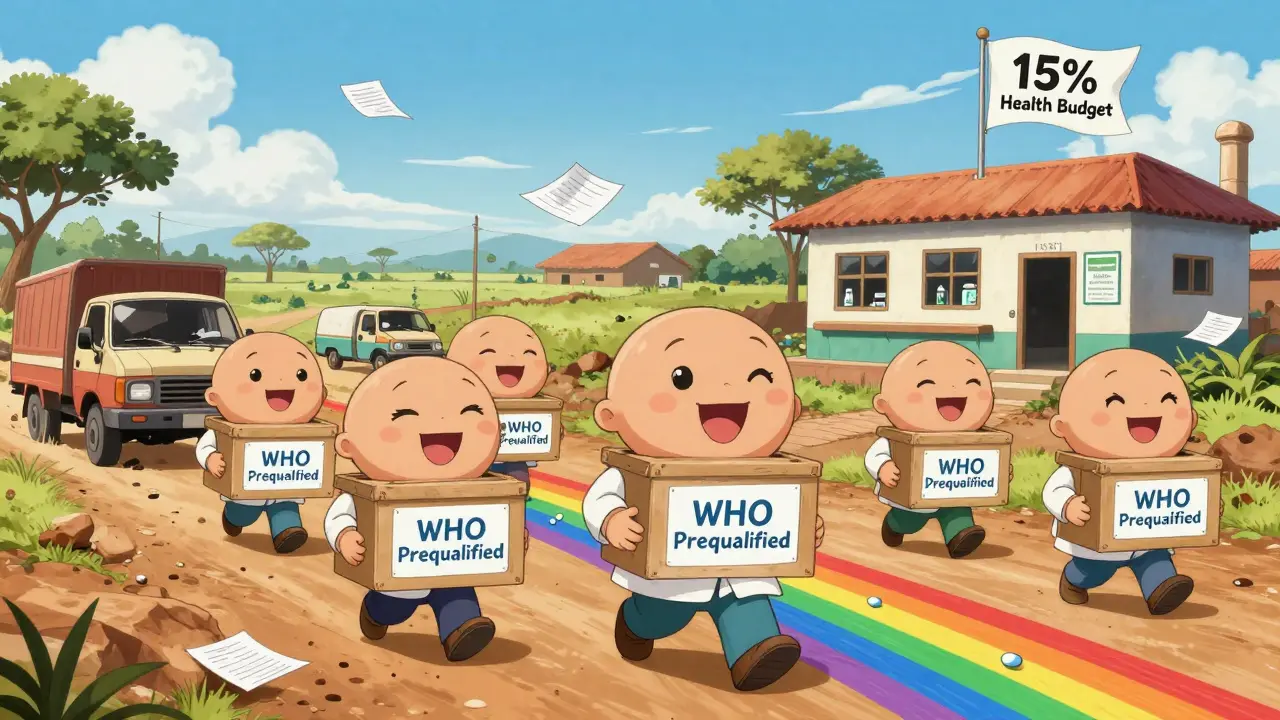
Many low-income countries have strict rules for drug approval - rules copied from the U.S. or Europe. But those rules were designed for wealthy systems with labs, inspectors, and funding. In a country where the health ministry has three staff members and no electricity for three days a week? The paperwork takes years. A drug that could save lives sits on a shelf while bureaucrats wait for a signed form.Some countries are fixing this. Rwanda simplified its approval process and cut approval time from 18 months to 30 days. Uganda now accepts WHO prequalification as proof of safety - no extra testing needed. That’s how you move fast. But most countries still require redundant, costly testing. It’s not about safety. It’s about bureaucracy.
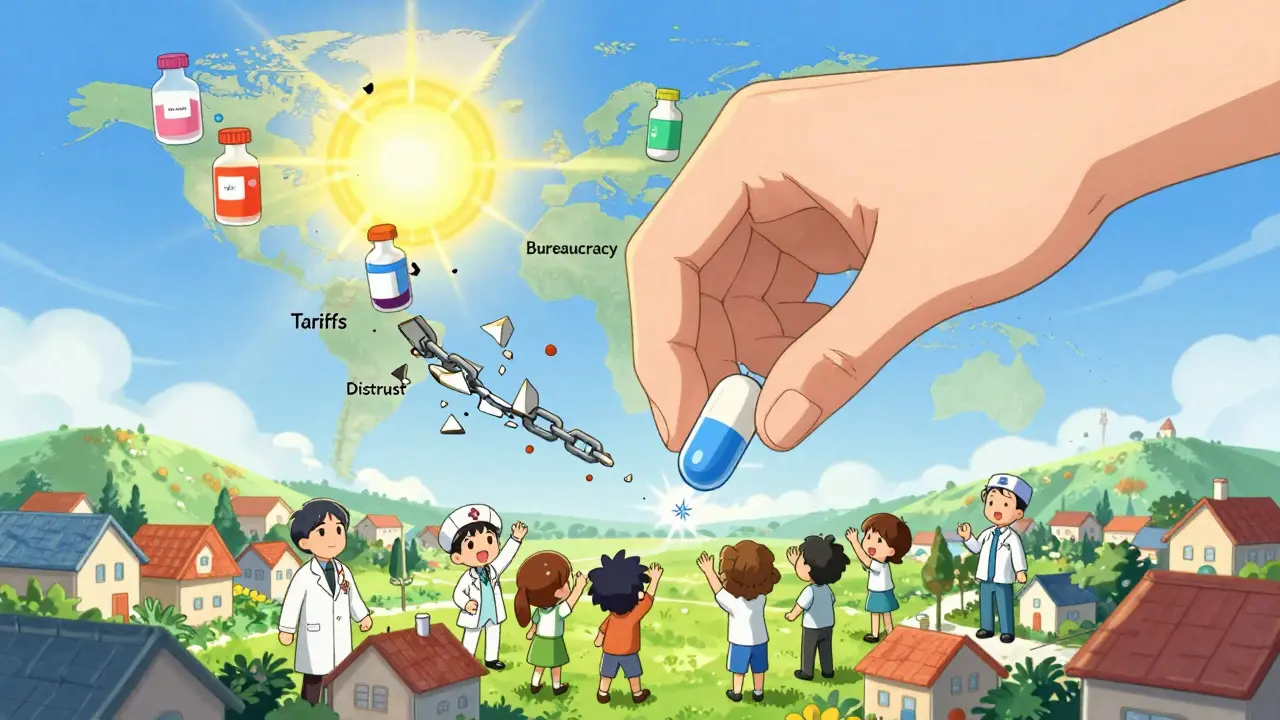
On top of that, tariffs and import taxes on medicines are common. In some places, a 10% tax on a generic drug adds hundreds of dollars to the final price. The Geneva Network says: abolish those taxes. It’s not complicated. It’s just political.
The Real Cost of Not Acting
Every year, 100 million people are pushed into extreme poverty because they have to pay for medicine out of pocket. Nearly 90% of people in developing nations pay for drugs themselves - no insurance, no safety net. A child with pneumonia needs antibiotics. The family sells their goat. The mother skips meals. The father takes a risky job abroad. That’s not healthcare. That’s survival.The Abuja Declaration in 2001 asked African nations to spend at least 15% of their budgets on health. In 2022, only 23 of 54 African countries met that target. The rest spent less than 5%. That’s why clinics are empty. That’s why medicines are scarce. That’s why people die because they can’t afford a $2 pill.
What’s Actually Working
There are bright spots. In India, Cipla started selling HIV generics for $1 a day in 2001. The world laughed. Then the world copied them. Today, India supplies over 80% of the world’s generic HIV drugs.In Uganda, Gilead ran clinical trials for a new long-acting HIV injection - and made sure the drug was priced for local use before launch. Merck and Novartis teamed up through the PAMAfrica consortium to test new antimalarials in low-income countries - and made the results public. These aren’t charity cases. They’re smart business. If you design for the poorest, you build a market that scales.
Big data is helping too. Seventy-six percent of health organizations in emerging markets are investing in digital tracking systems to monitor stock levels, predict shortages, and cut waste. That’s progress. But tech alone won’t fix a broken system.
The Path Forward
The fix isn’t one big idea. It’s a chain of small, doable actions:- Remove taxes and tariffs on essential medicines - immediately.
- Simplify drug approval by accepting WHO prequalification and regional standards.
- Require transparent pricing from manufacturers - publish who gets what, where, and at what cost.
- Boost public health funding - even 10% of GDP would be a start.
- Train local pharmacists to explain and trust generics - community trust is the missing link.
Generics have already saved millions. They can save millions more. But only if we stop treating access as a technical problem and start treating it as a moral one. You can’t have universal health coverage if your medicines are priced for someone else’s economy.
What You Can Do
If you’re in a high-income country, your voice matters. Support organizations pushing for fair pricing and transparent supply chains. Demand that your government fund global health initiatives that prioritize generics. Ask: Are we helping people get medicine - or just selling it?Change doesn’t come from big announcements. It comes from policy changes, local leadership, and the quiet decisions made every day by nurses, pharmacists, and health workers who show up even when the power’s out.
Generics aren’t a miracle. They’re a tool. And tools only work when someone’s willing to use them.
15 Comments
Justin Fauth
Let me get this straight - we’re supposed to trust some random generic pill from India that costs $1 when the brand-name stuff costs $10,000? Yeah, right. I’ve seen what happens when you cut corners on medicine. People die. And then lawsuits happen. This isn’t charity, it’s a liability waiting to explode.
Meenal Khurana
Generics saved my father’s life in Delhi. Same drug. Same results. Just no branding.
Joy Johnston
The data supporting the efficacy and safety of WHO-prequalified generic medicines is robust and peer-reviewed across decades of clinical use. The disparity in access is not a pharmacological issue - it is a structural, logistical, and political failure. Regulatory harmonization, supply chain investment, and tiered pricing models are not optional; they are non-negotiable components of equitable global health infrastructure.
Shelby Price
So… generics work? 😮 And we’re still making people sell goats to buy them? Feels like we’re all just waiting for someone to fix this…
Jesse Naidoo
Who’s really behind this? Big Pharma’s playing dumb, but I bet they’re secretly funding these ‘generic’ operations to destabilize the market. You think this is about saving lives? Nah. It’s about control.
Sherman Lee
They say generics are safe… but have you seen the labs in some of these countries? No QA. No inspections. Just a guy in a warehouse mixing powders with a spoon. And you wanna give this to your kid? 🤡
Lorena Druetta
Every life matters. Every pill should be accessible. We have the science. We have the will. What we need is the courage to act like we mean it.
Zachary French
Y’all are actin’ like this is some new revelation. Cipla’s been doin’ this since 2001. The whole world just didn’t wanna believe a poor country could out-innovate Big Pharma. Classic. Now they wanna patent the solution? 😒
Joseph Cooksey
It’s not just about price - it’s about perception. In many low-income countries, patients equate packaging and branding with quality. A white pill in a plain blister pack? That’s ‘cheap.’ A colorful, branded pill? That’s ‘real medicine.’ This isn’t ignorance - it’s a legacy of aggressive marketing campaigns that convinced entire populations that their health is only worth something if it comes with a logo. And until we address that psychological barrier, no amount of cost reduction will matter. The real enemy isn’t the patent - it’s the myth of superiority that’s been sold to the poor for decades.
Samuel Bradway
My cousin works in a clinic in Malawi. They get generics shipped in, but half the time the boxes are damaged or expired. No one’s tracking them. It’s heartbreaking.
pradnya paramita
From a pharmacoeconomic standpoint, the marginal cost of regulatory duplication in low-resource settings is disproportionately high. Accepting WHO prequalification reduces transaction costs by 60–70%, accelerates time-to-market, and enhances supply chain predictability. The bottleneck is not technical - it’s institutional inertia driven by donor-driven compliance frameworks that prioritize auditability over accessibility.
caroline hernandez
Training community pharmacists to become trusted advocates for generics is the missing link. When a nurse in rural Uganda explains to a mother why the unbranded tablet is just as safe - and how it’s saving her family’s income - that’s when change sticks. Trust isn’t built by press releases. It’s built in clinics, one conversation at a time.
Geri Rogers
Let’s stop pretending this is a ‘developing world problem.’ The same supply chain failures exist in rural Appalachia and inner-city Detroit. We’re all just one disaster away from needing a $2 pill we can’t afford. This isn’t charity. It’s justice.
Caleb Sutton
They’re using generics to test drugs on poor people without consent. It’s a cover for unethical trials. I’ve seen the reports. They don’t even record adverse reactions.
Jhoantan Moreira
India’s example proves that scaling generics is possible. What if every country adopted Rwanda’s 30-day approval rule? We could save millions. Let’s not wait for a miracle - let’s copy what works. 🙌