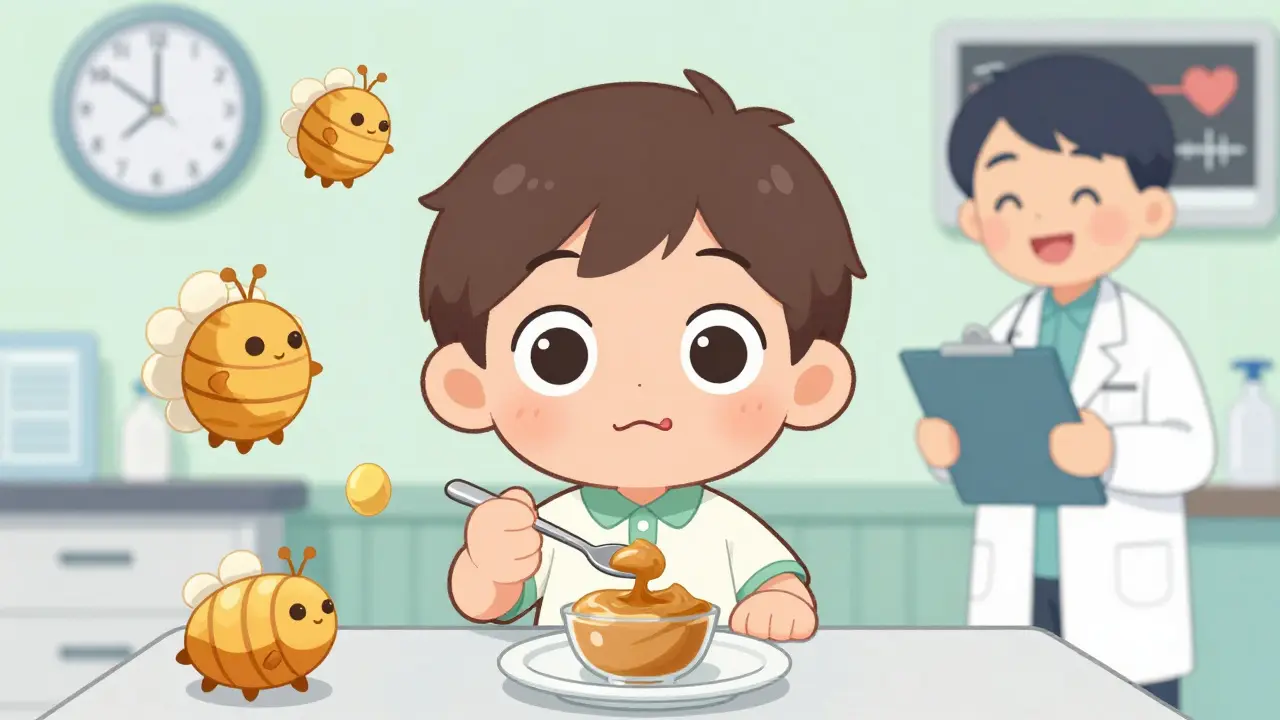
When a child breaks out in hives after eating peanut butter, or an adult gets stomach cramps every time they drink milk, it’s natural to wonder: is this a true allergy? Many people assume skin prick tests or blood tests are enough to confirm it. But here’s the truth: those tests alone can be wrong more than half the time. That’s where the oral food challenge comes in - the only test that can give you a definite answer.
Why Oral Food Challenges Are the Gold Standard
Oral food challenges (OFC) aren’t just another test. They’re the most reliable way to confirm or rule out a food allergy. Unlike skin tests or blood work, which measure immune markers that don’t always match real-life reactions, an OFC lets your body actually respond to the food in real time. If you eat it and don’t react, you likely don’t have an allergy. If you do react, you know exactly what triggers you - and how much. The American Academy of Allergy, Asthma & Immunology (AAAAI), the European Academy of Allergy and Clinical Immunology (EAACI), and the Italian Society of Pediatric Allergy and Immunology all agree: OFC is the gold standard. Why? Because clinical history and lab tests alone have a diagnostic accuracy of less than 50% for many common allergens like egg, milk, and peanut. That means nearly half the time, people are told they’re allergic when they’re not - or told they’re fine when they’re not. This matters because unnecessary food avoidance can be harmful. Kids miss out on critical nutrition. Families spend extra money on specialty foods. Parents live in constant fear of accidental exposure. An OFC can lift that burden. Studies show that 25-30% of people referred for food allergy testing turn out to be tolerant after a challenge. That’s not a small number. That’s life-changing.How an Oral Food Challenge Works
An OFC isn’t just eating a peanut butter sandwich and waiting to see what happens. It’s a carefully controlled medical procedure. You start with a tiny amount - often just 1 to 2 milligrams of the allergen, which is about one-thousandth of a serving. That’s less than a grain of rice for peanut. The dose is slowly increased every 15 to 30 minutes, under constant observation. The whole process takes 3 to 6 hours. That’s because reactions don’t always happen right away. Some show up in minutes. Others take hours. That’s why you stay for observation even after the last bite. There are three types of OFCs:- Open challenge: Both you and the doctor know what food you’re eating. This is the most common - about 90% of cases.
- Single-blind: Only the doctor knows what’s being given. Used when psychological factors might affect the result.
- Double-blind placebo-controlled: Neither you nor the doctor knows if it’s the real food or a placebo. This is the most accurate but rarely used outside research because it’s complex and expensive.
Is It Safe?
Yes - when done right. About 40-60% of oral food challenges result in mild reactions. These are usually skin symptoms like hives, flushing, or lip swelling. They’re uncomfortable, but easily treated with antihistamines in the clinic. Severe reactions requiring epinephrine happen in only 1-2% of cases. That’s low - especially when you consider the procedure is done in a medical setting with emergency equipment on hand: epinephrine, oxygen, IV fluids, and trained staff ready to act. A 2020 study in the Journal of Allergy and Clinical Immunology found that only 0.9% of OFCs led to treatment-requiring reactions. That’s safer than many routine medical procedures. But safety depends entirely on where and how it’s done. The AAAAI says OFCs must be performed by experienced allergists in a facility equipped to handle anaphylaxis. You won’t find this test in a regular doctor’s office or urgent care. It needs a dedicated space, trained nurses, and a physician on-site at all times.
Who Should Get One?
Not everyone needs an OFC. But it’s essential in these situations:- Your skin or blood test was positive, but you’ve never had a clear reaction to the food.
- You’ve had a reaction, but it was mild or unclear - and you’re not sure if it was truly allergic.
- You think your child has outgrown a food allergy (especially milk, egg, soy, or wheat).
- Your doctor suspects the allergy was misdiagnosed in the first place.
Preparing for the Challenge
Preparation is key. Here’s what you need to do:- Stop antihistamines for 5-7 days before the test. They can mask early signs of a reaction.
- Don’t come sick. If you have a cold, asthma flare-up, or infection, reschedule. Your body is already stressed - that increases reaction risk.
- Bring distractions. Especially for kids. Tablets, books, toys, or favorite snacks (that aren’t the challenge food) help pass the time.
- Wear loose clothing. That way, if hives appear, they’re easier to see and monitor.
- Ask questions. Know what the starting dose is, what the stop criteria are, and what happens if you react.
What Happens After the Challenge?
If you don’t react, you’re cleared. You can start eating the food regularly - but your doctor will likely advise you to include it in your diet at least a few times a week to maintain tolerance. If you do react, you’ll get treatment right away. Then, you’ll get a clear diagnosis: what you’re allergic to, how much triggers you, and how to manage it going forward. Even a reaction gives you valuable information. Some people are surprised to find out they can tolerate small amounts of the food - like a few drops of milk in tea - even if they react to a full serving. That’s called a threshold. Knowing your threshold helps you avoid unnecessary restrictions.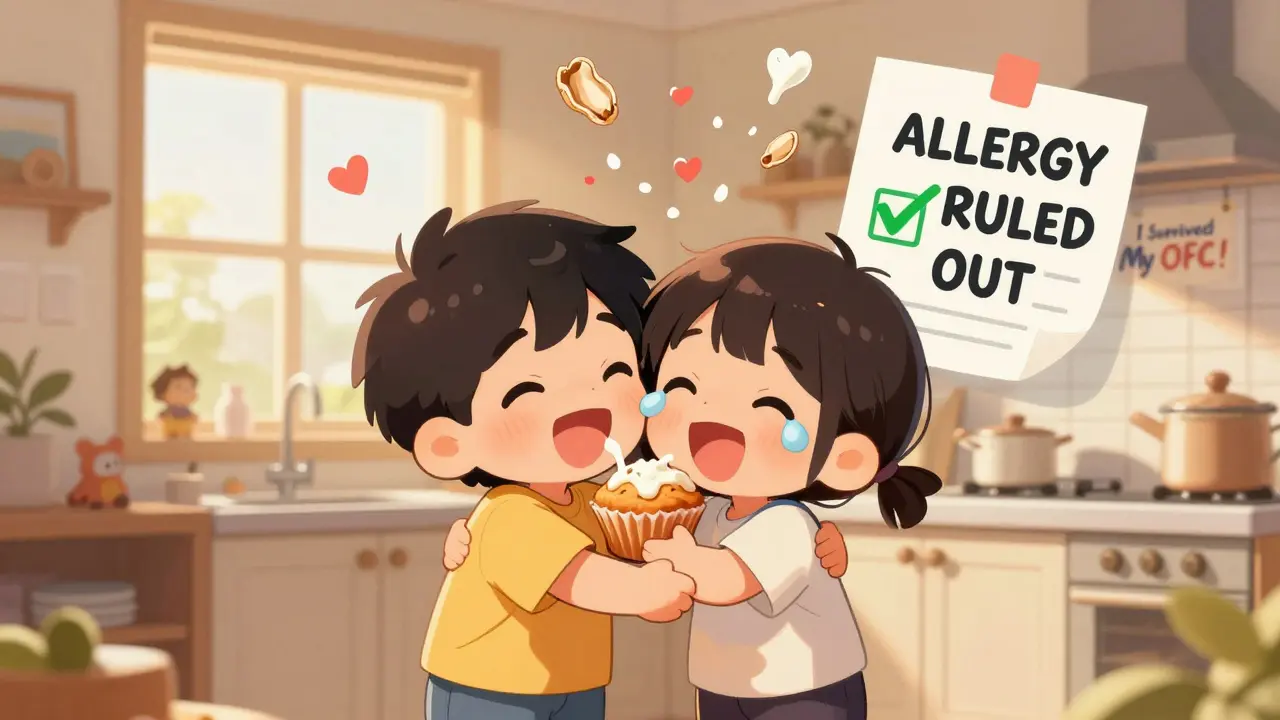
What About Other Tests?
Skin prick tests and blood tests (specific IgE) are common, but they’re not enough. For peanut, the positive predictive value of a blood test is only 50-60%. That means half the time, a positive result doesn’t mean you’re truly allergic. Component-resolved diagnostics (CRD) look at specific proteins in foods. They’re more precise than traditional blood tests - but still only about 85% accurate. They can help narrow things down, but they can’t replace the OFC. There’s no alternative that gives you the same level of certainty. That’s why experts say: no in vitro test can replace the oral food challenge for definitive diagnosis.The Bigger Picture
Food allergies affect 32 million Americans - and the numbers are rising. More people are being tested, and more are being told they’re allergic. But without OFC, many are misdiagnosed. The good news? OFC use is growing. Major hospitals like Cleveland Clinic and Children’s Hospital of Philadelphia perform 500-1,000 challenges a year. Private allergists do 50-200. And now, new guidelines from the AAAAI allow home-based OFCs for low-risk cases - a potential game-changer for access. Research is also moving forward. The NIH is funding studies to create safer, more standardized dosing protocols for high-risk foods like tree nuts. But the message from experts like Dr. Kari Nadeau at Stanford is clear: OFC will remain the gold standard for the foreseeable future.Final Thoughts
An oral food challenge isn’t easy. It’s long. It’s nerve-wracking. It can be scary - especially for parents watching their child. But it’s the only test that gives you real answers. It stops the guessing. It ends the fear. It lets you live without unnecessary restrictions. If you’ve been told you or your child has a food allergy - and you’re not sure if it’s real - ask your allergist about an OFC. It might just change everything.Are oral food challenges dangerous?
When performed in a medical setting by trained professionals, oral food challenges are very safe. Mild reactions like hives or flushing occur in 40-60% of cases but are easily treated. Severe reactions requiring epinephrine happen in only 1-2% of challenges. The risk is far lower than the danger of living with an undiagnosed or misdiagnosed allergy.
Can I do an oral food challenge at home?
Under strict guidelines, home-based oral food challenges are now allowed for low-risk cases - such as children with mild, confirmed allergies who are likely to tolerate the food. This requires prior approval from an allergist, a detailed emergency plan, and training on how to use epinephrine. It’s not for everyone and should never be attempted without professional guidance.
How long does an oral food challenge take?
Most oral food challenges take between 3 and 6 hours. The first 1-2 hours involve gradually increasing the dose of the food. After the final dose, you’ll be monitored for another 2-3 hours to watch for delayed reactions. Plan for a full morning or afternoon.
Do I need to stop my allergy meds before the test?
Yes. Antihistamines - even over-the-counter ones like cetirizine or loratadine - can block early signs of a reaction. You’ll need to stop them 5-7 days before the challenge. Always check with your allergist about other medications too, including asthma inhalers or steroid creams.
What if my child has a reaction during the challenge?
If a reaction occurs, the challenge is stopped immediately. Medical staff will treat it right away - usually with antihistamines for mild symptoms or epinephrine for more serious ones. The goal isn’t to cause a reaction, but to safely identify one if it happens. Even a reaction gives you clear, valuable information for future management.
Can an oral food challenge diagnose non-IgE-mediated allergies?
Yes. While skin and blood tests only detect IgE-mediated allergies (immediate reactions), oral food challenges can identify non-IgE-mediated allergies too - like food protein-induced enterocolitis syndrome (FPIES) or eosinophilic esophagitis. These reactions are delayed, often involving vomiting, diarrhea, or poor growth, and can only be confirmed through an OFC.
14 Comments
Shawn Peck
Man, I had no idea these challenges were this safe. I thought they were like, super risky. Turns out you're more likely to get hurt crossing the street than having a bad reaction during one. My kid's been avoiding peanuts for three years and we just found out he's fine. Life-changing.
Sarah Blevins
The cited studies are methodologically sound, but the generalization of 'nearly half the time' diagnostic inaccuracy is misleading. The 50% figure applies only to specific allergens under narrow clinical conditions. Meta-analyses show specificity ranges from 71% to 94% depending on IgE thresholds and population stratification. The assertion that OFCs are the 'only' definitive test ignores the growing utility of component-resolved diagnostics as triage tools.
Yanaton Whittaker
AMERICA STILL LEADS IN ALLERGY CARE. 🇺🇸 Look at these numbers - 500-1000 challenges a year at top hospitals? That's what happens when you fund real science. In Europe they're still debating if it's 'ethical' to make kids eat peanuts. We don't waste time with bureaucracy. We save lives. #MakeAllergyTestingGreatAgain
Kathleen Riley
The epistemological foundation of the oral food challenge rests upon a Cartesian model of bodily certainty - a direct, unmediated observation of physiological response as the sole arbiter of truth. Yet, this assumes the body is a transparent vessel, disregarding the phenomenological experience of anxiety, the placebo effect, and the somatic amplification inherent in the clinical encounter. Is certainty, then, merely the absence of doubt - or the suppression of complexity?
Beth Cooper
Wait… so you're telling me the FDA and big pharma don't want us to know we can just eat peanuts again? 😏 I read somewhere that they make billions off 'allergy-free' snacks. And why do they always say 'low-risk' cases can do it at home? Sounds like they're testing us… like guinea pigs. I'm not doing this. I'm keeping my peanut-free zone. #BigAllergy
Melissa Cogswell
I'm a pediatric allergist and I run OFCs weekly. The most common mistake parents make? Stopping antihistamines but forgetting about the topical steroid cream they've been using for eczema. That stuff can mask reactions too. Always ask about ALL meds - even the 'tiny' ones. And yes, it's scary for kids. But we use stuffed animals, cartoons, and sometimes even ice cream as rewards. The relief on their faces when they eat a cookie without fear? Worth every hour.
Diana Dougan
So you're telling me I spent 5 years avoiding eggs because some blood test said 'positive'? 😭 My kid got hives once at 18 months and now we're broke buying 'allergen-free' muffins that taste like cardboard. And now you want me to just feed him a whole omelet? In a clinic? Like a lab rat? I'm not doing it. I'm not risking it. And btw, you spelled 'epinephrine' wrong in the article. 🤦♀️
Holly Robin
Let me get this straight - we're supposed to trust a doctor who makes us eat the thing that almost killed us? And they call it 'safe'? You know what's really dangerous? The fact that this test is only available in rich neighborhoods. My cousin in rural Alabama tried to get one and they told her to 'just avoid it'. Meanwhile, rich moms in Manhattan are getting home OFCs with private nurses. This isn't medicine - it's a class war disguised as science. #FoodAllergyApartheid
KATHRYN JOHNSON
Oral food challenges require specialized infrastructure. They are not outpatient procedures. They are medical interventions. Performing them outside accredited allergy centers violates standard of care. Any suggestion otherwise is negligent. Patients must be informed of the legal liability associated with unmonitored administration. This is not a suggestion. It is a protocol.
Sazzy De
my sister did one last year for milk. took 5 hours. she cried the whole time. but when she ate ice cream after? she just smiled. no panic. no fear. just ice cream. that's all i needed to see. 🥹
Beth Beltway
Of course the 'gold standard' is expensive and inconvenient. That's how they keep you dependent. If you could just eat what you want, why would you need expensive specialists? Why would you need to buy $12 gluten-free bread? Why would Big Allergy need your fear? They don't want you to know you're probably fine. They want you to stay scared. And they want you to pay.
Marc Bains
I’ve seen this play out in immigrant families - parents avoid foods they grew up with because their kid had a rash once. Then the kid grows up not knowing their own culture’s food. I had a mom from Nigeria who stopped feeding her son egusi soup because of a false positive. We did an OFC. He ate it. He cried. Not from reaction - from joy. That’s not just medicine. That’s identity restored.
Russ Kelemen
There’s something deeply human about the oral food challenge - it’s not just science, it’s trust. Trust in your body, in your doctor, in the slow, quiet process of testing fear. We treat allergies like enemies to be defeated, but maybe they’re just signals - misunderstood, overreacted to, pathologized. The challenge doesn’t just test for allergy. It tests for courage. And sometimes, the bravest thing you can do is eat a crumb.
Adarsh Uttral
i read this while eating peanut butter on roti. no hives. no problem. maybe all these tests are just making us scared of food. in india we just eat and see what happens. if u get sick? go to doc. if not? good. why make it so complicated?