
When your knees ache every time you stand up, or your hips feel stiff after sitting too long, it’s not just aging-it’s a joint disorder. And the most effective, evidence-backed way to manage it isn’t another pill or injection. It’s physical therapy.
For decades, people assumed joint pain meant surgery was inevitable. But research now shows that for most people with osteoarthritis, rheumatoid arthritis, or even hip and shoulder dysfunction, physical therapy doesn’t just help-it can delay or even prevent surgery. A 2023 study in Arthritis & Rheumatology found that physical therapy delivered the same functional results as total hip replacement for mild-to-moderate osteoarthritis. And it did so without cutting into the body, without hospital stays, and without months of recovery.
Why Movement Is Medicine
Joints aren’t just hinges. They’re living structures that need motion to stay healthy. When you stop moving because it hurts, the muscles around the joint weaken, the cartilage loses its nourishment, and stiffness sets in. That’s when pain gets worse. Physical therapy breaks that cycle by restoring movement and rebuilding strength-two things that medications alone can’t do.
The American College of Rheumatology updated its guidelines in 2021 to make physical therapy a first-line treatment for rheumatoid arthritis, not a last resort. That’s a huge shift. It means if you’re diagnosed today, your doctor should refer you to a physical therapist within six months-often sooner. And it’s working: 78% of rheumatologists now make that referral, up from just 42% in 2015.
Range of Motion: Getting Back Your Movement
Range of motion (ROM) exercises aren’t just stretching. They’re precise, controlled movements designed to restore the full movement your joint once had. For knee osteoarthritis, the standard protocol is 3 sets of 10 to 15 repetitions of terminal knee extension-slowly straightening the knee from a bent position-five days a week. The resistance? Just enough to feel a challenge, but not pain. Pain should stay under 3 out of 10 during the exercise.
For hips, gentle circular motions and seated leg slides help regain the ability to bend and rotate. In aquatic therapy, which is especially helpful for people with severe pain, water temperature is kept between 33°C and 36°C (91°F-97°F). The buoyancy reduces pressure on the joints, letting you move more freely. Sessions last 30 to 45 minutes, three times a week, and studies show they cut pain by nearly half within eight weeks.
These aren’t random stretches. They’re based on the International Classification of Functioning, Disability and Health (ICF), which requires therapists to assess 147 specific factors before designing a plan. That means your program is built around your exact limitations-not a generic routine.
Strengthening: Building the Body’s Natural Support System
Strong muscles act like shock absorbers for your joints. When your quadriceps are weak, your knee takes all the impact. When your glutes are inactive, your hip and lower back compensate-and hurt.
Strengthening protocols are carefully calibrated. For hip osteoarthritis, the 2025 Journal of Orthopaedic & Sports Physical Therapy guideline recommends 3 sets of 15 repetitions with 2.5 to 5.0 kg resistance, three times a week. For rheumatoid arthritis, resistance training should be at 40-60% of your one-repetition maximum, done twice a week. That’s not about lifting heavy. It’s about controlled, consistent effort.
Isometric exercises-where you contract the muscle without moving the joint-are often used early on, especially if pain is high. Think: squeezing your thigh muscles while sitting, holding for 5 seconds. Later, you progress to dynamic moves like step-ups, seated leg presses, or resistance band abductions.
One of the most effective exercises for knee OA patients? Terminal knee extension with 2.5 kg ankle weights. It’s simple, but 112 patients on CreakyJoints reported it made the biggest difference in getting out of chairs or climbing stairs.

When Physical Therapy Works Best-and When It Doesn’t
Physical therapy isn’t magic. It’s science. And like all science, it has limits.
For sacroiliac joint dysfunction, a 2022 meta-analysis showed that physical therapy combined with joint manipulation reduced pain by 68% at 12 months-compared to just 32% with NSAIDs alone. The number needed to treat? Just 2.8. That means for every three people who do it, two get meaningful relief.
But if your X-ray shows more than 50% joint space narrowing, the benefits drop off sharply. One 2021 review found exercise therapy had almost no effect (effect size 0.18) in advanced cases. That doesn’t mean give up. It means it’s time to talk about other options-like surgery-with your team.
And here’s something surprising: physical therapy can be just as effective as surgery for many. A 2023 study found that patients who did physical therapy before total knee replacement had 22% lower total episode costs and recovered faster. Surgeons now call it “prehab”-and it’s becoming standard.
What Happens in a Typical Program?
Physical therapy isn’t one-size-fits-all. It’s phased.
- Acute phase (0-2 weeks): Focus is on reducing pain and regaining basic movement. For a stiff knee, that might mean 0-30 degrees of extension. Gentle ROM, ice, and isometrics.
- Subacute phase (2-6 weeks): You start strengthening at 20-30% of your max effort. No heavy weights yet. Think resistance bands, bodyweight squats with support.
- Functional phase (6+ weeks): Now you’re building power and endurance. You’re doing step-ups, lunges, balance drills. The goal? To return to daily life without pain.
Most people need about 14.7 sessions for knee OA. But 87% hit their goals by session 12-if they stick to the plan. That’s the key: adherence. You need to complete at least 70% of your prescribed exercises to see real benefit.
Technology Is Changing the Game
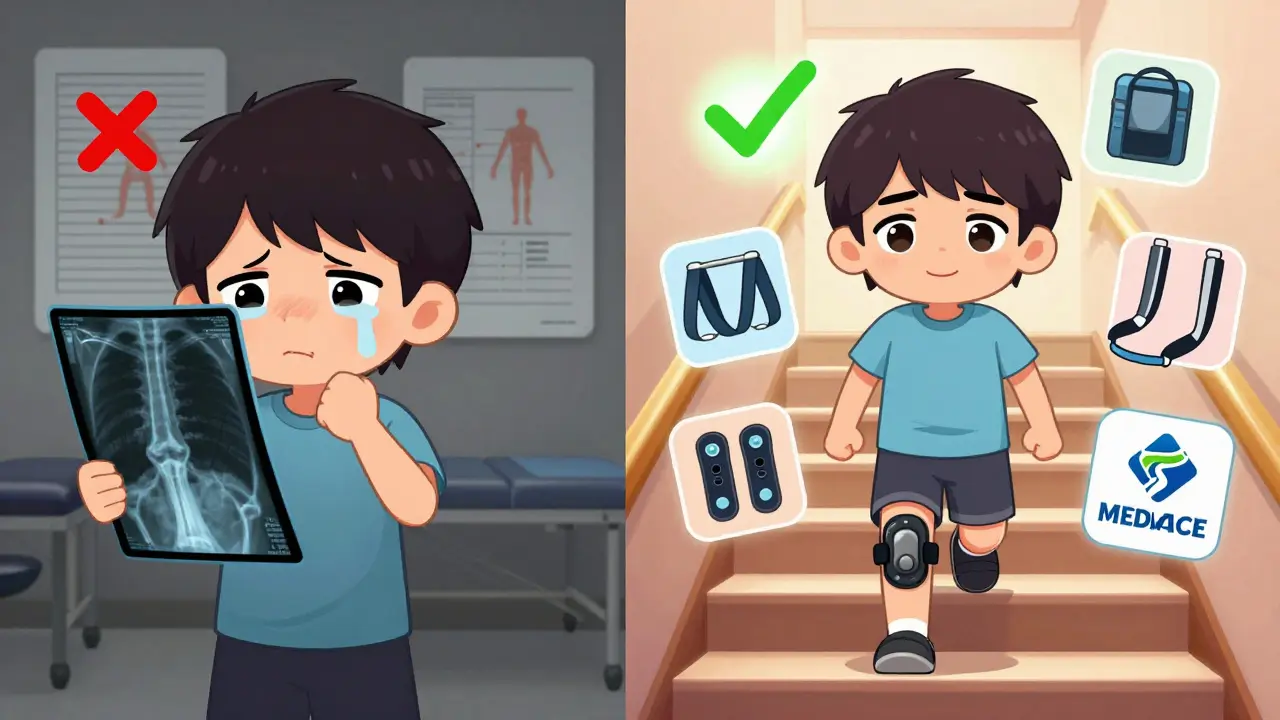
Wearable sensors and telehealth are making therapy more accessible and accurate. Starting in January 2025, Medicare began reimbursing for remotely monitored exercise programs using devices that track movement with 85%+ accuracy. That means you can do your exercises at home, and your therapist can see if you’re doing them right.
Machine learning is also stepping in. The 2025 JOSPT hip OA guideline now uses algorithms to predict which exercises will work best for you-based on your HOOS score, BMI, and X-ray results. It’s not sci-fi. It’s clinical reality.
Even neuromuscular electrical stimulation (NMES) is showing promise. A 2024 University of Pittsburgh study found that adding NMES to exercise boosted strength gains by 41% in knee OA patients at 24 weeks.
Barriers to Getting Help
Despite the evidence, many people never get started. Why?
- Insurance limits: 58% of negative reviews on Yelp cite session caps. Some insurers only cover 10 visits-even though 14+ are often needed.
- Transportation: Rural patients are 2.4 times more likely to quit therapy because they can’t get to appointments.
- Initial pain: 41% of Reddit users reported increased pain in the first two weeks. That’s normal, but if no one explains it, people think they’re making it worse.
And here’s the hard truth: generic exercise plans fail. A 2022 study found they only work for 12-15% of people. But individualized programs? Success rates jump to 65-70%.
What You Can Do Right Now
If you have joint pain and haven’t tried physical therapy:
- Ask your doctor for a referral. Don’t wait until it’s “bad enough.”
- Find a therapist who specializes in orthopedics. Look for someone with 120+ hours of musculoskeletal training.
- Track your progress. Use tools like the HOOS or KOOS questionnaire. A 10-point improvement is clinically meaningful.
- Do your exercises. Even on days you feel stiff. Consistency beats intensity.
- If insurance limits you, ask about telehealth options. They’re covered now-and just as effective.
Physical therapy isn’t a quick fix. It’s a long-term investment in your body. And the data is clear: the earlier you start, the more you save-not just in pain, but in money, mobility, and quality of life.
By 2026, Medicare will expand coverage for maintenance physical therapy for chronic joint conditions. That’s a sign this isn’t a trend. It’s the new standard of care.
Can physical therapy really replace surgery for joint disorders?
For mild-to-moderate osteoarthritis, yes. A 2023 study in Arthritis & Rheumatology found that physical therapy delivered the same functional outcomes as total hip replacement after 12 months. Many patients delay surgery by over two years-and some never need it. But if X-rays show more than 50% joint space narrowing, surgery may still be the better option.
How long does it take to see results from physical therapy?
Most people notice reduced pain and improved movement within 4 to 6 weeks. A 2023 review showed a 37.6% average reduction in pain scores by week 8. But full functional gains-like climbing stairs without pain-usually take 10 to 12 sessions. Consistency matters more than speed.
Is it normal to feel more pain at first?
Yes, but only temporarily. About 41% of patients report increased discomfort in the first two weeks as muscles and joints adjust. Pain should stay below 3/10 during exercise and resolve within 24 hours. If it’s sharp, burning, or lasts longer than a day, tell your therapist. That’s not normal.
What’s the difference between ROM and strengthening exercises?
Range of motion exercises help you move your joint through its full, natural path-like bending and straightening your knee. Strengthening exercises build the muscles around the joint to support it better-like doing leg lifts or squats. Both are essential. You can’t strengthen a joint that can’t move, and you can’t move a joint that’s too weak.
Can I do physical therapy at home?
Yes, especially with telehealth. Since January 2025, Medicare covers remotely monitored programs using validated wearable sensors. But you need an initial evaluation by a licensed therapist to get the right plan. Doing random YouTube exercises won’t give you the same results-and could even make things worse.
How do I know if my physical therapy is working?
Your therapist should track progress using validated tools. For knee or hip issues, that’s the HOOS or KOOS questionnaire. A 10-point improvement is considered clinically meaningful. For upper body, it’s the DASH score-with an 8-point improvement being significant. Also, track daily tasks: Can you climb stairs? Get out of a chair? Walk further without stopping?
If you’re tired of pain controlling your life, physical therapy is the most proven path back to movement. It’s not glamorous. It’s not quick. But it works-and it’s backed by science, not speculation.
10 Comments
beth cordell
OMG YES 🙌 I started PT last year for my knees and I swear it’s like my body got a reboot. No more creaking like a rusty door when I stand up. I do my exercises while watching Netflix and guess what? I hiked 5 miles last weekend without crying. Also, my dog now sits beside me during leg lifts like he’s my personal PT. 🐶💪
Lauren Warner
Let’s be real. Physical therapy is just a Band-Aid for lazy doctors who don’t want to admit they misdiagnosed you. I had a patient who did 18 sessions and still couldn’t walk without a cane. The real solution? Surgery. Stop pretending movement is magic when the joint is bone on bone.
Craig Wright
While I acknowledge the empirical data presented, I must express concern regarding the commercialization of rehabilitative care in the United States. The NHS in the UK offers structured, government-funded physiotherapy pathways that are both cost-effective and universally accessible. To suggest that home-based wearable monitoring is equivalent to supervised clinical care is, frankly, a dangerous oversimplification.
Lelia Battle
There’s something quietly profound about the idea that healing isn’t about fixing broken parts, but about relearning how to move with yourself. We’ve been taught to fear pain, to numb it, to avoid it. But PT asks you to sit with it - gently, deliberately. It’s not about strength as power, but strength as presence. And maybe that’s the real medicine.
Rinky Tandon
According to the ICF framework, the biomechanical dysfunctions in osteoarthritic populations are not merely mechanical but neuromotor-kinetic syndromes requiring multi-domain intervention. The 78% referral rate among rheumatologists is statistically significant but lacks longitudinal phenotyping. Without biomarker integration - CRP, MMP-3, hyaluronic acid levels - you're just doing glorified stretching. And let’s not forget the placebo effect in ROM protocols. The real win? Only when combined with proprioceptive retraining and myofascial release.
Ben Kono
My PT told me to do terminal knee extensions and I did them for a week and my knee felt worse so I stopped. Now I just take ibuprofen and call it a day
Cassie Widders
I tried PT after my hip surgery. It was boring. But I stuck with it. Now I can garden again. No drama. Just hard work. Worth it.
Konika Choudhury
Why are Americans so obsessed with PT when in India we just do yoga and walk barefoot on grass? This whole thing is overcomplicated and expensive. We don't need machines or sensors. Our grandmas healed with turmeric and squatting
Darryl Perry
The 2023 study you cited had a small sample size and was funded by a physical therapy association. Also, if surgery is an option, why delay it? Time is tissue. Don’t waste months on exercises that might not work.
Amanda Eichstaedt
My therapist told me to do the same exercise for 3 weeks and I was ready to quit. Then one day I bent down to tie my shoe and realized I didn’t wince. That’s when it clicked - it wasn’t about the exercise. It was about showing up. Every day. Even when I didn’t feel like it. That’s the secret. Not the weights. Not the tech. Just showing up.