When a drug’s patent runs out, prices don’t just drop-they often crash. But for patients and healthcare systems, that doesn’t mean everything gets easier. In fact, it’s when things get messy. If you’re taking a brand-name medication for diabetes, rheumatoid arthritis, or high cholesterol, you could be looking at a switch to a generic version in the next year or two. And if you’re part of a hospital, clinic, or insurance plan, you’re probably already scrambling to prepare. The truth is, patent expiry isn’t just a legal event. It’s a financial earthquake that reshapes who gets what drug, at what cost, and whether it still works the same way.
What Happens When a Patent Expires?
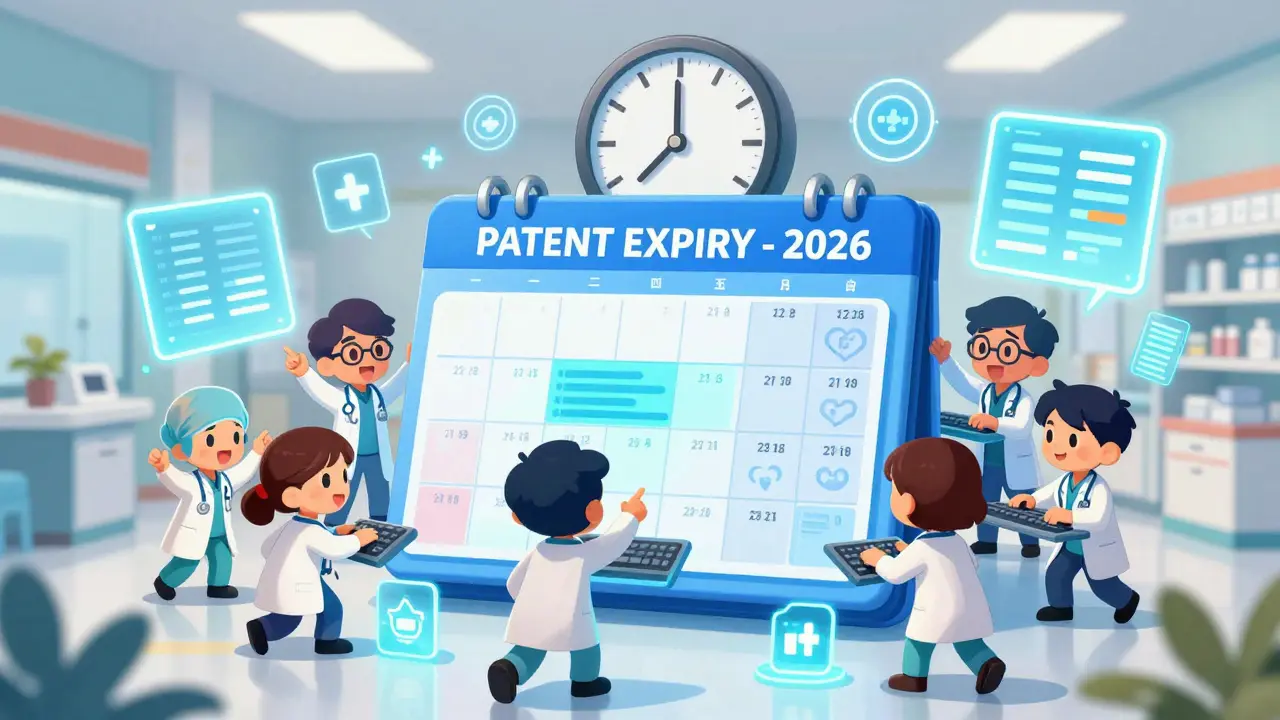
Every new drug starts with a 20-year patent clock. But because it takes 8-12 years to develop and get approved, most drugs only enjoy 7-10 years of real market exclusivity. Once that clock hits zero, any company can make a copy. That’s called a generic drug for small molecules, and a biosimilar for biologics-drugs made from living cells, like insulin or cancer treatments. The numbers are staggering. Between 2025 and 2029, over $90 billion in brand-name drug sales in the U.S. alone will lose patent protection. That’s not just a number-it’s hundreds of thousands of patients changing medications, pharmacies restocking shelves, and insurers rewriting formularies. And it’s happening all at once. We’re in the middle of what experts call “Patent Cliff 2.0,” the biggest wave of drug expirations in over a decade.Why This Isn’t Just About Saving Money
You’d think lower prices mean better outcomes. But reality is more complicated. Generic drugs are required to be bioequivalent to the original-meaning they deliver 80% to 125% of the same active ingredient. Sounds good, right? But inactive ingredients? Those can vary. A patient switching from a brand-name asthma inhaler to a generic might find the powder doesn’t dissolve the same way. Someone on a biologic for psoriasis might get a rash because the new version has a different stabilizer. In a 2022 Kaiser Family Foundation survey, 37% of patients reported side effects after switching to generics-even though regulators say they’re interchangeable. And here’s the kicker: not all generics are created equal. When a patent expires, multiple companies rush in. Some offer the cheapest version. Others charge more because they’ve added features-like a pre-filled syringe or a slower-release formula. Insurance plans often choose based on rebates, not price. So you might get a generic that costs less to the system but still costs you more out-of-pocket.What Patients Should Do
If you’re on a drug that’s about to lose its patent, here’s what you need to do:- Check your drug’s status. Look up your medication on the FDA’s Drug Approvals and Databases. If it says “Generic Available,” that means copies are on the market.
- Ask your pharmacist. Don’t assume the generic they give you is the cheapest. Ask: “Is there a lower-cost version?” or “Has the manufacturer changed?”
- Know your insurance rules. Some plans require you to try a generic before covering the brand. Others won’t cover certain generics at all. Call your insurer before your refill.
- Monitor how you feel. If you switch and notice new side effects-dizziness, nausea, or worsening symptoms-tell your doctor immediately. It’s not “all in your head.” Bioequivalence doesn’t always mean identical experience.
- Don’t stop cold. Never stop your medication just because the brand is gone. Work with your provider to transition safely.
What Healthcare Systems Must Plan For
Hospitals and health systems have a bigger job. They’re not just managing prescriptions-they’re managing budgets, supply chains, and clinical protocols. And they’re often caught off guard. Here’s what works:- Start 24 months out. The most successful systems begin planning two full years before the patent expires. That’s when they start tracking which generics are coming, what they cost, and how they’ll be priced.
- Build a team. Pharmacy directors, finance officers, clinicians, and contract managers need to sit in the same room. No one person can handle this alone.
- Use tracking tools. Software like Symphony Health’s PatentSight helps systems monitor over 1,400 patent expirations each year in the U.S. alone. Manual spreadsheets won’t cut it anymore.
- Negotiate early. Generic manufacturers want volume. If you lock in a contract 12-18 months before expiry, you can save 50-70% on the drug’s cost. Wait until the last minute, and you’re at the mercy of the market.
- Update clinical guidelines. Doctors need clear rules on when to switch patients. Don’t wait until the generic hits shelves to explain why a change is safe. Train staff, update EHR alerts, and give patients printed guides.
The Biosimilar Challenge
Biologics-drugs like Humira, Enbrel, or Herceptin-are the next big wave. These aren’t pills. They’re complex proteins made from living cells. Making a copy? It’s like cloning a Ferrari instead of copying a keychain. Biosimilars take longer to develop, cost more to produce, and face more resistance from patients and doctors. Even though they’re approved, only 38% of biologic prescriptions switch to biosimilars within two years of patent expiry. Compare that to 90%+ for small-molecule generics. Why? Because patients are scared. Doctors are cautious. And insurers often don’t incentivize the switch. The result? A slower, more expensive transition. Systems that proactively educate providers and patients on biosimilars see conversion rates jump to 60% or higher.Why the U.S. Is Different
In Europe, when a patent expires, prices drop fast-sometimes to 30% of the original cost. Why? Because governments set reference prices. If a drug costs $100 and the generic is $20, the government won’t pay more than $20. In the U.S., it’s messy. Rebates, formulary tiers, and pharmacy benefit managers (PBMs) create a fog of pricing. A drug might list for $500, but the net price after rebates is $120. Then a generic comes in at $100, but the PBM gets a $40 rebate from the brand, so the plan doesn’t save as much as it should. This means U.S. systems often see only a 60-70% price drop over 18-24 months-not the 80-85% seen in other countries. That’s why planning matters even more. Without proactive contracting, you’re leaving money on the table.The Hidden Trap: Patent Thickets
Here’s where drugmakers fight back. Instead of letting the patent expire cleanly, they file dozens of secondary patents-on packaging, dosing schedules, or even minor chemical tweaks. This is called a “patent thicket.” A single drug like Humira has over 100 patents. Some are real. Others? They’re just legal hurdles designed to delay generics. In 2023, the FTC reported a 35% drop in “pay-for-delay” deals-where brand companies pay generics to stay off the market. But these tactics still exist. And they’re why some patients are still waiting years for affordable copies. Health systems need to know: if a drug’s patent is supposed to expire in 2026, but no generics are available by 2027, there’s a good chance a thicket is blocking entry. That’s when legal challenges and regulatory pressure become part of the plan.
What’s Next?
The Inflation Reduction Act of 2022 lets Medicare negotiate prices for some drugs starting in 2026. That means the first 10 drugs selected for negotiation will likely be ones that just lost patent protection. This could force even steeper price drops. Meanwhile, the FDA is speeding up approvals for complex generics. New rules under GDUFA III aim to cut the approval timeline from 18 months to 12. And AI tools are now predicting patent expirations with 89% accuracy-up from 65% just a few years ago. The future belongs to systems that plan early, act decisively, and put patients first-not just cost savings.Real-World Impact: What Works
A 2023 analysis of 150 U.S. health systems found that those who started planning 24 months before patent expiry saved an average of $4.7 million per drug. Those who waited 12 months? Only $3.8 million. That’s a 22% difference in savings-just from starting earlier. One Midwest hospital system switched 1,200 patients from a brand-name biologic to a biosimilar after running a six-month education campaign. They saved $1.2 million in the first year. Patient satisfaction stayed high. Adverse events dropped. Another clinic in Texas used a simple trick: they sent patients a letter 6 months before their drug’s patent expired. The letter explained: “Your medication will soon be available as a lower-cost generic. Here’s what to expect. Here’s who to call if you have concerns.” Discontinuation rates fell by 35%. These aren’t miracles. They’re smart, simple steps.What happens if my insurance stops covering my brand-name drug after the patent expires?
If your drug loses patent protection, your insurer may stop covering the brand-name version entirely. This is legal and common. You’ll be switched to a generic or biosimilar unless your doctor files a medical exception. Don’t panic-most generics are safe and effective. But if you’ve had side effects before or are on a complex therapy, talk to your provider before the switch. You may qualify for a continued brand-name prescription if medically necessary.
Can I ask for the brand-name drug even after generics are available?
Yes, but you’ll likely pay more. Insurance plans often require you to try the cheaper generic first. If you still want the brand, your doctor can submit a prior authorization or medical exception. But you’ll probably pay the full cash price-sometimes hundreds of dollars more per month. Only do this if you’ve had a bad reaction to the generic or if your condition is unstable. For most people, the generic is just as good.
Why do some generics cost more than others?
Not all generics are the same. Some are made by the original drug company (called an “authorized generic”) and are priced higher. Others are made by smaller companies and are cheaper. Your pharmacy may stock the most profitable one, not the cheapest. Ask your pharmacist: “Is there a lower-cost version?” or “Which company makes this?” You can often switch to a cheaper option if your doctor approves.
Are biosimilars as safe as the original biologic drugs?
Yes. Biosimilars undergo rigorous testing to prove they work the same way as the original. The FDA requires them to match in structure, function, and safety. In clinical trials, biosimilars have shown no meaningful difference in effectiveness or side effects. That said, because they’re made from living cells, tiny variations can occur. If you switch and feel different-fatigue, rash, fever-report it. But don’t assume it’s unsafe. Most reactions are mild and temporary.
How do I know when my drug’s patent is about to expire?
Check the FDA’s Orange Book or Drugs@FDA database. You can also ask your pharmacist or doctor. Many health systems send alerts to patients 6-12 months before a patent expires. If you’re on a long-term medication, ask your provider to notify you when your drug’s exclusivity ends. You can also sign up for alerts from patient advocacy groups or pharmacy benefit managers like Express Scripts or CVS Caremark.
12 Comments
Martin Halpin
Okay, so let me get this straight-you’re telling me that after 20 years of drug companies getting a free pass to charge $500 for a pill that costs 7 cents to make, we’re now supposed to be *grateful* when generics finally show up? 🤡
Here’s the real story: the patent system was never meant to be a 20-year monopoly on life-saving meds. It was supposed to incentivize innovation, not turn insulin into a luxury SUV. And now? We’re acting like switching to a generic is some kind of medical gamble. Newsflash: the FDA doesn’t approve generics based on vibes. They test them. Repeatedly. With animals. With humans. With labs that could probably detect a single molecule of aspirin in a swimming pool.
And yet, somehow, the same people who scream about ‘drug safety’ when a new generic hits the market are the ones who never once questioned the $12,000-a-month price tag of the brand-name version. Hypocrisy? Or just capitalism with a side of placebo?
I’ve been on a generic statin for 5 years. My cholesterol? Stable. My bank account? Not in ruins. My doctor? Still alive. So yeah-I’m calling BS on the ‘bioequivalence is a myth’ narrative. It’s not a myth. It’s a marketing tactic dressed up as concern.
Eimear Gilroy
Interesting post. I’m from Ireland, and we’ve been dealing with generics for over a decade here. The system isn’t perfect, but it’s way more transparent. When a patent expires, the government sets a reference price, and everyone-pharmacies, hospitals, patients-knows what they’re paying. No rebates. No PBMs. No confusion.
One thing I’ve noticed: patients here don’t panic when they switch. Why? Because we’re told what to expect. A leaflet. A chat with the pharmacist. Maybe a follow-up call. No ‘surprise’ side effects because we prepared.
Also, biosimilars? We’ve had them since 2007. Doctors don’t treat them like alien tech. They’re just… another tool. Maybe the U.S. needs to stop treating healthcare like a stock market and start treating it like a public service.
Michael FItzpatrick
Yo. Let me break this down like I’m explaining it to my cousin who still thinks ‘generic’ means ‘made in a basement.’
Think of a drug like a smartphone. Brand name? iPhone 15 Pro Max. Generic? A phone that does the same thing-calls, texts, takes pics-but no titanium frame, no 120Hz screen, no Apple logo.
Does it work? Hell yes.
Does it feel different? Maybe. But if you’re not a graphic designer who needs pixel-perfect color accuracy, you’re not losing anything.
And let’s be real-the ‘side effects’ people report? Half the time, it’s the nocebo effect. You hear ‘this is a cheap copy’ and suddenly your head hurts. That’s not the drug. That’s your brain playing a horror movie on loop.
Also, the $4.7M savings stat? That’s not a number. That’s 470 people who didn’t have to choose between rent and refills. That’s real. That’s worth fighting for.
Brandice Valentino
ok so like i read this whole thing and im just like... why is everyone so dramatic?? like i switched to generic adderall last year and i felt fine?? like i dont even remember the brand name anymore?? like i just take the little white pill and go about my day?? also my insurance pays like 5 bucks for it now?? idk why this is such a big deal?? like maybe we should chill?? 🤷♀️
Larry Zerpa
Let’s cut through the fluff. The ‘patent cliff’ isn’t a cliff-it’s a controlled demolition. And the real villain isn’t Big Pharma. It’s the pharmacy benefit managers (PBMs) who pocket rebates and then pretend they’re saving you money.
Here’s the truth: when a generic hits the market, the brand-name company doesn’t just vanish. They sell their own ‘authorized generic’ at a 30% discount-same formula, same packaging, same profit margin. Meanwhile, the ‘cheap’ generic? It’s often made by a company that just got a 70% rebate from the PBM. So the insurer saves $10, but you pay $15 more out-of-pocket because your copay tier got restructured.
And don’t get me started on biosimilars. The FDA says they’re ‘similar.’ But ‘similar’ isn’t ‘identical.’ And when you’re on a biologic for Crohn’s? ‘Similar’ can mean a flare-up. A hospitalization. A lost job.
So no. This isn’t about savings. It’s about who gets to decide what ‘safe’ means-and it’s not you.
Gwen Vincent
I’ve been a nurse for 18 years. I’ve seen patients cry because they couldn’t afford their meds. I’ve seen them switch to generics and thrive. I’ve also seen them switch and spiral-because their doctor didn’t monitor them, and their pharmacist didn’t explain anything.
This isn’t about generics being good or bad. It’s about *communication*. A letter. A follow-up. A 5-minute chat before the switch.
The Midwest hospital that saved $1.2M? They didn’t just swap pills. They held town halls. They made videos. They trained nurses to ask, ‘How are you feeling since the switch?’
That’s the real innovation here. Not the drug. The care.
Valerie Letourneau
While the American discourse on patent expiry is understandably heated, I would respectfully submit that the Canadian approach-anchored in the Patented Medicine Prices Review Board (PMPRB)-offers a more sustainable model. We do not rely on market forces alone to determine drug affordability. Rather, we enforce price ceilings based on international benchmarks, ensuring that even pre-expiry, drug costs remain within reasonable parameters.
Furthermore, our public pharmacare program ensures that no patient is forced to choose between medication and basic necessities. The transition to generics is thus not a financial emergency, but a routine administrative update.
It is not a question of whether generics are safe-they are. It is a question of whether we as a society value equitable access over corporate profit margins. The answer, in Canada, is clear.
Khaya Street
Look, I’m from South Africa. We don’t have the luxury of 24-month planning cycles. When a drug’s patent expires, we get generics in 3 weeks-or we don’t get them at all.
What works here? Community health workers. Simple flyers. Phone calls. No fancy software. No ‘patent sight.’ Just people talking to people.
And honestly? Patients don’t care about rebates or formularies. They care if they can still breathe. If they can still walk. If they can still see their kid’s graduation.
So yeah-plan ahead. But don’t forget: the most powerful tool in healthcare isn’t a spreadsheet. It’s a human voice saying, ‘I’m here. Let’s figure this out together.’
Christina VanOsdol
OMG I JUST HAD TO SWITCH MY BIOLGIC AND I WAS SO SCARED 😭 BUT THEN I READ THIS AND I FELT SO MUCH BETTER!! 🤗 I’M ACTUALLY CRYING RN BECAUSE I THOUGHT I WAS GOING TO DIE OR SOMETHING 😅 MY DOCTOR SAID IT WAS FINE BUT I STILL DIDNT TRUST IT UNTIL I SAW THE FDA STUFF AND THE 90% SUCCESS RATE!! 🥹 THANK YOU FOR WRITING THIS!! 🙏❤️
Brooke Exley
You know what? I used to be scared of generics too. Then I started asking my pharmacist: ‘What’s the difference between this and that?’
Turns out? The cheaper one? Made by the same company that made the brand. Just sold under a different label. The ‘premium’ generic? Same thing. Different packaging.
So I switched. No side effects. No drama. Just… cheaper.
And guess what? My insurance gave me a $50 gift card for switching. Yeah. You read that right.
Stop overthinking it. Talk to your pharmacist. Ask for the lowest price. Take the pill. Breathe.
You’re not a lab rat. You’re a person. And you deserve to be informed-not frightened.
Alfred Noble
so i got my generic metformin last month and it felt kinda weird at first? like i was more tired? idk maybe i was just stressed? but i kept taking it and after 2 weeks i was fine. also my co-pay went from $45 to $8. so like... maybe the side effects were in my head? 🤔 my dr said it happens sometimes. also i love that they sent me a letter. it was chill. not scary. just info. 🙌
Matthew Brooker
Patent expiry isn’t a crisis. It’s a correction.
The system was built to keep prices high. Now it’s being forced to adapt. That’s not chaos. That’s evolution.
Patients who panic? They’re reacting to years of being treated like account numbers. Systems that panic? They’re reacting to decades of neglect.
The solution isn’t more bureaucracy. It’s more trust.
Trust the science. Trust your pharmacist. Trust your body.
And if you’re still scared? Ask for help. Not a lawsuit. Not a protest. Just a conversation.
That’s how change happens. Not in boardrooms. In clinics. In pharmacies. In quiet moments when someone says, ‘You’re not alone.’