At its core, a LASA Medication is a drug that is easily confused with another because of its name, phonetic sound, or physical appearance. These aren't just 'honest mistakes'-they are systemic failures. In the United States, roughly one out of every four medication errors is tied to name confusion. These slips happen across the board, from the moment a doctor writes a prescription to the final second a nurse administers a dose. When high-alert medications like insulin or chemotherapy agents are involved, the results can be fatal.
How These Confusions Actually Happen
Errors don't just happen because someone isn't paying attention. They happen because our brains are wired to recognize patterns, and LASA drugs exploit those patterns. There are four primary ways these traps are set:
- Orthographic (Visual) Similarity: This is when two names look almost identical on paper. Think of drugs like doxorubicin and daunorubicin. If you're skimming a chart quickly, your eyes might skip over a few letters, leading to a catastrophic swap.
- Phonetic (Auditory) Similarity: This occurs during verbal orders. In a loud emergency room, "hydromorphone" might sound exactly like "hydrocodone" over a phone call or a shouted instruction.
- Packaging Confusion: Many pharmaceutical companies use similar color schemes or bottle shapes across their product lines. If two different strengths of the same drug-say, 10mg and 20mg of simvastatin-come in nearly identical bottles, a pharmacist might grab the wrong one during a rush.
- Physical Appearance: Some pills are the same shape, color, and size, making it impossible to tell them apart once they are removed from their primary packaging.
Research shows that name confusion is the biggest culprit, accounting for about 64.6% of these errors. However, packaging issues still trigger nearly a quarter of all LASA-related incidents. This means the problem isn't just in the spelling; it's in the entire design of the product.
The High-Stakes Danger Zone
Not all LASA errors are created equal. While mixing up two mild vitamins is a problem, mixing up High-Alert Medications is a nightmare. These are drugs that have a narrow therapeutic index, meaning a small dose difference can lead to severe harm. The American Society of Health-System Pharmacists (ASHP) highlights a few specific categories that demand extreme caution:
| Medication Category | Typical LASA Risk | Potential Outcome |
|---|---|---|
| Chemotherapy Agents | Extreme (e.g., Cisplatin vs Carboplatin) | Severe toxicity or treatment failure |
| Opioids/Sedatives | High (e.g., Hydromorphone vs Hydrocodone) | Respiratory depression or overdose |
| Anticoagulants | High (e.g., different concentrations of Heparin) | Internal bleeding or clotting |
| Insulin | Moderate to High (Rapid vs Long-acting) | Severe hypoglycemia (blood sugar crash) |
The danger is amplified during "transition periods." Think about shift changes in a hospital or a busy pharmacy during the 5:00 PM rush. When staff are exhausted and multitasking, the brain relies on shortcuts. An "anticipatory error" happens when a provider assumes they are grabbing the usual 10mg dose, but they actually grab 20mg because the bottles are identical.
Strategies That Actually Work to Stop the Slide
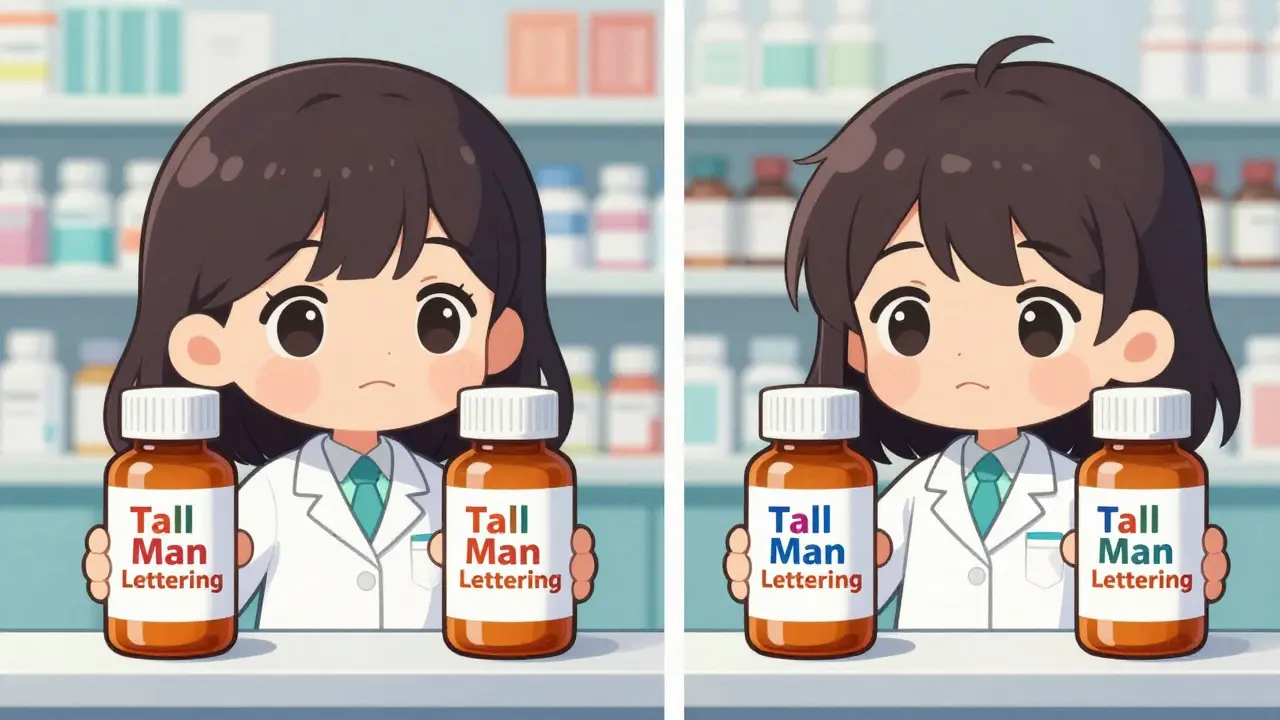
We can't just tell nurses to "be more careful." We need systems that make it hard to do the wrong thing. One of the most common tools is Tall Man Lettering, which is a method of using mixed-case letters to highlight the differences between similar-looking drug names. For example, instead of writing hydromorphone and hydrocodone, the FDA recommends HYDROmorphone and hYDROcodone. While some critics say this is only marginally effective, it provides a visual speed bump that forces the brain to stop and process the difference.
Beyond lettering, hospitals are moving toward more aggressive interventions:
- Customized LASA Lists: The Joint Commission advises against using generic lists. Instead, every hospital should create its own list based on the specific drugs they actually stock. If you don't use a certain drug, it shouldn't be on your alert list.
- Clinical Decision Support (CDS): Modern EHR systems now use software that pops up a warning when a doctor prescribes a drug that is a known LASA pair. If you type in a drug that looks like another, the system asks, "Did you mean X instead of Y?"
- Physical Separation: Stop storing look-alike drugs next to each other. By physically separating a high-alert drug from its look-alike counterpart on the pharmacy shelf, you remove the possibility of a "reach-and-grab" error.
- Double-Check Protocols: For hazardous drugs, requiring two separate clinicians to verify the drug name, dose, and patient before administration is still one of the most effective safety nets.
The Future of Medication Safety
We are moving toward a world where the software does the heavy lifting. The FDA is currently exploring mandatory orthographic and phonetic testing for every new drug name before it even hits the market. The goal is to stop the problem at the source-if a name is too similar to an existing drug, it simply isn't approved.
Even more futuristic is the use of AI. Researchers at Johns Hopkins are testing voice-recognition systems that can listen to a verbal order in a loud room and flag a potential LASA confusion in real-time, alerting the nurse that the requested drug sounds too similar to another high-risk medication. While technology is a huge help, the human element remains the final line of defense. The most successful healthcare systems are those that foster a "just culture," where staff feel safe reporting "near-misses" without fear of punishment, allowing the hospital to fix the system before a patient actually gets hurt.
What is the difference between a look-alike and a sound-alike drug?
Look-alike drugs are those with visual similarities, either in the spelling of their names (orthographic) or the appearance of their packaging and pills. Sound-alike drugs are those that sound nearly identical when spoken aloud (phonetic), which often leads to errors during verbal orders or phone communications.
Does Tall Man Lettering actually prevent all errors?
No, it is not a perfect solution. While it helps highlight differences (e.g., predNISON vs predNIZONE), some studies suggest it is only marginally effective because users may become desensitized to the capitalization over time. It works best when combined with other strategies like physical separation and double-checking.
Why are chemotherapy drugs particularly prone to LASA errors?
Chemotherapy agents often share similar naming conventions (prefixes and suffixes) and are managed by specialized teams who handle a large volume of these similarly-named drugs. Because these medications are highly toxic, even a small error in selecting the drug can lead to severe patient harm or death.
How can a pharmacy reduce the risk of LASA errors during dispensing?
Pharmacies can reduce risk by utilizing electronic prescribing to avoid handwriting errors, storing LASA pairs in separate bins, using distinctive labels or colored stickers to alert staff to high-risk drugs, and implementing a strict two-person verification process for high-alert medications.
What should a healthcare worker do if they encounter a "near-miss" LASA error?
Near-misses should be reported immediately to the facility's patient safety or quality department. Reporting these incidents allows the organization to identify dangerous drug pairs in their specific formulary and implement safeguards-like Tall Man lettering or relocated shelving-before a real error occurs.
8 Comments
Mary Johnson
This is exactly why you can't trust big pharma or the government with your health. They make these drugs sound and look the same on purpose to keep the medical system in a state of chaos so we're all just guinea pigs in their twisted little game of Russian roulette with our veins. It's not a "systemic failure" it's a feature of the design to ensure we stay dependent and terrified. Wake up people because once they start "standardizing" names they just have more control over who gets what and who doesn't survive the night in some corporate-owned ICU ward.
Scott Lofquist
Actually, the claim that Tall Man lettering is "marginally effective" is a total undergrad take 🙄. Anyone who actually understands cognitive ergonomics knows that visual disruption triggers a P300 wave in the brain, forcing a re-evaluation of the stimulus. It's basic neurology, really. Also, the FDA is way behind on the orthographic testing standards compared to what's happening in the EU. Get your facts straight before posting 💅✨
john chiong
absolute madness that we let these corporate vultures name drugs like they're picking out colors for a nursery while real people pay the price in blood and guts it is a moral bankruptcy of the highest order to prioritize branding over human life simply disgraceful
Princess Busaco
It is honestly just so typical that we are trying to solve a fundamental human failure with a few capital letters here and there as if that's going to magically fix the soul-crushing exhaustion of a nurse who has been on her feet for twelve hours straight in a system that views patients as numbers on a spreadsheet rather than actual human beings with families and hopes and dreams. I've seen this exact same apathy in my own holistic practice where people think a checklist is a substitute for actual mindfulness and presence, and frankly, the arrogance of thinking a "pop-up warning" on a computer screen can replace the intuitive connection between a healer and the sick is just beyond a joke at this point, it's a tragedy.
Catherine Mailum
oh wow a pop up window will definitely save everyone
i'm sure the nurses just love clicking 'ignore' on a hundred alerts a day while the patient is literally crashing
Clint Humphreys
I completely agree that the human element is the final line of defense, although it's quite fascinating to consider how the move toward AI voice-recognition might actually be a stealthy way for insurance companies to record every single verbal interaction in a hospital to find reasons to deny claims later on. It's a very friendly gesture on the surface, but if you analyze the data flow, you realize that the "safety net" is actually a net designed to catch the providers in a legal trap the moment a mistake happens, which is just how the system works these days, don't you think?
Tabatha Pugh
I actually work in a pharmacy and we don't use a generic list; we have a very specific internal protocol that involves secondary verification and physical distance between the Heparin and Insulin stocks. I've noticed that some of the newer staff struggle more with the phonetic ones though, especially when the pharmacy is loud and the phone is ringing off the hook, which is why we've started implementing a mandatory read-back policy for all verbal orders regardless of the drug type.
Rim Linda
This is literally a nightmare scenario! :O