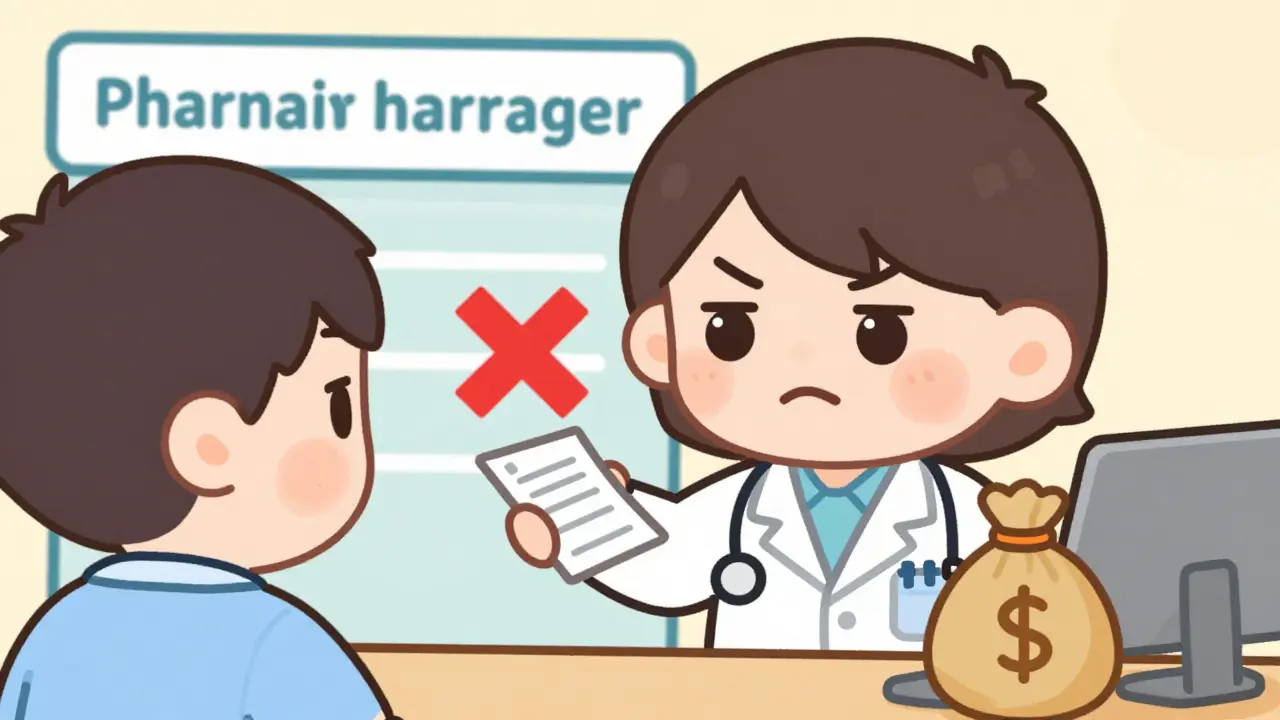
You'd think generic drugs, being cheaper, wouldn't need extra steps. But that's changing. Today, even common generics like metformin or lisinopril sometimes require prior authorization a process where insurance companies require approval before covering certain medications from your insurance before you can get them. This counterintuitive practice is causing delays, higher costs, and even health risks for patients.
Why Generics Now Require Approval
Generics make up 90% of all prescriptions filled in the U.S., yet they now face prior authorization in 15-20% of cases. That's up from just 5% in 2018, according to the Generic Pharmaceutical Association. Why? It boils down to how pharmacy benefit managers (PBMs) operate. PBMs pharmacy benefit managers organizations that manage prescription drug programs for insurance companies control which drugs insurers cover and often prioritize generics based on rebates from manufacturers, not clinical need. For example, a PBM might push a specific generic version of a blood pressure drug because it offers higher rebates-even if another generic works just as well. This turns cost-saving drugs into administrative hurdles.
The American Medical Association's 2023 survey found 93% of physicians report prior authorization causes treatment delays, with 24% seeing serious health issues like hospitalizations directly linked to these delays. Meanwhile, CoverMyMeds data shows healthcare practices spend an average of 43 prior authorization requests per physician weekly, with 38% involving generics. This isn't just paperwork-it's time stolen from patient care.
How the Process Works for Generics
When your doctor prescribes a generic that needs prior authorization, they must submit clinical details to your insurer. This could be done electronically, by fax, or phone. For instance, CoverMyMeds a digital platform for submitting prior authorization requests shows providers who use electronic submissions cut approval time by 32% compared to fax or phone. Documentation usually includes specific ICD-10 codes standardized diagnostic codes used in medical billing matching the medication's purpose, proof of failed treatments (if step therapy applies), and clinical notes explaining why the generic is necessary.
Approval times vary widely. Cigna states decisions take 5-10 business days, while Mayo Clinic notes it can stretch to "a few weeks" depending on urgency and insurer responsiveness. For emergencies, providers can request "urgent" status-Cigna processes these within 72 hours-but delays still happen. A 2024 Journal of the American Pharmacists Association study found even urgent requests take days to resolve in practice.
Real Impact on Patients and Providers
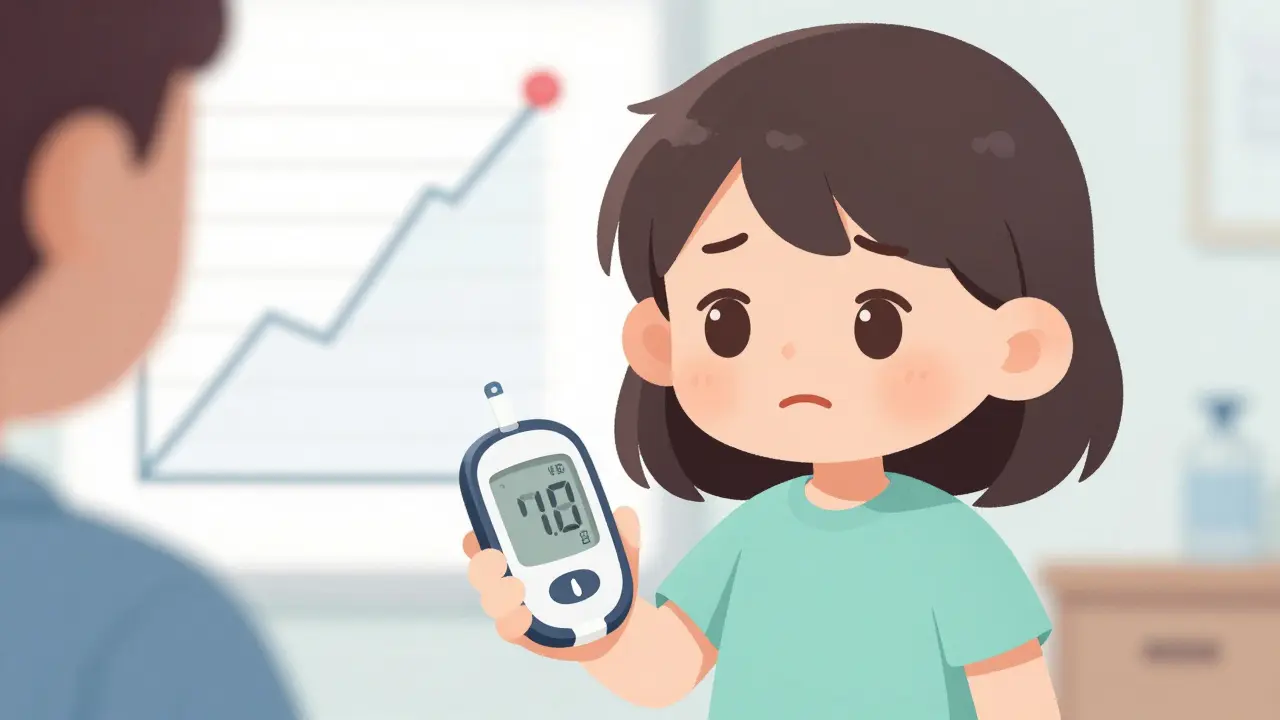
Real-world consequences are severe. In a Kaiser Family Foundation case study, a diabetic patient faced a 14-day delay for generic metformin due to prior authorization. Their HbA1c levels jumped from 6.8% to 8.2% during the wait, worsening their condition. On Reddit's r/healthinsurance community, a September 2024 thread about metformin requiring prior authorization had 147 comments. One provider wrote: "My clinic spends 17.3 hours weekly on prior auths for generics. That's nearly half a full-time employee's time on paperwork instead of patients."
Step therapy requirements-where insurers force patients to try cheaper drugs first-often apply to generics. The Crohn's & Colitis Foundation documented cases where generic immunosuppressants like methotrexate needed prior authorization despite being first-line treatments for inflammatory bowel disease. This creates absurd situations where patients with life-threatening conditions wait for approval of drugs meant to save them.
Current Reforms Changing the Game
Laws and industry changes are pushing back against this trend. The 2024 Improving Seniors' Timely Access to Care Act, signed in December 2023, requires Medicare Advantage plans to use electronic prior authorization by 2026 and mandates 72-hour responses for urgent requests. California's SB 1024 (effective January 2025) bans prior authorization for medications on the state's Essential Drug List, including 47 common generics like insulin and asthma inhalers.
Major insurers also agreed in June 2025 to streamline processes. CVS Health (Aetna), UnitedHealthcare, Cigna, Humana, Elevance Health, and Blue Cross Blue Shield announced they'll eliminate prior authorization for 12 common generic drug classes starting January 2026. This includes ACE inhibitors, statins, and metformin-drugs critical for heart health and diabetes management. The American Gastroenterological Association's May 2025 position statement called for eliminating prior authorization for "all first-line generic medications for chronic conditions," citing evidence it increases total healthcare costs by 18% due to treatment delays and complications.
What You Can Do Now
If your generic medication requires prior authorization:
- Ask your doctor to submit the request electronically through platforms like CoverMyMeds-it's 32% faster than fax or phone.
- Ensure all required documentation is included: specific ICD-10 codes, proof of previous treatment failures (if needed), and clinical notes explaining why the medication is necessary.
- For urgent cases, request "urgent" status. Cigna processes these within 72 hours, though other insurers may vary.
- If denied, appeal with additional clinical evidence. The Crohn's & Colitis Foundation notes 67% of denials are overturned with proper documentation.
Patients should also track all prior authorization communications. Keep copies of approval letters, denials, and appeals. Many states now restrict prior authorization for certain generics; for example, 34 states have limits on Medicaid prior authorization for generic drug classes, according to MACPAC's 2024 report. Check your state's rules-this could save you time and health risks.
What's Next for Prior Authorization?
The Congressional Budget Office projects a 40% reduction in prior authorization requirements for generics by 2028 if current reforms continue. But until then, the system remains broken. As Dr. Robert W. Dubois of the National Pharmaceutical Council stated in a May 2024 Health Affairs blog, "Expanding prior authorization to generics undermines the cost-saving purpose of generic medications and creates unnecessary administrative burden." Meanwhile, insurers argue it ensures "clinically appropriate treatment," but the data shows clear harm: treatment delays, higher costs, and avoidable health crises.
Why do insurance companies require prior authorization for generic drugs?
Insurance companies require prior authorization for generics primarily due to rebate agreements between pharmacy benefit managers (PBMs) and drug manufacturers. PBMs often prioritize specific generic versions that offer higher rebates, even if other generics are equally effective. This practice contradicts the intended cost-saving purpose of generics. For example, a PBM might push a particular generic blood pressure drug because it gives them a larger rebate, forcing patients to wait for approval despite the drug being cheaper than the brand-name version.
How long does prior authorization for generics usually take?
Approval times vary significantly. Cigna states decisions take 5-10 business days, while Mayo Clinic reports the process can range from "a few days to a few weeks" depending on urgency and insurer responsiveness. Urgent requests are processed faster-Cigna handles them within 72 hours-but delays still occur. A 2024 Journal of the American Pharmacists Association study found electronic submissions reduce approval time by 32% compared to fax or phone.
What should I do if my generic medication requires prior authorization?
First, ask your doctor to submit the request electronically through platforms like CoverMyMeds-it's 32% faster than fax or phone. Ensure all required documentation is included: specific ICD-10 diagnostic codes, proof of previous treatment failures (if step therapy applies), and clinical notes explaining why the medication is necessary. If denied, appeal with additional clinical evidence; 67% of denials are successfully overturned with proper documentation.
Are there any laws changing how prior authorization works for generics?
Yes. The 2024 Improving Seniors' Timely Access to Care Act requires electronic prior authorization for Medicare Advantage plans by 2026 and mandates 72-hour responses for urgent requests. California's SB 1024 (effective January 2025) prohibits prior authorization for medications on the state's Essential Drug List, including 47 commonly prescribed generics. Major insurers also agreed in June 2025 to eliminate prior authorization for 12 common generic drug classes like ACE inhibitors, statins, and metformin starting in 2026.
Can prior authorization for generics cause health risks?
Absolutely. The American Medical Association's 2023 survey found 24% of physicians have witnessed serious adverse events due to prior authorization delays, including hospitalizations. A Kaiser Family Foundation case study showed a diabetic patient's HbA1c levels rose from 6.8% to 8.2% during a 14-day delay for generic metformin, worsening their diabetes control. For patients with conditions like hypertension or chronic pain, even short delays can lead to dangerous complications.
12 Comments
Matthew Morales
priror auth for generics is such a hassle. my dr had to call for metformin. 😕
Jennifer Aronson
The data shows prior authorization for generics has risen from 5% in 2018 to 15-20% today. This creates significant delays in patient care.
anjar maike
Prior auth for generics is messed up 😤
Diana Phe
Big Pharma controls everything. 😡
Kate Gile
I totally get it. My clinic spends about 17 hours a week on prior auth paperwork. It's frustrating, but we're pushing for changes.
Sam Salameh
This is ridiculous. Prior auth for generics is killing our healthcare system. We need to fix this ASAP.
Arjun Paul
This is why US healthcare is broken. Prior auth for generics is unnecessary.
divya shetty
You should be aware of the state laws regarding prior authorization. Many states have restrictions on Medicaid prior auth for generics.
Lana Younis
The whole prior authorization process for generics is a mess. PBMs are supposed to manage costs, but instead they're using rebates to push specific generics that aren't necessarily better.
This means doctors have to jump through hoops to get patients the meds they need. For example, metformin for diabetes or lisinopril for blood pressure.
The AMA survey says 93% of physicians see treatment delays because of this. And it's not just paperwork; it's actual health risks.
A diabetic patient's HbA1c can spike during a delay. Plus, the time spent on prior auths takes away from patient care.
My clinic spends 17 hours a week on this stuff. The new laws are a step forward, but we need more.
States like California are banning prior auth for essential drugs. Medicare Advantage plans have to use electronic submissions by 2026.
But until then, patients are suffering. It's frustrating because generics are supposed to save money, not create more bureaucracy.
This whole system needs a complete overhaul. The pharmaceutical companies and PBMs need to stop prioritizing profits over patient health.
It's time to make healthcare accessible and efficient. Prior auth for generics is counterproductive and needs to be eliminated for all first-line medications.
The data shows it increases costs by 18% due to delays. We need to push for change now.
Samantha Beye
It's important to advocate for changes. There are steps patients can take to speed up the process.
one hamzah
This is tough but we can fix it! 🙌 The new laws in California and federal act are steps in the right direction.
Jenna Elliott
The laws are just a bandaid. Big pharma controls everything. They want you sick. No wonder healthcare costs are high.