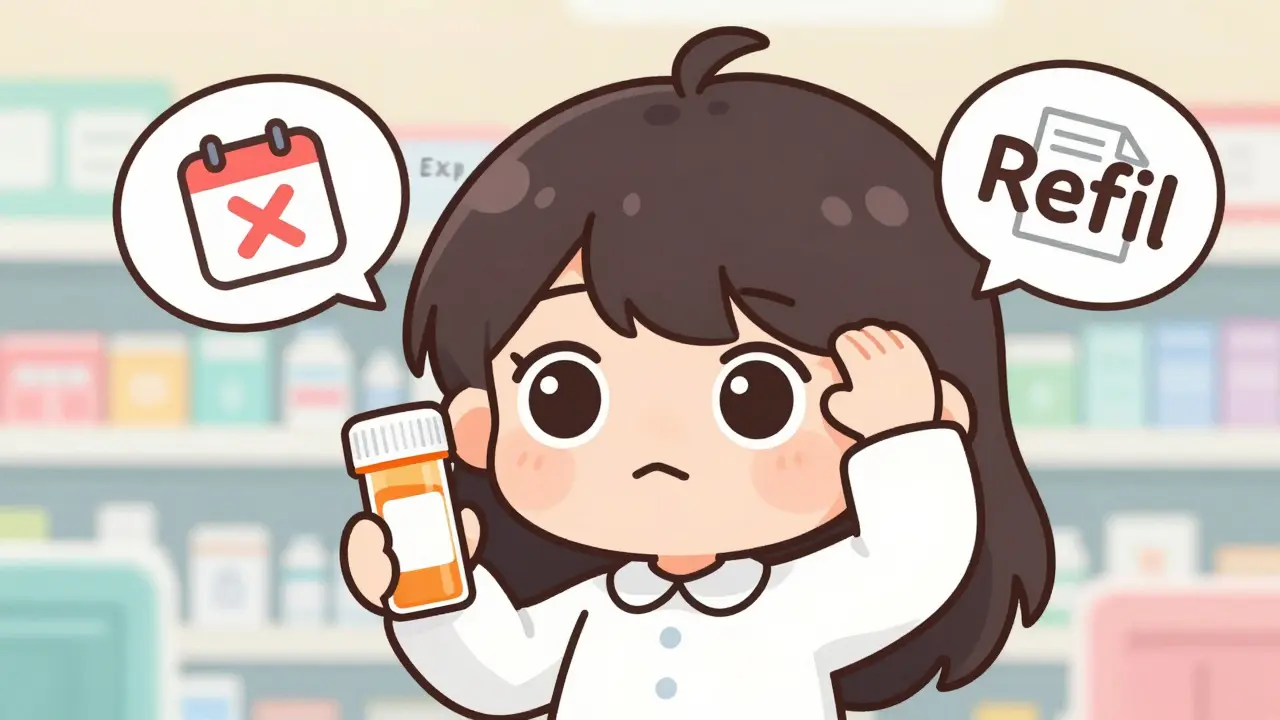
Have you ever stared at your prescription bottle, confused by two different dates printed right next to each other? You’re not alone. Most patients see an Expiration Date and a Refill-Through Date (sometimes called Refill-By) and assume they mean the same thing. They don’t. Mixing them up can lead to wasted money, dangerous gaps in treatment, or even taking medication that has lost its potency.
Understanding these two dates is crucial for your health and your wallet. One tells you when the drug itself becomes unsafe to take. The other tells you when your permission from the doctor runs out. Let’s break down exactly what each date means, why they exist, and how to manage them so you never miss a dose or throw away good medicine.
The Expiration Date: A Safety Limit
The Expiration Date is the deadline set by the manufacturer based on scientific stability testing. This is the point after which the pharmaceutical company cannot guarantee that the medication remains safe and effective. It’s not just a formality; it’s a hard limit on chemical integrity.
According to the U.S. Food and Drug Administration (FDA), this date is determined through rigorous stability testing under controlled conditions. For most solid oral medications like pills and capsules, this date is typically one year from the day the pharmacy dispenses the drug. However, for compounded liquids or refrigerated items, this window might be as short as 30 days.
- What it controls: The chemical stability of the drug.
- Who sets it: The drug manufacturer and the dispensing pharmacist.
- The risk: Taking medication past this date could result in reduced effectiveness or potential harm due to degradation.
A common myth is that all drugs stay potent long after this date. While some studies suggest certain medications maintain potency if stored perfectly, legally and medically, pharmacists are prohibited from dispensing drugs past their labeled expiration date. If the date says May 2026, do not take it in June 2026.
The Refill-Through Date: An Administrative Deadline
The Refill-Through Date is the final day you can claim remaining refills authorized by your prescriber. Unlike the expiration date, this isn’t about chemistry-it’s about authorization. It marks the end of the legal validity of your current prescription order.
This date is variable and determined by state laws, insurance plans, and the prescribing doctor. In many states, a standard non-controlled substance prescription expires one year from the original fill date. However, for controlled substances (like ADHD medications or strong painkillers), the window is often much shorter-sometimes just six months or even less.
- What it controls: Your legal right to get more pills from this specific prescription.
- Who sets it: State pharmacy boards, DEA regulations, and insurance policies.
- The risk: Missing this date means you must contact your doctor for a new prescription, leading to delays in care.
If your Refill-Through Date is January 15, 2027, but your medication doesn’t expire until March 2028, you still need a new prescription from your doctor before January 15 to keep getting your meds. The pharmacy cannot legally give you the drug without that valid authorization.

Why the Confusion Causes Real Problems
It’s easy to mix these up because they both look like deadlines. But the consequences of confusing them are very different. A study published in Pharmacy Times found that nearly 70% of medication access issues stem from patients misunderstanding these labels.
Consider this scenario: You have high blood pressure medication. The bottle says "Refill-Through: Dec 2026" and "Exp: Jan 2027." You finish your pills in November. You realize you forgot to refill. You wait until January. By then, the Refill-Through date has passed. Even though the pills are still chemically fine (they haven't expired), the pharmacy system blocks the refill. You now have to call your doctor, wait for a new script, and potentially go without medication for days. That gap in treatment is dangerous.
Conversely, some people see the Refill-Through date pass and think the whole bottle is bad news. They throw away unexpired medication, wasting hundreds of dollars. In one Reddit thread, a user reported discarding $300 worth of insulin because they thought the refill deadline meant the drug was spoiled. It wasn’t.
| Feature | Expiration Date | Refill-Through Date |
|---|---|---|
| Primary Purpose | Safety & Potency | Legal Authorization |
| Determined By | Manufacturer/Science | Doctor/State Law/Insurance |
| Typical Duration | 1 Year (or less for liquids) | Varies (6 months for controlled substances) |
| Action Required After Date | Discard Medication | Contact Doctor for New Rx |
| Impact on Health | Risk of ineffective/toxic drug | Risk of treatment interruption |
How to Manage Both Dates Effectively
You don’t need to be a pharmacist to handle these dates, but you do need a system. Relying on memory often leads to mistakes. Here are practical steps to stay on top of both timelines.
- Check the Label Immediately: When you pick up a new prescription, write down both dates in a calendar app or a dedicated medication log. Don’t wait until you’re half-empty.
- Set Early Reminders: Set a phone alert for 7-10 days before the Refill-Through Date. This gives you time to request a refill or contact your doctor if you need a renewal. Don’t wait until the last day.
- Monitor Supply Levels: If you know you’ll run out of pills before the Refill-Through date, plan ahead. Many pharmacies allow you to schedule automatic refills.
- Understand Controlled Substances: If you take Schedule II drugs (like Adderall or Oxycodone), be extra vigilant. These often have strict 6-month limits and cannot be refilled electronically without a new physical prescription in many jurisdictions.
- Ask Questions: If the dates seem close together or unclear, ask your pharmacist. They spend minutes verifying this info for every bottle and can explain your specific situation.
Technology is also helping. Major chains like CVS and Walgreens are introducing color-coded labels-often using red for safety-critical expiration dates and blue for administrative refill dates-to make the distinction visually obvious. Some apps even scan QR codes on bottles to provide video explanations of these terms.
Special Cases: Insurance and Medicare
Your insurance plan adds another layer of complexity. Sometimes, your insurance will stop paying for refills before the pharmacy’s Refill-Through date expires. This is known as a coverage gap or benefit period reset.
For Medicare Part D beneficiaries, misalignment between insurance cycles and prescription authorizations is a major issue. Data shows that over 30% of seniors experience coverage gaps because their insurance plan resets while their prescription is still technically valid. Always check with your insurer about your specific refill allowances, not just the pharmacy’s limits.
If you travel frequently, remember that federal law allows you to carry a reasonable amount of medication, but international borders may have stricter rules regarding expiration dates. Always carry your prescription label when traveling abroad.
Can I refill my prescription after the Refill-Through date?
No. Once the Refill-Through date passes, the prescription is no longer valid. You must contact your healthcare provider to obtain a new prescription authorization before the pharmacy can dispense more medication.
Is it safe to take medication one month past the expiration date?
Generally, no. While some studies show certain drugs retain potency briefly after expiration, there is no guarantee of safety or efficacy. The FDA advises against using medications past their labeled expiration date, especially for critical treatments like heart medication or insulin.
Why does my controlled substance prescription expire faster than others?
Controlled substances (Schedule II-V) are regulated more strictly by the DEA to prevent misuse and diversion. Most states limit the validity of these prescriptions to six months from the date written, whereas non-controlled drugs often remain valid for one year or longer.
What should I do if my medication expires before I use it all?
Do not take the expired medication. Contact your pharmacist for disposal instructions. Many pharmacies have take-back bins for safe disposal. Do not flush medications unless specifically instructed to do so, as this can harm the environment.
Does the Refill-Through date affect my insurance coverage?
Yes. Insurance plans often have their own refill windows that may align with or differ from the pharmacy's Refill-Through date. If you miss the insurance window, you might have to pay out-of-pocket even if the pharmacy would otherwise accept the refill.