
REM sleep behavior disorder isn’t just about talking in your sleep or kicking out during a dream. It’s when your brain stops turning off your muscles during REM sleep - the stage where most dreaming happens. Normally, your body is paralyzed during this phase to keep you from acting out dreams. But in RBD, that safety switch fails. You might punch, yell, jump out of bed, or even run into walls - all while still asleep. This isn’t rare. It affects about 1 in 200 adults over 50, and it’s often the first sign of something far more serious: Parkinson’s disease, dementia with Lewy bodies, or multiple system atrophy.
What Happens During an RBD Episode?
Imagine dreaming you’re being chased. In a normal sleep, your body stays still. In RBD, your body responds like you’re really running. You might flail your arms, shout, kick, or leap out of bed. These episodes usually happen in the second half of the night, when REM sleep is longest. They’re not just random movements - they match the content of the dream. A 2017 study found people with RBD act out their dreams an average of 4.2 times per hour. That’s more than once every 15 minutes. Bed partners often wake up bruised, scratched, or terrified. One spouse described it as "sleeping next to a stranger who suddenly turns violent."
The problem isn’t just the violence. It’s the risk of injury. Falls, broken bones, head trauma - all common. A 2019 study found 78% of people with RBD made changes to their bedroom: removing sharp furniture, adding padding, taking down weapons, or putting down thick rugs. Even then, 42% still end up sleeping separately from their partner because it’s too dangerous.
How Is RBD Diagnosed?
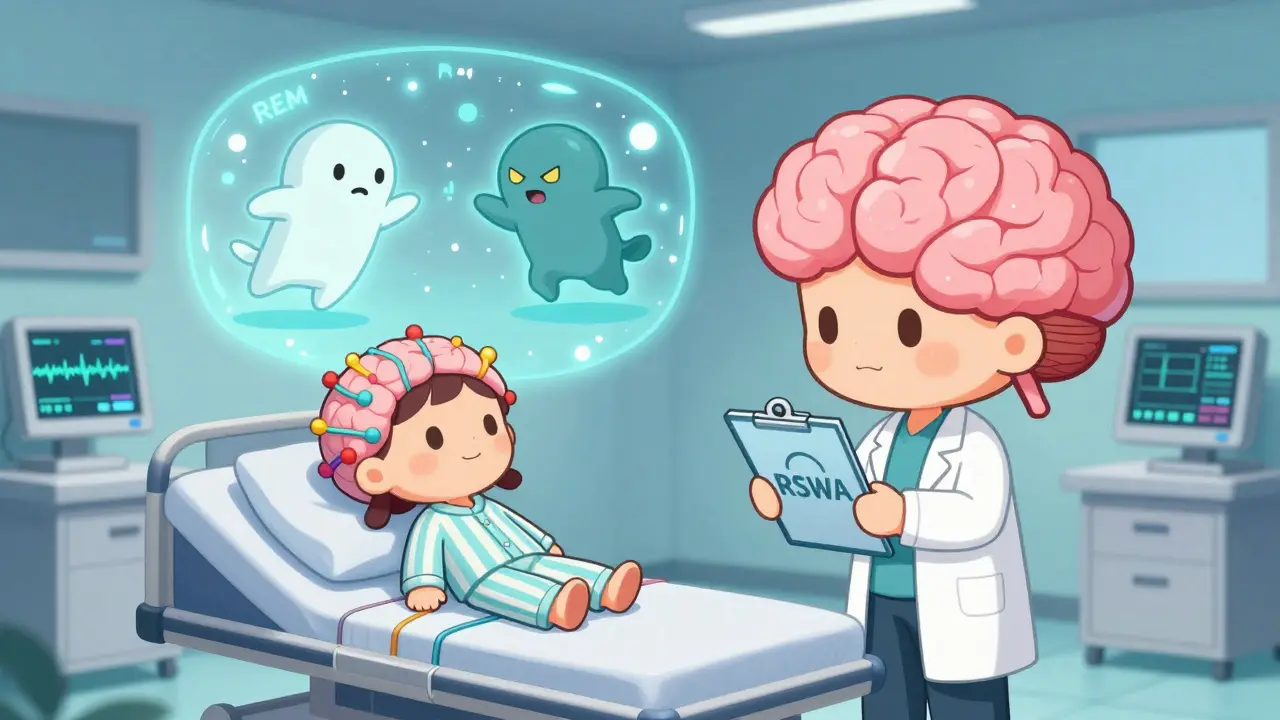
You can’t diagnose RBD with a questionnaire or a quick exam. You need a sleep study - polysomnography (PSG). This is the only way to confirm it. During the test, electrodes track brain waves, eye movements, muscle activity, heart rate, and breathing. The key finding? REM sleep without atonia (RSWA). That means your muscles aren’t paralyzed like they should be during REM sleep. The International Classification of Sleep Disorders says RSWA must be present in at least 15% of REM sleep epochs to confirm RBD.
Doctors also rule out other causes. Seizures, sleep apnea, or certain medications (like antidepressants) can mimic RBD. If you’re taking SSRIs, SNRIs, or tricyclics, those could be triggering the behavior. Stopping them might fix the problem - but only if RBD isn’t already linked to something deeper.
Why Does RBD Matter Beyond the Bed?
Here’s the hard truth: RBD is rarely just a sleep problem. About 90% of cases are tied to underlying brain diseases that involve abnormal proteins called alpha-synuclein. These are called synucleinopathies - Parkinson’s, dementia with Lewy bodies, and multiple system atrophy. A 2010 study followed 328 people with idiopathic RBD (no known cause) for 12 years. Of those, 73.5% developed one of these neurodegenerative diseases. That’s more than 7 in 10.
Even scarier: the risk doesn’t stop after 12 years. A 2019 review in Lancet Neurology found people with RBD have a 6.3% chance each year of developing Parkinson’s or another synucleinopathy. That’s higher than the risk of stroke or heart attack in many high-risk groups. RBD isn’t a symptom - it’s a warning sign. And it often appears 10 to 15 years before motor symptoms like tremors or stiffness show up.
Medications: What Actually Works?
There are no FDA-approved drugs for RBD. Everything used is off-label. But two options have strong real-world support: melatonin and clonazepam.
Melatonin is the first choice for most neurologists today. It’s a natural hormone your body makes to regulate sleep. In RBD, it helps restore muscle control during REM. Dosing starts at 3 mg at bedtime. Most people need to go up to 6 mg, 9 mg, or even 12 mg. It takes 2 to 4 weeks at each dose to see if it’s working. About 65% of patients see big improvements. Side effects? Mild. Maybe a little morning grogginess. One 68-year-old man went from 7 episodes a week to just 1 after starting 6 mg. He kept sleeping in the same bed with his wife.
Clonazepam - a benzodiazepine - has been used since the 1980s. It’s more effective, with 80-90% of patients responding. It works fast - often within a week. But it comes with risks. Dizziness happens in 22% of users. Unsteadiness in 18%. Daytime sleepiness in 15%. For older adults, the risk of falls jumps by 34%. One patient stopped after 3 months because he started falling twice a month. Another worry: dependence. If you stop clonazepam suddenly, 38% get bad nightmares or agitation. That’s why doctors taper it slowly - by 0.125 mg every 1 to 2 weeks.
Here’s how neurologists are choosing today: 58% start with melatonin. 32% start with clonazepam. 10% use both. Melatonin wins for safety. Clonazepam wins for speed and strength. But for someone over 70, or with balance issues, melatonin is the obvious pick.
Other Options - What’s on the Horizon?
Pramipexole, a drug used for Parkinson’s and restless legs, helps about 60% of RBD patients - especially if they also have leg movements at night. But it can cause nausea, dizziness, or even impulse control problems. Rivastigmine, an Alzheimer’s drug, showed promise in one small trial for RBD patients with mild memory loss. But it’s not a standard option.
The most exciting new direction? Dual orexin receptor antagonists. Orexin is a brain chemical that keeps you awake. Blocking it helps you sleep more deeply - and might stop the muscle activity during REM. Mount Sinai’s 2023 research showed these drugs cut dream enactment behaviors by 78% in animal models. Suvorexant (Belsomra), already approved for insomnia, is being tested for RBD. Neurocrine Biosciences is developing NBI-1117568, a more targeted version. The FDA gave it Fast Track status in January 2023. That means approval could come faster.

What You Must Do Beyond Medication
Medication alone isn’t enough. Safety comes first. Here’s what every RBD patient needs to do:
- Remove all weapons from the bedroom - knives, guns, tools.
- Pad sharp corners of furniture.
- Place thick carpets or foam mats next to the bed.
- Install bed rails if you’re at risk of falling.
- Avoid alcohol. Even one or two drinks can trigger an episode in 65% of people.
- Don’t sleep on the bottom bunk or near windows.
These steps aren’t optional. They’re lifesaving. And they work - even if medication doesn’t fully stop the episodes.
Neurological Monitoring: The Long Game
If you have RBD, you need to see a neurologist every year. Not just for sleep. For your brain. The American Academy of Neurology recommends annual checkups to look for early signs of Parkinson’s or dementia. That means testing movement, memory, smell, and autonomic function (like blood pressure control). Early detection means earlier treatment - and possibly better outcomes.
There’s hope on the horizon. Researchers are now testing drugs that might stop the spread of alpha-synuclein in the brain. If they work, they could delay or even prevent Parkinson’s in people with RBD. That’s the real goal: not just stopping the kicks and shouts - but stopping the disease before it starts.
Final Thoughts
RBD is more than a sleep problem. It’s a neurological red flag. The good news? We can treat the symptoms. We can keep people safe. We can improve sleep for patients and their partners. The better news? We’re getting closer to stopping the disease behind it. For now, melatonin and safety changes are your best tools. Clonazepam works - but only if you can manage the risks. And if you’re diagnosed with RBD, don’t ignore it. See a neurologist. Get tested. Take action. Because what happens in your sleep tonight might be the first clue to what happens to your brain tomorrow.
Can REM sleep behavior disorder be cured?
No, RBD cannot be cured - but it can be managed effectively. Medications like melatonin and clonazepam reduce or stop dream enactment in most patients. However, since RBD is often a warning sign of Parkinson’s disease or dementia with Lewy bodies, the underlying brain changes continue to progress. Current treatments control symptoms but don’t stop the neurodegeneration. Research is now focused on finding therapies that can delay or prevent these diseases in RBD patients.
Is RBD always a sign of Parkinson’s disease?
Not always, but very often. About 90% of RBD cases are linked to neurodegenerative diseases involving alpha-synuclein, such as Parkinson’s disease, dementia with Lewy bodies, or multiple system atrophy. In about 10% of cases, RBD is idiopathic - meaning no clear cause is found at diagnosis. But even in these cases, up to 74% will develop a neurodegenerative disorder within 12 years. So while RBD doesn’t guarantee Parkinson’s, it’s one of the strongest predictors we have.
Can alcohol make REM sleep behavior disorder worse?
Yes. Even one or two drinks can trigger or worsen RBD episodes in 65% of patients. Alcohol disrupts the normal sleep cycle and reduces REM sleep suppression - which is already impaired in RBD. Many patients report more violent or frequent dream enactment after drinking. For this reason, doctors strongly advise complete avoidance of alcohol. Some patients see dramatic improvement just by cutting out alcohol, even before starting medication.
What’s the difference between melatonin and clonazepam for RBD?
Melatonin is a natural hormone that helps regulate sleep and restore muscle control during REM. It’s safer, with mild side effects like drowsiness. It works in about 65% of patients but takes weeks to show results. Clonazepam is a prescription sedative that acts faster - often within days - and works in 80-90% of cases. But it carries risks: dizziness, falls, dependence, and withdrawal symptoms like nightmares if stopped suddenly. For older adults or those with balance problems, melatonin is preferred. For younger, healthier patients with severe symptoms, clonazepam may be chosen if risks are managed.
Do I need a sleep study to be diagnosed with RBD?
Yes. A sleep study called polysomnography (PSG) is required to confirm RBD. It’s the only way to detect REM sleep without atonia (RSWA), the key brain signature of the disorder. Other conditions like seizures or sleep apnea can mimic RBD symptoms. Without a PSG, you might get the wrong diagnosis and wrong treatment. Even if your doctor suspects RBD based on your symptoms, they’ll still refer you for a sleep study to be sure.
Can RBD be treated without medication?
Safety measures alone can reduce injury risk, but they won’t stop the dream enactment. Removing weapons, padding furniture, and avoiding alcohol are essential - but they don’t fix the underlying brain issue. Most patients need medication to reduce or eliminate episodes. However, in rare cases where RBD is caused by a medication like an antidepressant, stopping that drug may resolve symptoms without needing other treatments. Always consult a sleep specialist before making any changes.
How often should I see a neurologist if I have RBD?
You should have a neurological checkup at least once a year. RBD is a strong predictor of Parkinson’s disease, dementia with Lewy bodies, or multiple system atrophy. Annual exams help detect early signs like subtle tremors, loss of smell, constipation, or changes in mood or memory. Early detection means earlier intervention, which can improve quality of life and slow progression. Some neurologists may recommend more frequent visits if you have other risk factors or worsening symptoms.
Are there new drugs being developed for RBD?
Yes. The most promising new class is dual orexin receptor antagonists, which target the brain’s wakefulness system. Suvorexant (Belsomra) is already approved for insomnia and is being tested for RBD. Neurocrine Biosciences’ drug NBI-1117568, a selective orexin-2 blocker, received Fast Track designation from the FDA in January 2023. Early studies show it reduces dream enactment behaviors with fewer side effects than clonazepam. Phase II trials are ongoing, with results expected in 2024. These drugs could become first-line treatments in the next few years.
12 Comments
Himanshu Singh
Man, this hit different. I used to think my dad was just having wild dreams until he broke a lamp trying to "fight off a bear" in his sleep. 🙃 Turns out it wasn't just bad dreams - it was his brain not turning off his muscles. Melatonin fixed it for him. No more bruises on my mom’s arms. Just quiet nights now. 🙏
Jamie Hooper
so like… rbd = pre-parkinson’s? 😳 like… my grandad started acting weird in his sleep 10 years ago and now he can’t walk without a cane… i’m kinda panicking rn. why does no one talk about this??
Husain Atther
It’s sobering to realize that what appears to be a sleep disturbance may be the earliest whisper of a neurological shift. The data is compelling - RBD isn’t merely a symptom but a sentinel event. While pharmacological interventions offer relief, the real imperative lies in longitudinal neurological monitoring. Early detection remains our most potent tool against the inevitable progression of synucleinopathies.
Helen Leite
WAIT. So if you have RBD, you’re basically a walking time bomb for Parkinson’s?? 😱 And they’re not telling us this?? I bet Big Pharma is hiding the cure so people keep buying clonazepam forever. Also, I think the government is using orexin drugs to control our dreams. 🤫👁️🗨️
Izzy Hadala
While the clinical utility of melatonin and clonazepam in the management of REM sleep behavior disorder is well-documented, the absence of FDA approval for these indications raises significant questions regarding standardization of care. Furthermore, the longitudinal progression rate of 6.3% annually toward synucleinopathy warrants reconsideration of RBD as a prodromal biomarker rather than a discrete clinical entity.
Elizabeth Cannon
my aunt had this and she just stopped drinking alcohol and her episodes dropped by 90%. no meds. just no booze. why isn’t everyone screaming this?? also, pad your damn floor. i’m not cleaning up broken glass again.
Marlon Mentolaroc
so let me get this straight - you’re telling me that 70% of people with RBD end up with Parkinson’s? and we’re just giving them melatonin like it’s a bedtime snack? that’s not treatment, that’s putting a bandaid on a hemorrhage. this is a neurological emergency and we’re treating it like a bad dream.
Gina Beard
It’s not the kicks. It’s the silence after.
Don Foster
Most people don’t realize that RBD is basically the brain’s way of screaming that it’s dying. You think melatonin fixes it? Nah. It just makes you sleep better while your neurons turn to mush. Clonazepam? That’s just chemical sedation. The real fix? Stop eating processed carbs and start doing cold plunges. I read it on a blog. It’s science.
siva lingam
so you spent 2000 words to say "sleep weirdly = brain failing" and then sell melatonin? cool. i’ll just sleep on the floor.
Phil Maxwell
My brother was diagnosed last year. He started melatonin and now he doesn’t flail anymore. We still sleep in separate rooms though. Just in case. Honestly, I’m just glad he’s still here. This post really put things in perspective.
Himanshu Singh
Phil, I feel you. My dad’s still sleeping alone too. But now he tells me his dreams are calmer. Like he’s just watching a movie instead of being in it. That’s the win. Melatonin didn’t cure him - but it gave him back his peace. And that’s enough for now.