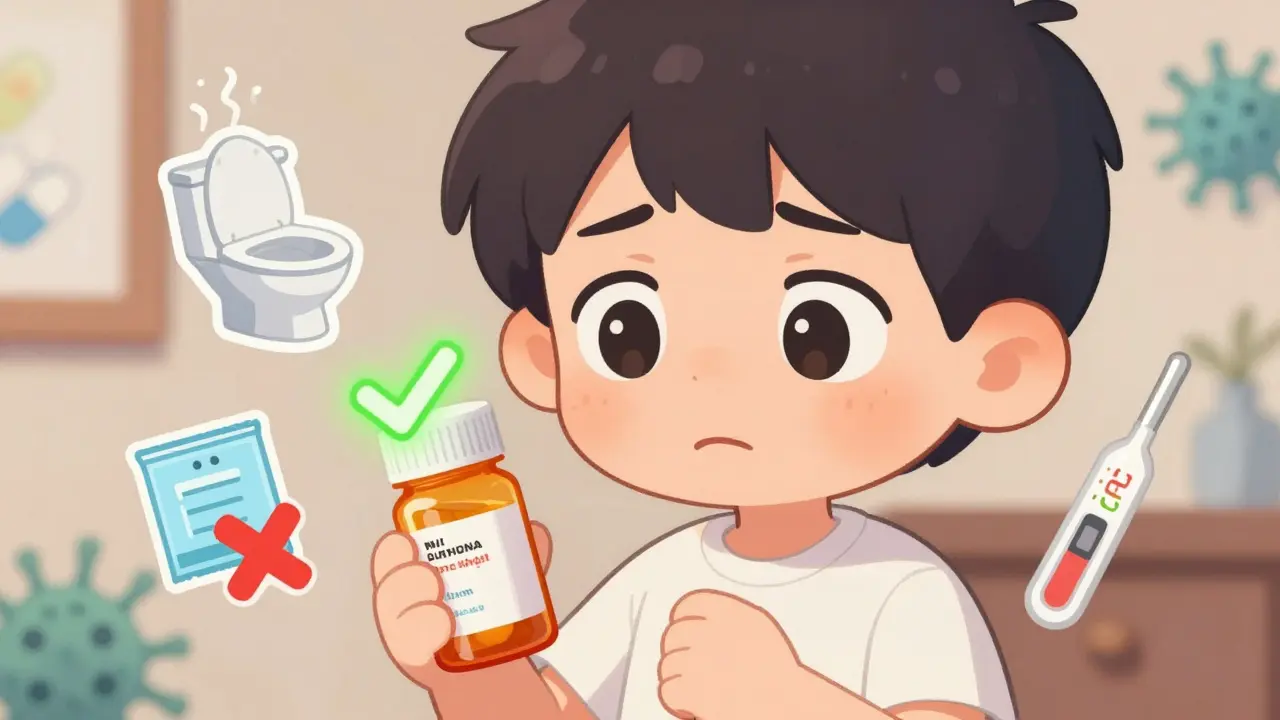
Most people think expired antibiotics are dangerous-like poison sitting in the medicine cabinet. But here’s the truth: expired antibiotics usually don’t turn toxic. They just stop working as well as they should. And that’s worse than you think.
What Does an Expiration Date Actually Mean?
The date on your antibiotic bottle isn’t a "use-by" warning like milk. It’s a manufacturer’s guarantee: until that date, they promise the drug will still have at least 90% of its labeled strength, if stored properly. After that? They don’t test it anymore. That doesn’t mean it’s useless. It means they’re no longer legally responsible if it fails.
The U.S. government tested over 3,000 lots of drugs-including antibiotics-through the Shelf Life Extension Program. The results? About 90% of them, even 15 years past their expiration date, still worked at or above 90% potency. That includes pills like amoxicillin, cephalexin, and doxycycline. But here’s the catch: those were stored in controlled, cool, dry labs-not your bathroom.
Not All Antibiotics Are the Same
Some antibiotics hold up. Others fall apart fast. Solid pills and capsules? Generally stable. Liquid suspensions? Not so much.
Take amoxicillin. The tablet form can sit on your shelf for years and still work. But once you mix it with water to make the kids’ syrup? That clock starts ticking. Studies show it loses nearly half its strength in just seven days after expiration, especially if left at room temperature. By two weeks, it might be barely effective.
Beta-lactam antibiotics-like penicillin and cephalosporins-are especially fragile. They break down when exposed to moisture and heat. Even if the bottle looks fine, the active ingredient could be gone. And you won’t know. Eighty-nine percent of degraded antibiotics show no visible change-no color shift, no smell, no clumping. You can’t taste it. You can’t see it. That’s the danger.
Why Taking Expired Antibiotics Is Riskier Than You Think
It’s not just about the infection not going away. The real threat is antibiotic resistance.
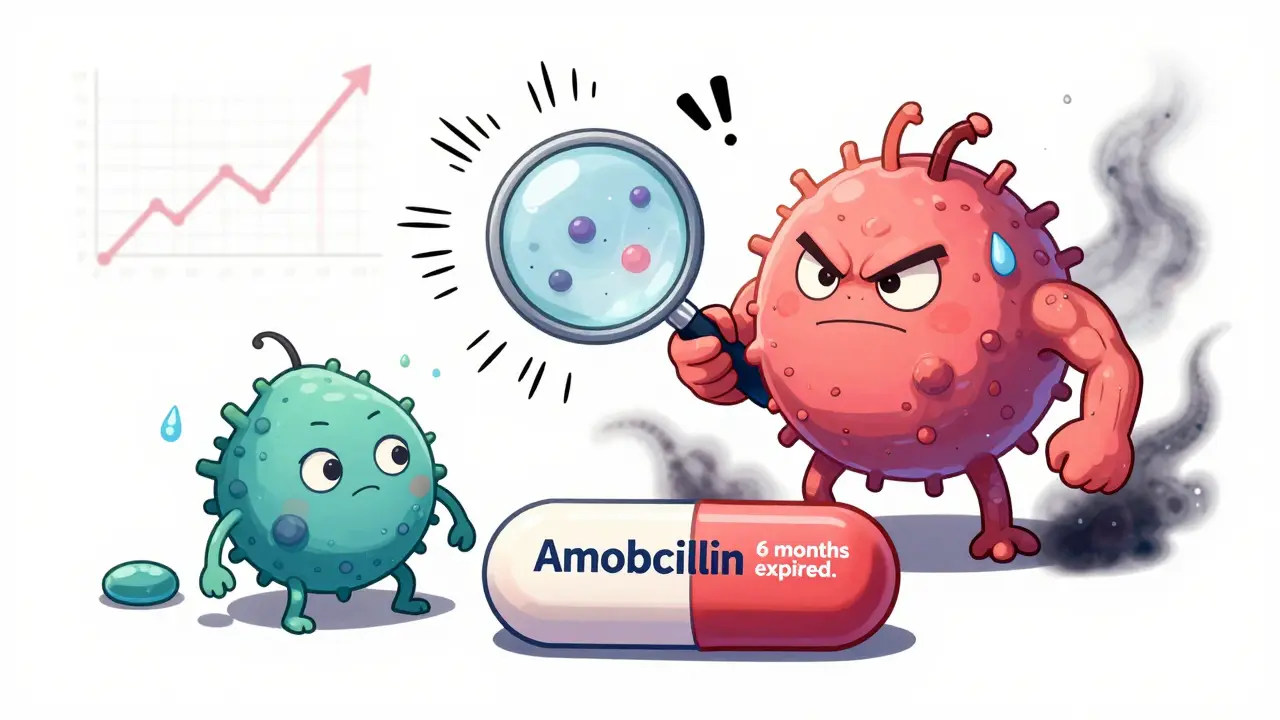
If you take an expired antibiotic and it’s only 30% potent, you’re not killing the bacteria-you’re training them. The weak dose kills off the easy targets, but leaves behind the tough ones. Those survivors multiply. Soon, the same bug that once responded to a simple pill now needs a hospital IV.
A 2023 analysis of over 12,000 patient cases found that when expired amoxicillin was used, resistance rates against common infections like E. coli jumped from 14% to nearly 99%. Minimum inhibitory concentration (MIC)-the lowest dose needed to stop growth-skyrocketed from 0.5 μg/mL to 256 μg/mL. That’s a 500-fold increase in resistance.
The Infectious Diseases Society of America calls this a public health emergency. Sub-therapeutic doses from expired meds are helping create superbugs. And those don’t just hurt you-they spread to your family, your coworkers, your community.
When Might It Be Okay to Use an Expired Antibiotic?
There’s no blanket yes or no. But there are gray areas.
During a drug shortage, some hospitals and emergency systems have extended expiration dates for critical antibiotics-under strict conditions. Johns Hopkins did this with 14 antibiotics during shortages. Over 2,300 patients got them. Zero treatment failures.
Here’s when experts say it might be acceptable:
- The antibiotic is a solid tablet or capsule (not liquid)
- It’s been stored in a cool, dry place-not a bathroom or car
- The packaging is sealed and undamaged
- It’s only been a few months past expiration (12 months max)
- The infection is mild-like a sinus infection or simple UTI
- You have no other option and can’t get a new prescription
Even then, don’t guess. If symptoms don’t improve in 48 hours, stop and see a doctor. Don’t double the dose. That won’t help. It’ll just make resistance worse.
What You Should Never Do
Never use expired antibiotics for:
- Severe infections: pneumonia, meningitis, sepsis, endocarditis
- Children under two
- Pregnant women
- Any liquid suspension-especially amoxicillin or amoxicillin/clavulanate
- Antibiotics that look or smell weird-discolored, crumbly, cloudy
And never use leftover antibiotics from a past illness. That’s not the same as taking an expired one. It’s often the wrong drug, wrong dose, wrong duration. You’re not saving money-you’re risking your life.
Storage Matters More Than You Realize
Where you keep your meds affects their lifespan more than the expiration date.
A 2022 study found antibiotics stored in a bathroom cabinet-hot, humid, steamy-lost potency 37% faster than those kept in a bedroom drawer. The ideal spot? A cool, dry place between 15-25°C (59-77°F), with humidity under 45%. A drawer away from the sink, the shower, the window. Not the glove compartment. Not the nightstand next to your lamp.
Keep them in the original bottle with the desiccant packet still inside. That little packet? It’s there to suck up moisture. Throw it away, and you’re speeding up the decay.
What Are Experts Really Saying?
The FDA says: don’t use expired meds. Period. Their warning is clear: potency and safety can’t be guaranteed.
But the real world is messier. Pharmacists who’ve seen SLEP data? 77% say they’d extend solid antibiotic expiration dates during shortages. Only 18% would without it.
The European Medicines Agency says solid antibiotics may be fine for 6-12 months past expiration-if stored right. But they ban it for life-threatening infections and all liquids.
And the WHO? They call expired antibiotic use a major driver of global resistance. In low-income countries, nearly half of pharmacies knowingly sell expired antibiotics. Treatment failure rates? 18% higher.
There’s no perfect answer. But there’s a clear pattern: the risk rises when you’re desperate, uninformed, or out of options.
What’s Changing Now?
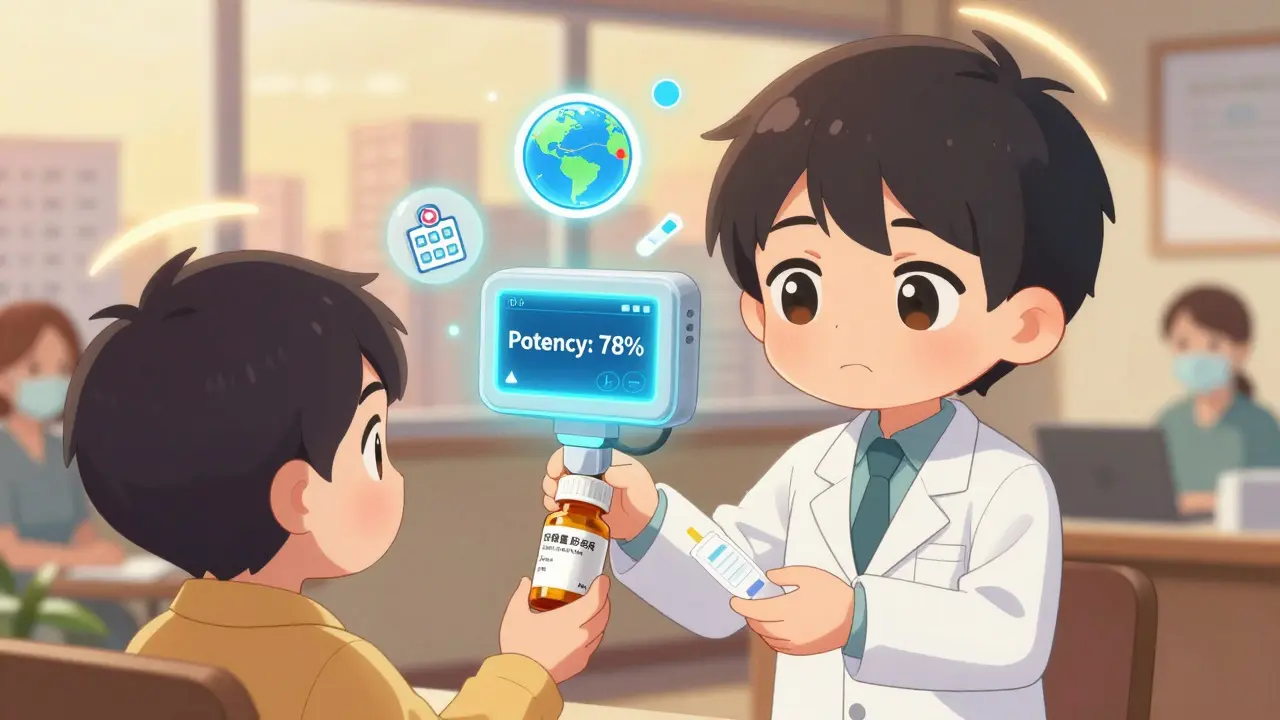
Things are shifting. The FDA launched a pilot program in 2023 to test rapid methods for extending expiration dates during shortages. Researchers at the University of Illinois developed paper test strips that can detect if amoxicillin has lost potency. In trials, they were 94.7% accurate.
IBM and the FDA are working on an AI tool that predicts how long a drug will last based on its storage history-temperature, humidity, time. Imagine scanning your pill bottle and getting a real-time potency estimate. That’s coming.
But until then, we’re stuck with expiration dates-and our own judgment.
What Should You Do Today?
Here’s your action plan:
- Check your medicine cabinet. Pull out any antibiotics past their date.
- Separate pills from liquids. Liquids go straight in the trash.
- For pills: ask yourself-was it stored well? Is it less than a year expired? Is this a minor infection?
- If unsure? Don’t take it. Call your pharmacy. Ask if they have samples or a discount program.
- Never keep antibiotics "just in case." Buy only what you need.
And if you’ve taken an expired antibiotic and didn’t get better? Don’t feel guilty. But do go see a doctor. Your body might be fighting a resistant bug now-and you don’t want to be the reason it spreads.
Final Thought
Antibiotics are powerful tools. But they’re not magic. And they’re not safe to use when they’re weak. The cost of saving a few dollars or avoiding a doctor’s visit isn’t just your time-it’s the future of medicine. Every time we use a half-dead antibiotic, we make the next infection harder to treat-for everyone.
Respect the date. Store them right. And when in doubt, get a new prescription. Your body-and the world-will thank you.
Are expired antibiotics dangerous to take?
Expired antibiotics aren’t usually toxic, but they often lose potency. Taking them won’t poison you-but they might not work, which can lead to worse infections and antibiotic resistance. The real danger isn’t the pill itself-it’s what happens when the infection doesn’t clear.
Can I take amoxicillin that expired 6 months ago?
If it’s the tablet form, stored in a cool, dry place, and the bottle is sealed and undamaged, it may still be effective. But if it’s the liquid suspension, throw it out. Even if it looks fine, it could have lost over half its strength. For minor infections, you might try it-but if symptoms don’t improve in 48 hours, stop and see a doctor.
Why do some people say expired antibiotics still work?
Because they often do-especially solid pills stored properly. Government tests show most antibiotics retain 90%+ potency years past expiration under ideal conditions. But home storage is rarely ideal. Heat, moisture, and light degrade them faster. So while some people get lucky, many don’t-and the risk of resistance is real.
Can I tell if an antibiotic has gone bad by how it looks or smells?
No. Over 89% of degraded antibiotics show no visible or sensory changes. A tablet might look perfect but have lost 60% of its strength. A liquid might look clear but be too weak to work. You can’t rely on appearance, taste, or smell. Only lab tests can confirm potency.
What should I do with expired antibiotics?
Don’t flush them or toss them in the trash. Take them to a pharmacy with a drug take-back program. Many pharmacies offer free disposal. If that’s not available, mix them with coffee grounds or cat litter in a sealed bag before throwing them away-this makes them unappealing to kids or pets and reduces environmental harm.
Is it safe to use expired antibiotics in a survival situation?
In extreme emergencies with no access to care, a properly stored solid antibiotic may be better than nothing. But only for mild, non-life-threatening infections. Never use them for fever, chest pain, swelling, or signs of sepsis. And never use liquids. The risk of resistance is high, but in life-or-death scenarios with no alternatives, some experts consider it a last resort.
How can I store antibiotics to make them last longer?
Keep them in their original container, with the desiccant packet still inside. Store them in a cool, dry place-like a bedroom drawer-away from sunlight, heat, and moisture. Avoid bathrooms, kitchens, and cars. Ideal temperature: 15-25°C (59-77°F). Humidity should be below 45%. Proper storage can extend potency by months-even years.
9 Comments
Jody Fahrenkrug
So I just checked my cabinet and found three expired amoxicillin pills from last year’s sinus infection. I didn’t throw them out because I’m cheap, but now I’m not sure if I’m a hero or a dumbass. Guess I’m calling my pharmacy tomorrow.
Kasey Summerer
Oh wow, so the government’s been secretly testing antibiotics like they’re dating apps and saying "90% still work"? 😏 That’s cute. Meanwhile my bathroom shelf is basically a science experiment with humidity and steam as the main ingredients. Thanks for the reassurance, FDA. 🙃
kanchan tiwari
THIS IS A BIG PHARMA COVER-UP. THEY WANT YOU TO BUY NEW PILL BOTTLES EVERY SIX MONTHS SO THEY CAN MAKE BILLIONS. THE REAL TRUTH? THE GOVERNMENT AND BIG PHARMA KNOW EXPIRED ANTIBIOTICS WORK JUST FINE. THEY’RE HIDING THE DATA BECAUSE IF YOU KNEW YOU COULD SAVE MONEY, THEY’D LOSE CONTROL. I SAW A VIDEO ON TIKTOK WHERE A DOCTOR IN INDIA USED 15-YEAR-OLD DOXYCYCLINE AND CURED A WHOLE VILLAGE. THEY’RE SCARED OF US BECOMING SELF-SUFFICIENT.
Bobbi-Marie Nova
Okay but can we talk about how we treat our meds like they’re left-over pizza? 😅 I’ve got a drawer full of "just in case" antibiotics from three different infections I never had again. And now I’m supposed to feel guilty? Nah. I’m just gonna start storing them in my closet like sensible adults do. Also, if your kid’s liquid amoxicillin smells like regret, throw it out. No shame.
john Mccoskey
The entire premise here is dangerously oversimplified. You’re framing antibiotic degradation as a binary issue - either it works or it doesn’t - when the reality is a gradient of subtherapeutic exposure that creates selective pressure across microbial populations at the molecular level. The 90% potency statistic from the SLEP program is meaningless in a domestic context because storage conditions are uncontrolled variables. You can’t extrapolate lab-grade environmental stability to a humid bathroom in suburban Ohio. And the idea that someone might "try" an expired antibiotic for a minor infection ignores the fact that what you perceive as "minor" could be the first step in a cascade of resistance that renders penicillin useless for an entire community. This isn’t about saving money. It’s about the erosion of public health infrastructure through individual negligence disguised as pragmatism. The WHO isn’t being alarmist - they’re documenting the slow collapse of modern medicine one poorly stored pill at a time.
Ryan Hutchison
USA still leads the world in medical innovation. Other countries are still stuck in the 1980s. If you’re worried about expired antibiotics, maybe you should’ve gone to a real doctor instead of playing Russian roulette with your medicine cabinet. We don’t need Europeans or WHO telling us how to handle our own meds. The FDA says don’t use them - end of story. Respect the system. Don’t be that guy.
Stephen Tulloch
Look, I get it - you’re trying to sound enlightened, but this whole thing is just a fancy way of saying "you’re not smart enough to handle your own meds." 🤷♂️ I mean, really? A paper test strip that detects amoxicillin potency? That’s not science, that’s a startup pitch. And AI predicting drug shelf life? Cute. Meanwhile, my grandpa in Quebec took his 12-year-old tetracycline for a tooth infection and lived to tell the tale. Maybe the real problem is we’ve outsourced common sense to algorithms and regulatory bodies. 🌍💊
Melodie Lesesne
Just wanted to say thank you for writing this. I’ve been so confused about what to do with all my old meds. I’ve been tossing them in the trash thinking it’s fine, but now I’ll take them to the pharmacy. Also, I’m definitely moving my antibiotics out of the bathroom. No more steamy mornings with my pills. 😅
Corey Sawchuk
My cousin in Alberta used a 3-year-old doxycycline for a bad UTI last winter. Worked fine. No issues. But she kept it in a sealed bottle in her basement. No heat. No sun. Just dry. So yeah. Storage matters. And maybe we’re overreacting a little.