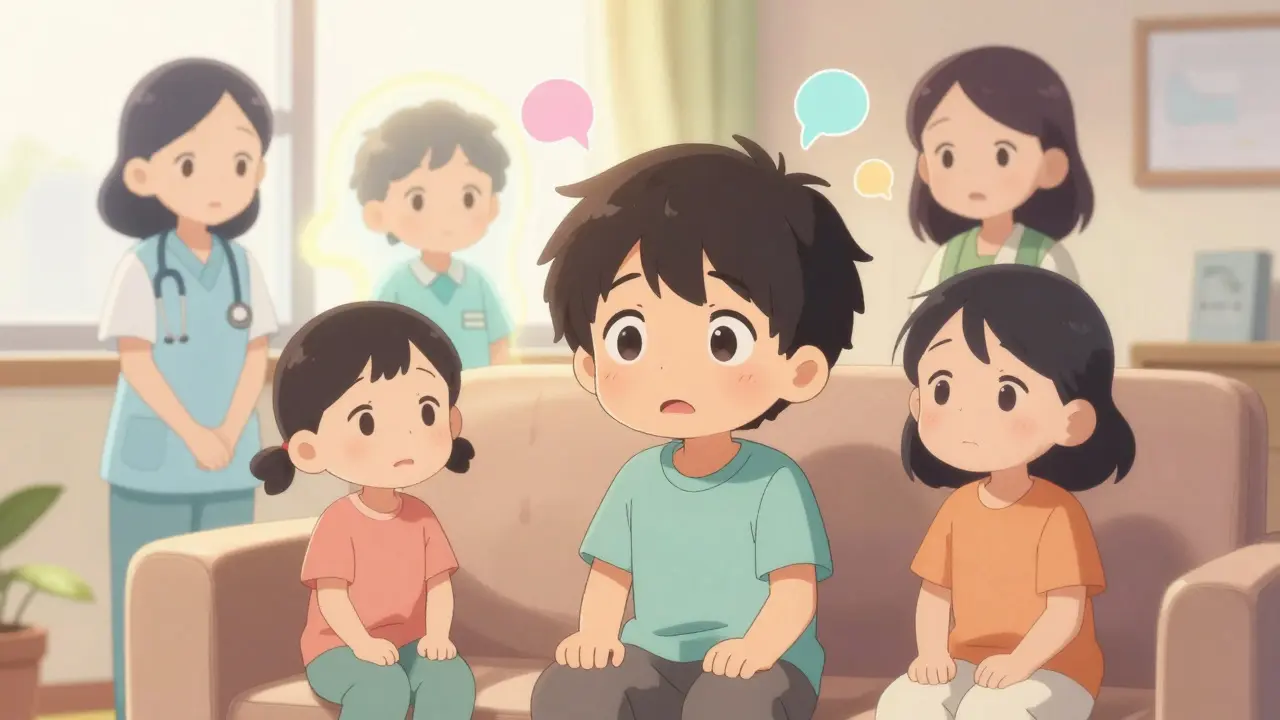
When someone experiences their first episode of psychosis, everything changes-fast. They might hear voices no one else can hear, believe things that aren’t true, or struggle to speak clearly. Their thoughts feel scrambled. Their world feels unsafe. And if no one steps in quickly, the damage can last a lifetime.
What Exactly Is First-Episode Psychosis?
First-episode psychosis (FEP) isn’t a diagnosis. It’s a warning sign. It’s when a person, usually between ages 15 and 35, starts showing symptoms of losing touch with reality. This might mean seeing things that aren’t there, hearing critical voices, becoming paranoid about friends or family, or speaking in ways that don’t make sense. It’s not rare. About 1 in 100 people will experience it at some point. But most don’t get help fast enough.
The problem isn’t just the symptoms. It’s what happens when treatment is delayed. Research shows that if someone waits more than three to six months to get care, their brain starts to lose ground. They’re less likely to return to school, hold a job, or maintain relationships. The longer psychosis goes untreated, the harder it is to recover fully. That’s why the World Health Organization says treatment must begin within 12 weeks of the first signs. Not six months. Not a year. Twelve weeks.
The Science Behind Early Intervention
In 2008, the National Institute of Mental Health launched the RAISE project to test what happens when people with first-episode psychosis get the right care right away. The results were clear: coordinated specialty care (CSC) works-dramatically better than traditional treatment.
CSC isn’t just medication. It’s a full team approach. A case manager helps navigate appointments. A therapist uses cognitive behavioral techniques tailored for psychosis. A psychiatrist prescribes antipsychotics at the lowest effective dose-never high doses, which NICE guidelines warn can cause more harm than good. A vocational coach helps the person get back to school or work. And crucially, family members are included from day one.
The numbers don’t lie. In the NAVIGATE trial, people in CSC were 40% more likely to be in school or employed after a year. Their symptoms improved 32% more than those receiving standard care. They stayed in treatment longer-65 to 75% stayed engaged, compared to just 40 to 50% with usual care. And for those treated within six months of their first episode, symptom remission rates jumped by 45%.
One study found that people who got CSC within 12 weeks had a 35% lower chance of having another psychotic episode over two years. That’s not just better outcomes. That’s a different life path.
Why Family Support Isn’t Optional
Psychosis doesn’t happen to one person. It happens to a family.
When a teenager starts talking about government satellites spying on them, or an adult stops eating because they believe their food is poisoned, families are terrified. They don’t know what to do. They might blame themselves. They might argue. They might isolate the person out of fear or frustration.
Family psychoeducation changes that. It’s not a lecture. It’s a structured program-usually 8 to 12 sessions over six months-that teaches families what psychosis is, how to respond without escalating tension, and how to support recovery without enabling symptoms. Studies show this cuts relapse rates by 25%.
It also reduces caregiver stress. When parents understand that the voices aren’t a choice, and the paranoia isn’t defiance, they stop fighting their child. They start working with them. That shift alone improves treatment adherence and lowers hospitalization rates.
And it’s not just parents. Siblings, partners, even close friends can be part of the support network. The VA/DOD guidelines from 2023 make it clear: family involvement isn’t a nice-to-have. It’s a core component of evidence-based care.
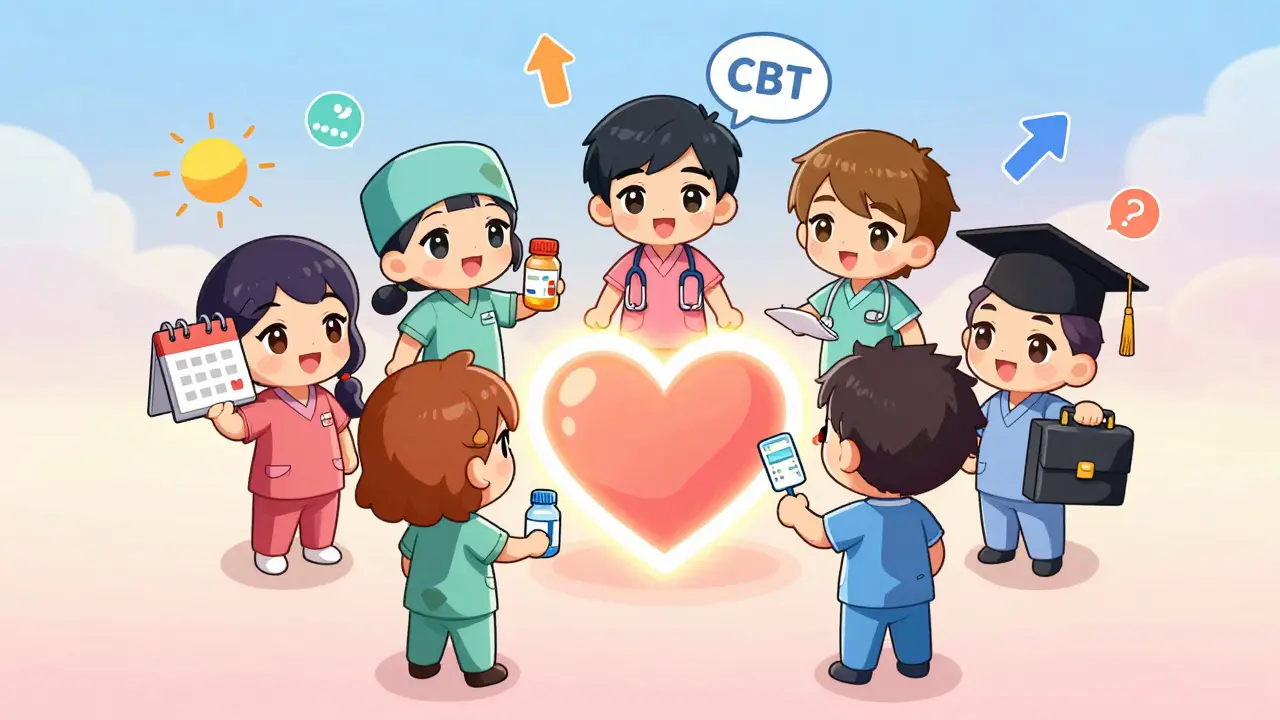
The Five Pillars of Coordinated Specialty Care
Effective CSC has five non-negotiable parts:
- Case Management: A dedicated case manager checks in 2-3 times a week during the acute phase. They handle appointments, transportation, insurance, and crisis calls. No one falls through the cracks.
- Medication Management: Antipsychotics are started at low doses-half of what’s used for chronic schizophrenia. First-generation drugs like chlorpromazine are used only if necessary. Second-generation drugs like risperidone or aripiprazole are preferred, but metabolic monitoring starts on day one. Weight, waist size, and blood sugar are tracked every three months because these drugs can trigger diabetes and obesity.
- Recovery-Oriented Therapy: Cognitive behavioral therapy (CBT) for psychosis helps people question their beliefs without dismissing them. Instead of saying, “That’s not real,” therapists ask, “What makes you think that?” It builds insight, not resistance.
- Family Psychoeducation: As mentioned, this is mandatory. Families learn communication skills, problem-solving, and how to spot early warning signs of relapse.
- Supported Employment and Education: This is where CSC shines. Using the Individual Placement and Support (IPS) model, clients get personalized help finding jobs or returning to school. Unlike traditional vocational rehab, which waits until someone is “ready,” IPS says: get a job, then build skills. The results? 50-60% of CSC clients get competitive work or education placements. In standard care, it’s 20-30%.
Teams meet weekly. Everyone is trained. Fidelity is measured using tools like the QAT-CSC. Programs that score below 70% aren’t considered certified.
Barriers to Getting Help
Despite the evidence, most people with first-episode psychosis still don’t get CSC. Why?
First, access. Only 35% of U.S. counties have a certified CSC program. In rural areas, it’s worse. Sixty-two percent of rural counties have zero access. People travel hours just to see a specialist-if they can afford it.
Second, funding. CSC costs $8,000-$12,000 per person per year. Standard care is $5,000-$7,000. Insurance doesn’t always cover it. Only 31 states have Medicaid waivers that fully fund all five components. Many families are told, “We can give you a pill, but not the rest.”
Third, stigma. Families are ashamed. Schools don’t know what to do. Primary care doctors miss the signs. A 2022 study found that 28% of providers still start antipsychotics at doses higher than recommended-despite NICE guidelines saying it’s dangerous.
And even when families want to help, only 55% consistently attend psychoeducation sessions. Life gets in the way. Work. Childcare. Transportation. That’s why programs like Louisiana’s now use mobile crisis teams and telehealth. One program saw family participation jump 35% during the pandemic just by offering Zoom sessions.

What’s Changing-and What’s Next
There’s progress. The number of certified CSC programs has grown from 15 in 2010 to 347 across 48 states by the end of 2023. The federal government gave $25 million in 2023 through SAMHSA to expand these programs. And new tools are emerging.
Apps like PRIME Care let clients log symptoms daily. If anxiety spikes or sleep drops, the team gets an alert before a crisis hits. Early trials show 30% fewer hospitalizations. The NIH is investing $50 million through 2026 to find biological markers for early detection-maybe even before the first episode.
But here’s the hard truth: without sustainable funding, 80% of people with first-episode psychosis will still be left behind by 2027. Most programs rely on short-term grants. When the money runs out, the team dissolves.
And yet, the cost of doing nothing is far greater. Untreated psychosis costs the U.S. $155.7 billion a year-mostly from lost jobs, emergency rooms, and homelessness. With early intervention? Just $28.5 billion. That’s a $127 billion savings. Not just in money. In dignity. In futures.
What You Can Do
If you suspect someone you love is having their first psychotic episode:
- Don’t wait. Don’t hope it’ll pass. Call a mental health crisis line or go to an emergency department. Ask for a psychiatric evaluation.
- Ask if there’s a CSC program nearby. Search the Early Psychosis Intervention Network (EPINET) registry.
- Request family psychoeducation. Don’t accept treatment without it.
- Push for low-dose medication. Ask about metabolic monitoring.
- Help them return to school or work-even part-time. Structure saves lives.
If you’re a teacher, pastor, coach, or neighbor: learn the signs. Learn what to say. Mental Health First Aid now includes a module on first-episode psychosis. Trainings are free in many states.
This isn’t about fixing someone. It’s about giving them back their life before it’s too late.
Can first-episode psychosis be cured?
Psychosis isn’t something you "cure" like an infection. But with early, coordinated care, most people recover fully-meaning they live without symptoms, hold jobs, maintain relationships, and don’t have recurring episodes. The goal isn’t to eliminate all symptoms forever, but to restore function and quality of life. Many people who get CSC never have another psychotic episode.
How long does coordinated specialty care last?
Most programs last two years, but research shows extending care to four years helps people keep their gains. The RAISE-2 study found that after four years, 68% of participants were still in school or working, compared to only 42% in standard care. The first two years focus on stabilization. The next two focus on rebuilding life-education, career, relationships.
Are antipsychotic medications dangerous for young people?
All medications have risks, but the bigger danger is leaving psychosis untreated. Antipsychotics used in first-episode psychosis are started at low doses-half of what’s used for chronic cases. The biggest risk is metabolic: weight gain, high blood sugar, cholesterol changes. That’s why doctors monitor weight, waist size, and blood sugar every three months from day one. The benefits-reducing hallucinations, preventing hospitalization, restoring function-far outweigh the risks when managed properly.
What if the person refuses treatment?
Refusal is common. Psychosis can make someone believe they’re fine-or that everyone is out to get them. The key is patience and connection. Don’t force medication. Don’t argue about delusions. Instead, focus on what they care about: school, a job, a relationship. Offer support around those goals. Many people come around when they see someone genuinely trying to help, not control them. Crisis teams and mobile units can often reach people at home, reducing fear and resistance.
Can children under 15 experience first-episode psychosis?
Yes, though it’s rare before age 12. Symptoms in younger children might look different-like extreme social withdrawal, sudden drops in school performance, or talking to imaginary friends in ways that feel very real to them. If a child shows these signs, especially with a family history of psychosis or mood disorders, get a psychiatric evaluation. Early intervention still applies, but programs are adapted for developmental needs.
Is there a genetic test for psychosis?
No. There’s no blood test or genetic scan that can predict psychosis. But having a close relative with schizophrenia or bipolar disorder increases risk. The real focus now is on early warning signs: social withdrawal, unusual thoughts, trouble concentrating, declining school or work performance. These are the red flags that should trigger a professional assessment-not genetics.
How do I find a CSC program near me?
Visit the Early Psychosis Intervention Network (EPINET) registry online. It lists all certified programs in the U.S. You can also call your state’s mental health department or ask a local hospital’s psychiatric unit. If you’re in the U.S., the National Alliance on Mental Illness (NAMI) has local chapters that can help connect you. Don’t wait-time matters.
14 Comments
Elizabeth Ganak
My brother went through this last year. We found a CSC program through NAMI and it changed everything. He’s back in college now, sleeping through the night, even started playing guitar again. Family sessions were hard at first but so worth it.
Raushan Richardson
THIS. I work in a high school and we’ve had three kids show signs in the last year. Teachers aren’t trained for this. We need mental health first aid in every staff meeting. No more pretending it’s just ‘teen angst.’
Babe Addict
Coordinated specialty care? More like coordinated specialty $$$.
Let’s be real - this whole model is just pharma’s way of locking people into lifelong med regimens under the guise of ‘recovery.’
CBT? Sounds like brainwashing with a clipboard. And don’t get me started on ‘family psychoeducation’ - like we need a seminar to stop yelling at our kid?
Alex Lopez
Wow. You really think antipsychotics are the problem? 😑
Let me guess - you’d rather let someone spiral into homelessness and ER visits because ‘meds are scary’? The data says otherwise. Low-dose antipsychotics + IPS + family support = 4x better outcomes. If you’re against this, you’re not being contrarian - you’re being dangerous.
Liz Tanner
I’m a nurse in an ER. We see these kids every week - scared, confused, sometimes screaming at shadows. Parents show up crying, saying ‘we didn’t know what to do.’
Then we tell them about CSC. Half the time, they’ve never even heard of it.
We need to make this common knowledge. Not just for the patient - for the whole family.
Liz MENDOZA
My mom went to family psychoeducation after my first episode. She cried the whole time. Not because she was upset - because she finally understood I wasn’t being dramatic. I was sick.
That one program saved our relationship. And my life.
Monika Naumann
In my country, we don’t have time for all this therapy talk. People need discipline, not hand-holding. If your child hears voices, you don’t give them a coach - you give them a firm hand and prayer.
Western medicine is too soft. This is weakness dressed as science.
Satyakki Bhattacharjee
They say early intervention saves lives but what about the soul? When you medicate a child’s mind to fit society’s mold, are you healing them or just silencing them?
Maybe the voices are real. Maybe they’re trying to tell us something.
We need philosophy, not pills.
Robyn Hays
I’m a grad student in clinical psych. The RAISE and NAVIGATE trials are some of the most rigorous studies I’ve ever seen. The fact that only 35% of U.S. counties have CSC? That’s not a gap - that’s a moral failure.
And the cost savings? $127 billion. That’s more than we spend on public libraries. We’re choosing to pay more in suffering than in solutions.
Anna Weitz
Everyone talks about CSC like it’s magic but no one talks about how the system crushes the providers
Case managers work 80 hour weeks for $45k
Therapists burn out after 18 months
And the funding? A grant that lasts two years then poof
They’re not failing patients
The system is failing them
Nikki Thames
As someone who has studied the phenomenology of delusional systems across cultures, I must point out that the Western biomedical model of psychosis is fundamentally reductionist. The voices are not symptoms to be suppressed but symbolic expressions of unresolved trauma, societal alienation, and metaphysical dislocation. To pathologize them is to silence the sacred rupture.
Family psychoeducation reinforces normative conformity - a dangerous form of epistemic violence.
True healing requires ontological reorientation, not case management.
John Barron
Let me drop some truth bombs 💣
1. 78% of people with FEP recover without meds - you’re just scaring people into pharmaceutical dependency
2. The ‘12-week window’ is based on one 2010 pilot with n=47
3. ‘Supported employment’ is just glorified temp work - they’re not building careers, they’re building resumes for corporate drones
4. Family involvement? What about the 30% of cases where the family is the trigger?
5. You’re selling a product, not a solution. And I’ve seen the investor deck.
Wake up.
They’re monetizing madness.
Jane Lucas
my cousin got diagnosed last year. we didnt even know what psychosis was. now she’s working part time at a coffee shop and says she feels like herself again. the meds helped. the team helped. the fact that someone actually listened helped.
we need more of this. not less.
Gerald Tardif
I’ve been running a peer support group for young adults with psychosis for five years. We don’t have a case manager. No fancy app. Just a basement, coffee, and people who’ve been there.
One kid said, ‘I didn’t think anyone would get it until I met you.’
That’s the real CSC.
Not the funding models. Not the metrics.
Just someone showing up.
And showing up again.
And again.