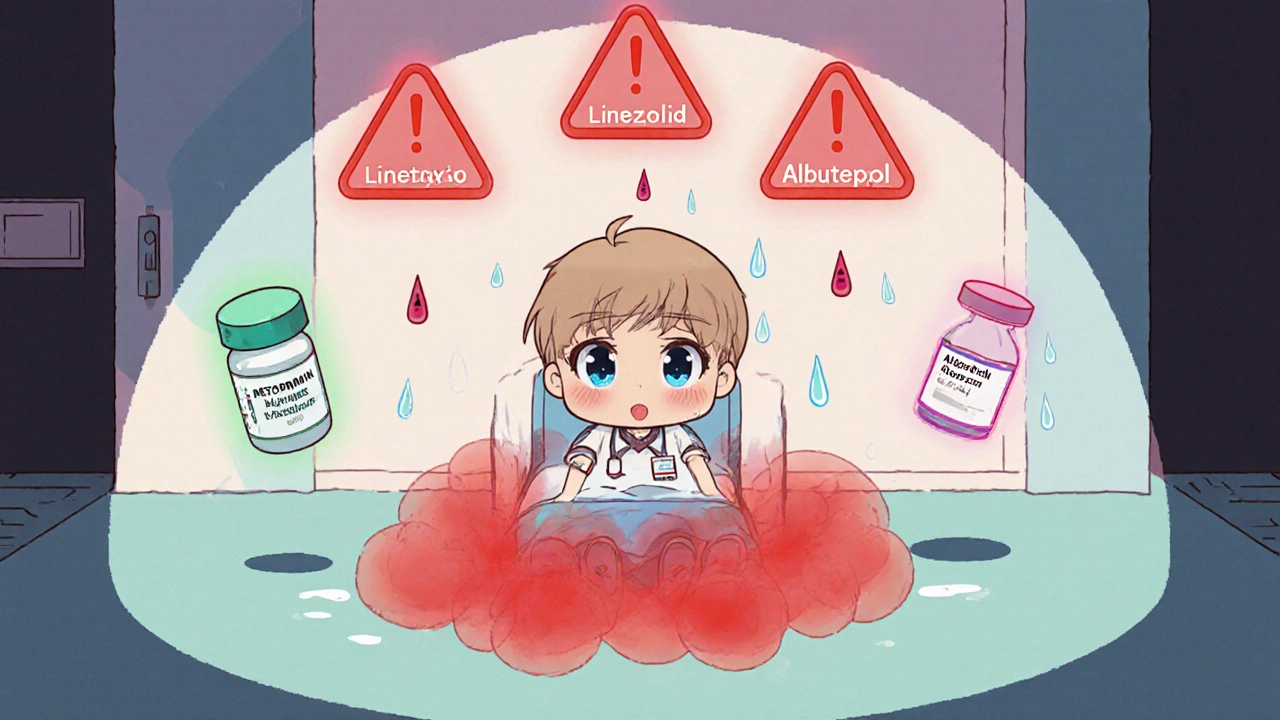
Most people assume that if a doctor prescribes a medication, it’s safe - especially if it’s been on the market for years. But some common drugs can quietly trigger a life-threatening condition called lactic acidosis. It doesn’t happen often. But when it does, it can turn a routine treatment into a medical emergency.
What Exactly Is Lactic Acidosis?
Lactic acidosis isn’t just high lactate levels. It’s a dangerous drop in blood pH caused by too much lactic acid building up in your bloodstream. Normal lactate? Between 0.5 and 2.2 mmol/L. When it hits 4 mmol/L or higher - and your blood pH falls below 7.35 - you’re in danger. Your body can’t clear the acid fast enough. Organs start to shut down. Your heart weakens. Blood pressure plummets. Without quick action, it can be fatal.
This isn’t the kind of acidosis you get from intense exercise. That’s temporary. Medication-induced lactic acidosis is different. It’s caused by drugs interfering with how your cells produce energy. Instead of using oxygen efficiently, your cells switch to a backup system that churns out lactic acid as waste. And when that waste piles up, your body can’t keep up.
Which Medications Can Cause It?
You might be surprised. Some of the most commonly prescribed drugs carry this risk.
- Metformin - The go-to drug for type 2 diabetes. Used by over 150 million people worldwide. Most take it safely for years. But in people with kidney problems, liver disease, or during severe infections, metformin can block mitochondrial energy production. The result? Lactate builds up. About 3 to 10 cases happen per 100,000 patient-years. Sounds rare? With that many users, it adds up to thousands of potential cases a year. And the death rate? Around 22% when it happens.
- Linezolid - An antibiotic used for stubborn infections like MRSA. It’s effective. But after 14 days or more, it starts damaging the mitochondria - the power plants inside your cells. Studies show 2.5% to 15% of patients on long-term linezolid develop elevated lactate. Some go on to full-blown acidosis. Doctors often miss it because they’re focused on the infection, not the side effect.
- Beta-2 agonists - Albuterol inhalers and nebulizers. Used for asthma and COPD. They’re lifesavers during an attack. But in high doses or with frequent use, they can push your body into overdrive. They boost sugar breakdown and block the enzyme that turns pyruvate into energy. That forces your body to make lactate instead. One documented case had lactate levels spike to 11 mmol/L after standard nebulizer treatments - then dropped to 4.5 mmol/L when the dose was cut back.
- Propofol - The sedative used in ICUs for ventilated patients. When given at high doses (over 4 mg/kg/h) for more than 48 hours, it can trigger Propofol Infusion Syndrome. Lactic acidosis is one of its key signs. Mortality? Over 66%. This isn’t theoretical. It’s happened in young, healthy patients after prolonged sedation.
- NRTIs - HIV medications like zidovudine and stavudine. They damage mitochondrial DNA. Women, older patients, and those with low CD4 counts are at higher risk. The damage builds slowly. By the time lactate rises, the patient may already be in trouble.
- Acetaminophen - Even at normal doses, it can cause lactic acidosis in elderly patients with multiple health issues. It’s often missed because everyone assumes it’s just liver damage. But the problem is mitochondrial. Symptoms like fatigue, nausea, and rapid breathing get blamed on aging - not the pill.
- Epinephrine - Used in anaphylaxis and shock. It’s life-saving. But in critically ill patients on continuous infusions, it can trigger lactate spikes. Doctors hesitate to stop it - and that’s the problem. The drug is necessary, but the acidosis it causes makes everything worse.
Why Is It So Dangerous?
Lactic acidosis doesn’t just sit there. It creates a downward spiral.
Your heart needs a stable pH to beat properly. When acid levels rise, your heart’s ability to contract drops by 25-30%. Your blood vessels stop responding to adrenaline. Blood pressure crashes. Organs don’t get enough oxygen. Your kidneys can’t clear the acid. Your lungs try to compensate by making you breathe faster - but that just makes you more tired. And if you’re already sick - say, with sepsis or heart failure - this acid buildup pushes you over the edge.
And here’s the kicker: many patients don’t even know they’re at risk. A 2023 study found that in elderly patients taking acetaminophen, diagnosis was delayed by an average of 36 hours. By then, the acidosis was severe. In ICUs, doctors often see rising lactate and assume it’s from sepsis - not the antibiotics or sedatives they just gave.
Who’s Most at Risk?
It’s not random. Certain people are far more vulnerable.
- People over 65
- Those with kidney disease (eGFR below 60 mL/min)
- Patients with liver cirrhosis
- Anyone with active infection or shock
- People on multiple high-risk drugs at once
- Women on NRTIs for HIV
- Those with genetic mutations like the POLG gene variant - which increases NRTI risk by over 8 times
Metformin is the most common culprit, but only when combined with one of these risk factors. Take metformin alone, with normal kidneys and no infection? Risk is extremely low. Add dehydration and pneumonia? Suddenly, you’re in danger.
How Is It Diagnosed?
There’s no single test. It’s a puzzle.
Doctors look for:
- Blood lactate above 4 mmol/L
- Arterial pH below 7.35
- Bicarbonate below 22 mmol/L
- High anion gap
But here’s the catch: some experts now say lactate above 3 mmol/L in high-risk patients should raise red flags - even if pH is still normal. Early detection matters. That’s why new guidelines from the World Federation of Critical Care Societies now recommend routine lactate monitoring for patients on continuous epinephrine or high-dose beta-agonists.
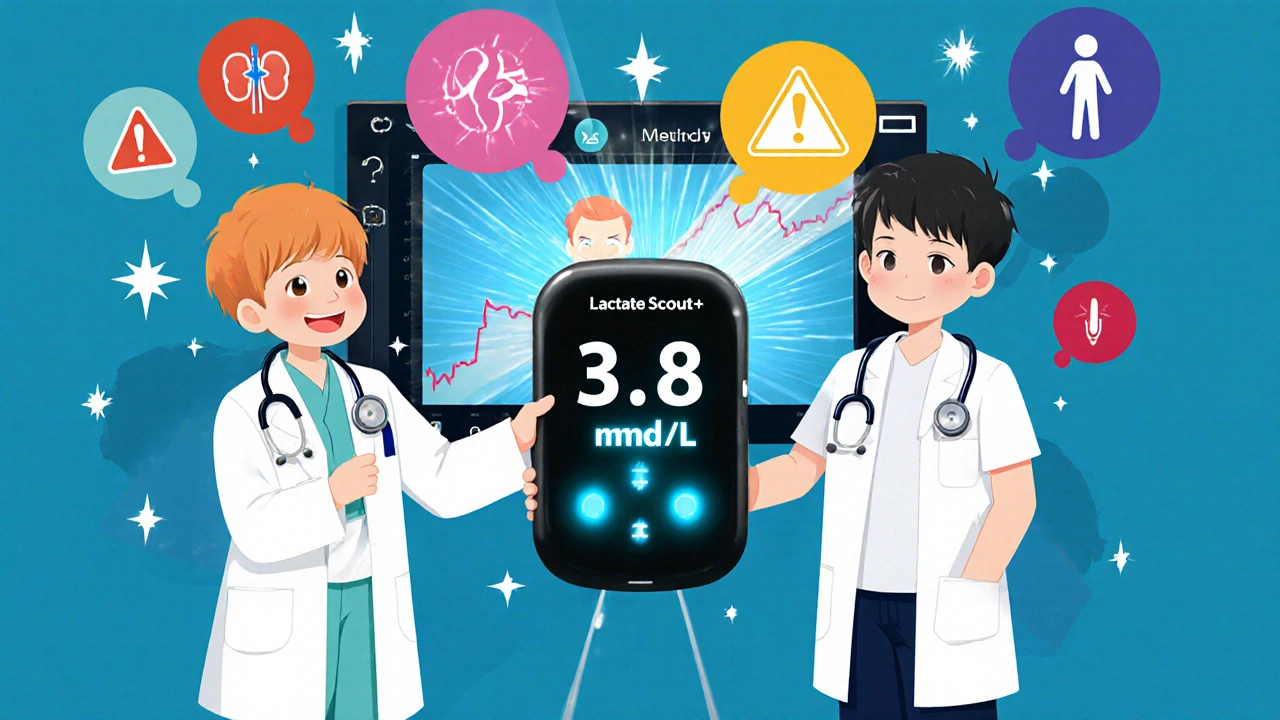
And new tech is helping. In 2023, the FDA approved the Lactate Scout+, a real-time monitor that tracks lactate every few minutes. One trial showed it cut detection time from over 12 hours to just 2 hours. That’s huge.

What Do You Do If It Happens?
Stop the drug - if you can.
For metformin? Stop it immediately. If lactate is above 20 mmol/L or pH below 7.1, start hemodialysis. It removes both the drug and the acid. For linezolid? Stop it. For albuterol? Cut the dose. For propofol? Stop the infusion - even if the patient still needs sedation.
Fluids are the first step. Give 20-30 mL/kg of IV saline. That helps flush out acid and improves kidney function. Bicarbonate? Controversial. The Surviving Sepsis Campaign says don’t use it routinely. But if pH drops below 7.15, some clinicians still give it - cautiously.
And here’s something most don’t talk about: you need to monitor lactate every 2-4 hours after stopping the drug. In medication-induced cases, lactate should drop by at least 50% within two hours. If it doesn’t, you’re missing something else - like sepsis or heart failure.
Can It Be Prevented?
Absolutely. Prevention is easier than treatment.
- For metformin: Check kidney function before starting. Avoid it if eGFR is below 30. Use lower doses if it’s between 30-45. Don’t give it during acute illness or dehydration.
- For linezolid: Limit use to 14 days unless absolutely necessary. Check lactate after day 7 if treatment continues.
- For albuterol: Use the lowest effective dose. If a patient’s breathing gets worse and lactate rises, don’t give more nebs - reassess.
- For propofol: Avoid prolonged infusions in young, healthy patients. Use alternatives when possible.
- For NRTIs: Screen for mitochondrial risk factors. Consider genetic testing if recurrent lactic acidosis occurs.
- For all: Educate pharmacists. They’re often the last line of defense. A pharmacist flagged metformin in a patient with rising creatinine - and prevented a crash.
And here’s a quiet win: many cases are avoidable. One hospital cut its metformin-related lactic acidosis cases by 70% in two years just by adding a pharmacist review step before prescribing.
The Bottom Line
Lactic acidosis from meds is rare. But it’s deadly. And it’s often missed because it looks like something else - sepsis, heart failure, pneumonia.
The key is awareness. If you’re on one of these drugs and you start feeling unusually tired, short of breath, or nauseous - especially if you have kidney or liver issues - get your lactate checked. Don’t wait. Don’t assume it’s just the illness.
Doctors and pharmacists need to ask: Could this drug be causing this? Not every high lactate is sepsis. Sometimes, it’s the treatment.
The good news? We’re getting better at spotting it. With new monitors, smarter guidelines, and more attention from clinical teams, deaths from this condition are starting to drop. But vigilance is still everything.
Can metformin cause lactic acidosis even if I’m taking it as prescribed?
Yes, but only if you have other risk factors like kidney disease, liver problems, or an acute illness like pneumonia or sepsis. Metformin alone, with normal kidney function, carries an extremely low risk - about 3 to 10 cases per 100,000 people per year. The danger comes when the drug builds up in your system because your kidneys can’t clear it, and your body is under stress.
Is lactic acidosis from albuterol common?
It’s not common in the general population, but it’s underrecognized. Beta-agonists like albuterol are the second most common drug cause of medication-induced lactic acidosis, making up nearly 29% of reported cases. It happens more often in patients getting frequent nebulizer treatments, especially if they’re already critically ill. One case showed lactate jumping from 2.1 to 11 mmol/L after standard nebulizer doses - then dropping to 4.5 when the treatment was reduced.
How long does it take for lactic acidosis to resolve after stopping the drug?
In most medication-induced cases, lactate levels should drop by at least 50% within 2 hours of stopping the drug and starting fluids. Full recovery usually takes 24 to 48 hours - unless there’s another underlying problem like sepsis. Acetaminophen-induced cases often clear within 24 hours. Propofol and metformin cases may take longer and sometimes require dialysis.
Can I take metformin if I have mild kidney disease?
Yes - but with caution. Since 2016, FDA guidelines allow metformin in patients with mild kidney impairment (eGFR 45-59 mL/min), as long as you’re monitored closely. Your doctor should check your kidney function every 3 to 6 months. Avoid metformin if your eGFR drops below 30. Never take it if you’re dehydrated or sick with vomiting or diarrhea.
Are there any new tools to detect lactic acidosis earlier?
Yes. In 2023, the FDA approved the Lactate Scout+, a handheld device that gives real-time lactate readings in under a minute. Hospitals using it have cut detection time from over 12 hours to just 2.1 hours. It’s especially useful in ICUs for patients on epinephrine, propofol, or high-dose albuterol. Some institutions are now using it routinely for at-risk patients.
10 Comments
Cinkoon Marketing
So let me get this straight - we’re giving people metformin like it’s candy, then acting shocked when their kidneys give out? I’ve seen this in my aunt’s chart. She was on it for 8 years, no issues. Then got a UTI, kept taking it, and ended up in the ICU. No one even checked her lactate until she was blue. Why isn’t this on the prescription label? Like, a little warning sticker? "May cause your body to turn into a soda can if you catch a cold."
robert cardy solano
Been an EMT for 12 years. Saw this once with a guy on linezolid for a bone infection. Lactate hit 18. He was breathing like he’d run a marathon, but he couldn’t even sit up. Docs thought it was sepsis. Turned out the antibiotic was the culprit. We stopped it, gave fluids, and he bounced back in 36 hours. Point is - don’t assume. Always ask: what’s the drug doing, not just what’s the disease?
Pawan Jamwal
USA and Canada think they invented medicine 😂 But in India, we’ve been warning about metformin since 2005! Elderly patients? Don’t give it unless you’re ready to pay for dialysis. And propofol? In our ICUs, we use it only if the patient is already on a ventilator AND has no other option. We don’t play Russian roulette with mitochondria 😤
Bill Camp
THIS IS WHY WE CAN’T HAVE NICE THINGS. Big Pharma knows this. They know metformin can kill. But they make billions off it. They don’t want you to know. They don’t want you to ask. They want you to just swallow the pill and shut up. And now they’re pushing that Lactate Scout+ like it’s a miracle - because they own the patent. It’s not innovation. It’s damage control with a price tag.
Matthew McCraney
They’re hiding this on purpose. The FDA, CDC, AMA - all in bed with the drug companies. Why do you think they never warn about acetaminophen? Because it’s in every medicine cabinet. Every cold pill. Every headache tablet. They want you addicted to it. And when you start having fatigue and nausea? They blame your age. Your stress. Your "lifestyle." But it’s the Tylenol. Always the Tylenol. They’re poisoning us slowly. And they call it "medicine."
serge jane
It’s funny how we treat drugs like they’re magic wands instead of biochemical agents with cascading effects. We prescribe metformin like it’s a vitamin, then act surprised when the mitochondria - the ancient powerhouses of our cells - start dying. We’ve forgotten that biology doesn’t care about our convenience. It doesn’t care about profit margins. It just responds. And when we overload it with synthetic signals, it breaks. Not because we’re weak. But because we’ve stopped respecting the complexity of life. We treat symptoms. We don’t listen to systems.
Rusty Thomas
OMG I JUST REALIZED MY MOM IS ON ALL OF THESE. Metformin. Albuterol. Acetaminophen. And she’s 72 with kidney issues. I’m calling her doctor RIGHT NOW. Like, why didn’t anyone tell me this? This is literally a death sentence and nobody talks about it. I’m gonna post this on Facebook. And tag my senator. And make a TikTok. This needs to go viral. 😭 #MedicationMurder #StopThePoison
Sarah Swiatek
Look - I’m not here to panic you. But I’ve worked in ICU for 15 years, and I’ve seen this exact scenario play out too many times. The saddest part? It’s always preventable. A simple blood test. A quick review of meds. A pharmacist asking, "Wait, is she on metformin AND this antibiotic?" That’s all it takes. We’re not failing because we’re stupid. We’re failing because we’re rushed. Because we’re overworked. Because no one’s paid to double-check. So yes - this is systemic. But the fix isn’t radical. It’s just… consistent. Slow. Human.
Dave Wooldridge
They’re testing this on poor people. That’s why it’s "rare." They don’t give metformin to rich people with private doctors. They give it to the uninsured. The elderly on Medicaid. The ones who can’t afford regular labs. And when they crash? It’s "unforeseen." Meanwhile, the CEOs get bonuses. I’ve seen the reports. This isn’t an accident. It’s economics. And the Lactate Scout+? That’s just a Band-Aid on a bullet wound. They want you to think tech will save you. But the real fix? Stop prescribing like it’s a game of chance.
Rebecca Cosenza
My dad died from this. They said "heart failure." But his lactate was 14. He was on metformin and acetaminophen. No one checked. No one asked. I’m not angry. I’m just… done pretending this system works. If you’re on any of these meds - get your lactate checked. Even if you feel fine. One test. That’s all it takes. Don’t wait for the crash.