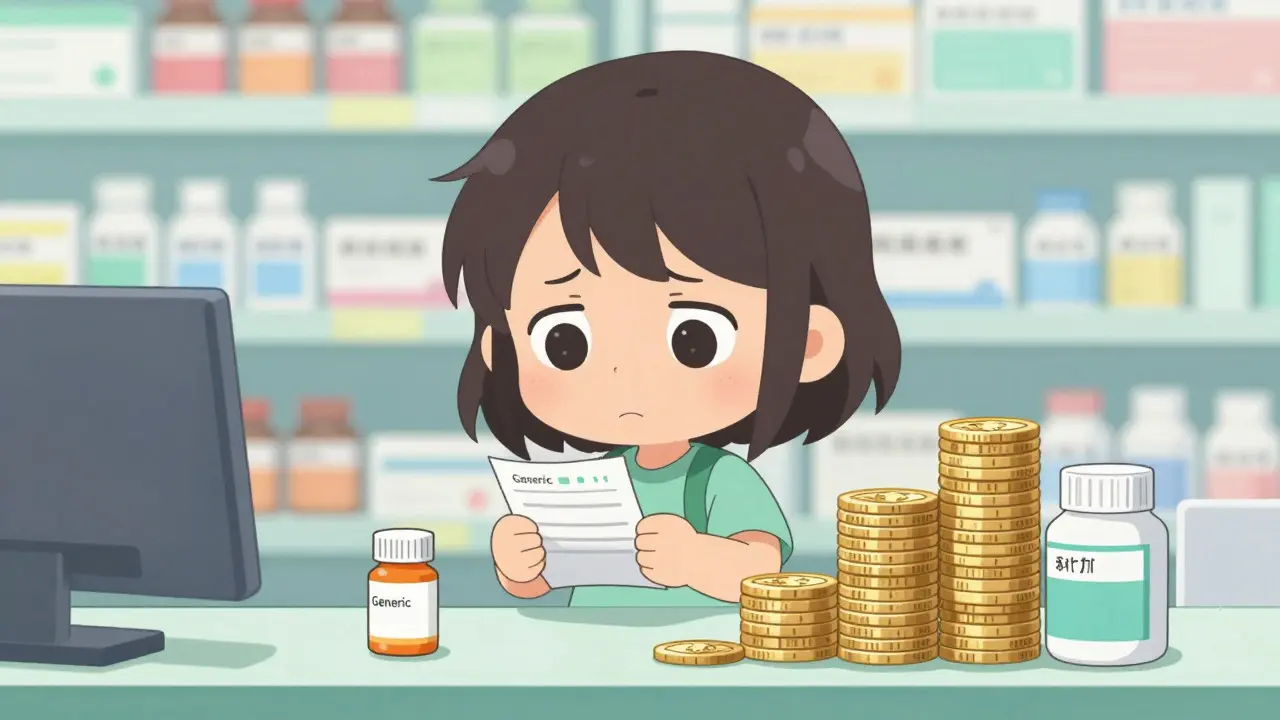
You walk into the pharmacy, hand over your prescription for a blood pressure medication, and brace yourself for the bill. But what you actually pay depends less on the medicine itself and more on a label that says "Generic" or "Brand Name." In the United States' complex healthcare system, this distinction isn't just about marketing; it is the single biggest factor determining your out-of-pocket costs. For millions of Americans relying on Medicare Part D or commercial insurance, understanding the difference between generic and brand copays is the difference between affording your health plan and falling behind on bills.
In 2024, the gap between these two costs widened significantly due to new regulations under the Inflation Reduction Act and shifting market dynamics. While generic drugs have become increasingly affordable-often costing mere dollars-the price tag for brand-name medications remains steep, frequently reaching hundreds of dollars per month. This guide breaks down exactly what those average costs were in 2024, why the disparity exists, and how you can navigate the tiered system to keep your expenses low.
The Tiered System: How Your Insurance Prices Drugs
To understand why one pill costs $5 and another costs $95, you first need to look at the structure of your insurance plan's formulary. A formulary is simply the list of drugs your plan covers, organized into tiers. Most plans in 2024 used a four-tier system, sometimes adding a fifth tier for specialty medications.
| Tier Level | Drug Type | Typical Patient Cost (Copay) |
|---|---|---|
| Tier 1 | Preferred Generic | $0 - $10 |
| Tier 2 | Non-Preferred Generic / Standard Generic | $7 - $15 |
| Tier 3 | Preferred Brand Name | $40 - $60 |
| Tier 4 | Non-Preferred Brand Name | $80 - $150+ |
| Tier 5 | Specialty Medications | $150 - 33% Coinsurance |
This structure is designed to nudge you toward cheaper options. When you choose a Tier 1 generic, you are paying the lowest possible rate because the insurance company has negotiated bulk rates with manufacturers who no longer hold patents. When you choose a Tier 3 or 4 brand name drug, you are paying a higher share because the manufacturer holds exclusive rights to that specific chemical formulation.
Average Generic Copays in 2024
If you are taking a generic medication, your costs in 2024 were likely very manageable. According to data from the Centers for Medicare & Medicaid Services (CMS) and analyses by the Kaiser Family Foundation (KFF), the vast majority of generic prescriptions fell into the lowest cost-sharing categories.
For beneficiaries enrolled in Medicare Advantage Prescription Drug (MA-PD) plans, the median copay for preferred generic drugs was often fixed at around $4.50 to $7.00. Many plans offered $0 copays for Tier 1 generics to encourage enrollment and satisfaction. Even for those in standalone Prescription Drug Plans (PDPs), where coinsurance (a percentage of the drug cost) is more common than fixed copays, the actual dollar amount remained low because the wholesale cost of generics is minimal.
Consider atorvastatin, a common cholesterol medication. The brand name version is Lipitor. The generic version contains the exact same active ingredient. In 2024, a patient with a standard Medicare Part D plan might pay $4.50 for a 30-day supply of generic atorvastatin. That is less than the cost of a cup of coffee. This affordability is driven by competition; dozens of manufacturers produce generic versions, driving prices down through market forces.
However, there is a catch. Not all generics are created equal in terms of pricing. Some pharmacies engage in "tying arrangements," where they accept higher wholesale prices for generics to maintain favorable contracts for brand-name drugs. As independent pharmacy owners noted in late 2023 and early 2024, this can occasionally lead to cash prices for generics being surprisingly high if you don't use insurance. But with insurance, the tiered protection usually keeps your out-of-pocket cost firmly in the single digits.
Average Brand Name Copays in 2024
Now, let’s look at the other side of the coin. If your doctor prescribes a brand-name drug that has no generic alternative, or if you require a specific brand due to medical sensitivity, your costs jump dramatically.
In 2024, the median copay for preferred brand-name drugs (Tier 3) in Medicare Advantage plans was approximately $47. For non-preferred brand-name drugs (Tier 4), which are often newer or less commonly covered, the median copay soared to around $100. These figures represent fixed amounts, meaning you pay $47 regardless of whether the drug costs the insurer $200 or $2,000.
For those in traditional PDPs, the situation could be even more volatile because many plans use coinsurance rather than flat copays for brand names. A typical coinsurance rate for brand drugs was 22% to 47% of the total drug cost. If a brand-name medication costs $500, a 25% coinsurance means you pay $125 out of pocket. This lack of predictability caused significant stress for patients, as highlighted by the Medicare Rights Center, which reported that 63% of beneficiaries using brand-name medications struggled to afford them in 2024.
Take the example of a popular diabetes medication like Ozempic (semaglutide). While not always covered on lower tiers, when it is covered as a brand-name specialty or non-preferred drug, the copay can easily exceed $100 per month, depending on the plan's specific formulary placement. This stark contrast between the $5 generic statin and the $100+ brand-name biologic illustrates the core economic challenge of modern healthcare: innovation comes at a premium.
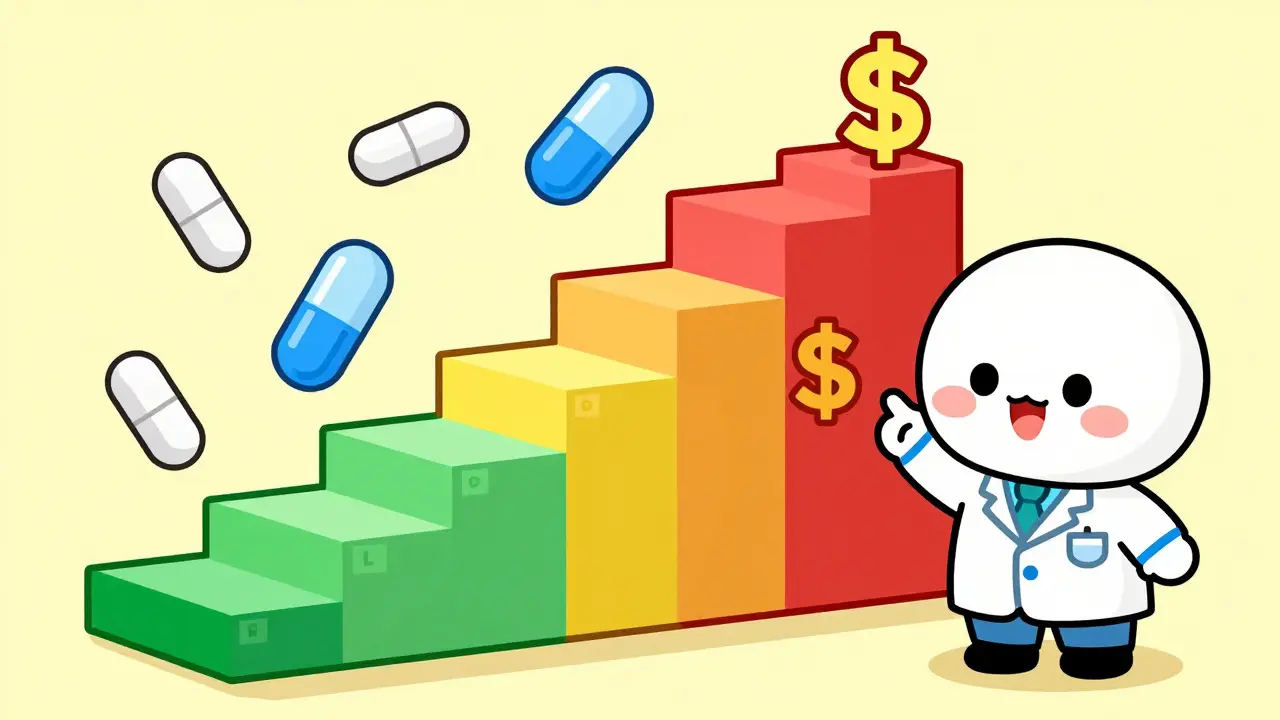
Commercial Insurance vs. Medicare: Key Differences
While Medicare sets the baseline for many discussions on drug costs, commercial insurance plans (those provided through employers or purchased individually via the ACA marketplace) operate similarly but with greater variability.
Commercial plans often use percentage-based coinsurance for both generics and brands. A typical commercial plan might charge 10-20% coinsurance for generics and 30-50% for brands. Because the base price of generics is so low, 20% of $10 is only $2. But 30% of a $300 brand-name drug is $90. The math works out to similar outcomes as Medicare, but the mechanism is different.
One critical feature in commercial plans is the "Member Pay the Difference" policy. If a generic exists for your prescribed brand-name drug, your insurance may require you to pay the standard brand copay PLUS the price difference between the brand and the generic. For example, if your brand copay is $40, but the generic costs $5 and the brand costs $100, you might be charged $40 + ($100 - $5) = $135. This aggressive cost-shifting is designed to force patients and doctors to switch to generics whenever medically safe.
The Impact of the Inflation Reduction Act
The landscape of drug pricing changed fundamentally in 2024 due to provisions in the Inflation Reduction Act passed in 2022. Two major changes directly affected copays:
- Insulin Cap: Starting in 2023 and continuing through 2024, Medicare beneficiaries were capped at paying $35 per month for each covered insulin product. This applied to both brand-name insulins (like Humalog or Novolog) and generic alternatives. This was a massive relief for diabetic patients who previously faced hundreds of dollars in monthly costs.
- Out-of-Pocket Maximum: While the full $2,000 annual out-of-pocket maximum for Medicare Part D didn't take effect until 2025, the groundwork was laid in 2024. During the "coverage gap" (or doughnut hole), beneficiaries paid 25% of drug costs. Once they reached catastrophic coverage, their responsibility dropped to 5%. This safety net prevented brand-name users from facing unlimited financial ruin, though the journey to reach that cap was still expensive.
These regulatory shifts signaled a broader trend: the government is intervening to cap extreme costs. For patients, this meant that while brand-name copays remained high on a per-prescription basis, the total annual financial risk was becoming more predictable and bounded.

Strategies to Lower Your Prescription Costs
Knowing the averages is helpful, but minimizing your personal bill requires action. Here are practical steps you can take based on the 2024 market reality:
- Check the Formulary Before You Enroll: Don't just look at the monthly premium. Use the Medicare Plan Finder tool to input your specific medications. A plan with a $0 generic copay might seem great, but if your necessary heart medication is a Tier 4 brand name costing $100/month, that plan will cost you thousands annually.
- Ask for Therapeutic Alternatives: Often, a generic alternative exists within the same drug class. For instance, if you are on a brand-name acid reflux drug, ask your doctor if omeprazole (generic) is appropriate for you. In 2024, 72% of Medicare Part D plans included preferred generic alternatives for at least 80% of commonly prescribed brand medications.
- Utilize Manufacturer Coupons: For brand-name drugs not covered well by insurance, pharmaceutical companies often offer savings cards that can reduce copays to $0-$25 for commercially insured patients. Note: These usually do not apply to Medicare beneficiaries due to federal laws, but they are vital for those with employer-sponsored insurance.
- Consider Specialty Pharmacies: If you are on Tier 5 specialty drugs, ensure your plan directs you to a specialty pharmacy. These pharmacies handle complex billing and often negotiate better rebates that translate to lower coinsurance percentages for the patient.
- Review During Open Enrollment: Formularies change every year. A drug that was Tier 3 in 2023 might move to Tier 4 in 2025. Review your coverage annually during the October-December window to avoid surprise cost hikes.
Understanding the "Why" Behind the Price Gap
It is natural to wonder why a pill made in the same factory, with the same ingredients, costs ten times more simply because it has a brand name. The answer lies in research and development (R&D) recovery. Pharmaceutical companies spend billions of dollars and years testing new drugs before they hit the market. Brand-name pricing allows them to recoup these investments.
Once the patent expires, generic manufacturers enter the market. They don't need to repeat the clinical trials; they only need to prove bioequivalence (that the drug works the same way in the body). This lack of R&D overhead allows them to sell at a fraction of the cost. Insurance tiers reflect this economic reality: they subsidize the high-cost innovation of brand names while rewarding the efficiency of generics.
However, critics argue that the current system sometimes over-penalizes patients who genuinely need brand names due to side effects or efficacy issues. As one user on a Medicare forum noted, "My doctor won't switch me from the brand to the generic because I get headaches with the generic, but now I'm paying $95 instead of $15." This highlights the ongoing tension between cost containment and individual patient needs.
Looking Ahead: What Changes in 2025?
As we move past 2024, the most significant change is the implementation of the $2,000 hard cap on out-of-pocket prescription drug costs for Medicare Part D beneficiaries. This means that once you spend $2,000 in true out-of-pocket costs (including your deductible and coinsurance), the plan pays 100% for the rest of the year. This will drastically alter the experience for those on multiple brand-name drugs, providing a definitive end to financial anxiety.
Additionally, CMS announced that 98% of 2025 Medicare Part D plans will include $0 preferred generic copays, up from 87% in 2024. This trend suggests that generic access will continue to become nearly free for enrollees, further widening the relative cost gap between generic and brand options.
What is the average copay for generic drugs in 2024?
In 2024, the average copay for preferred generic drugs (Tier 1) in Medicare Part D plans ranged from $0 to $10. For Medicare Advantage plans, the median was often around $4.50 to $7.00. Commercial insurance plans typically used coinsurance, resulting in similar low out-of-pocket costs due to the low wholesale price of generics.
How much do brand name drug copays cost on average?
Brand name drug copays are significantly higher. In 2024, the median copay for preferred brand drugs (Tier 3) was approximately $47, while non-preferred brand drugs (Tier 4) averaged around $100. Patients in plans with coinsurance structures could pay 25-50% of the drug's total cost, leading to much higher variability.
Why are generic drugs cheaper than brand names?
Generic drugs are cheaper because their patents have expired, allowing multiple manufacturers to compete on price. They do not carry the heavy research and development costs associated with bringing a new brand-name drug to market. Insurance plans place generics on lower tiers to encourage this cost-effective choice.
Does the $35 insulin cap apply to brand name insulin?
Yes. Under the Inflation Reduction Act, Medicare beneficiaries were capped at paying $35 per month for any covered insulin product, including both brand-name insulins (like Lantus or Humalog) and generic alternatives. This cap was fully in effect throughout 2024.
What is the difference between a copay and coinsurance?
A copay is a fixed dollar amount you pay for a prescription (e.g., $10). Coinsurance is a percentage of the drug's cost that you pay (e.g., 20%). Copays provide predictable costs, while coinsurance can result in higher bills for expensive brand-name medications.
How can I find out if my drug is covered as generic or brand?
You can check your insurance plan's formulary, which is available online through your insurer's website or the Medicare Plan Finder tool. Look for the tier level assigned to your specific medication. Tier 1 and 2 are typically generics, while Tier 3 and 4 are brand names.
9 Comments
Scott Colter
There is a profound philosophical irony in how we value the 'brand' over the substance. The label dictates our financial fate, yet the molecule remains identical. It forces us to question whether we are paying for health or merely for the illusion of superiority. A friendly reminder that true wisdom often lies in stripping away the unnecessary packaging.
Paul Lyons
This whole system is rigged against Americans! Why should we pay $100 for a drug while other countries get it for pennies? Our healthcare is a disaster because we let these globalist corporations dictate our lives. We need to take back control and stop subsidizing foreign profits with our hard-earned dollars!
Deva Vidya
It is encouraging to see such detailed breakdowns of costs. While the disparity is stark, knowing the tiers empowers patients to make informed choices. Collaboration between doctors and insurers can help navigate these complexities. Let us remain optimistic that transparency leads to better outcomes for everyone involved.
ANINDA GHOSH
As a cultural observer, I find the economic hierarchy of drugs fascinating. In India, generics are the norm, not the exception. The American insistence on brand names reflects a deeper societal trust in marketing over efficacy. However, the new caps are a step toward equity. :) Let us hope this trend continues globally.
MiMi Stanley
I just sat here reading through all the tier levels. It’s wild how much money is tied up in those labels. I don’t have strong opinions, but it makes you wonder if the innovation argument holds water when the price gap is so massive. Just observing from the sidelines.
Najmunisa Govender
Oh my!! This is truly heartbreaking for those who cannot afford their medications!!! How can anyone live with such uncertainty??? The emotional toll must be immense!!! Please, let us support each other during these difficult times!!!
Crystal Tadlock
They want you to believe generics are safe but they are hiding something. The big pharma companies are poisoning us with cheap knockoffs. Only the real brand works because they know the secret formula. Wake up people! They are stealing your health and your money.
Tad Cronn
So you're saying you're paying $100 a month for a drug? That's pathetic. You probably don't even read the formulary. Most people are just lazy and blame the system instead of fixing their own habits. Stop making excuses and start managing your life like an adult.
Sean Allwurden
Great analysis on the formulary structures. As a coach, I always tell my clients to leverage the data available. Understanding the coinsurance vs. copay dynamics is crucial for financial wellness. Let's collaborate on strategies to optimize these benefits. Friendly tip: check the manufacturer coupons early.