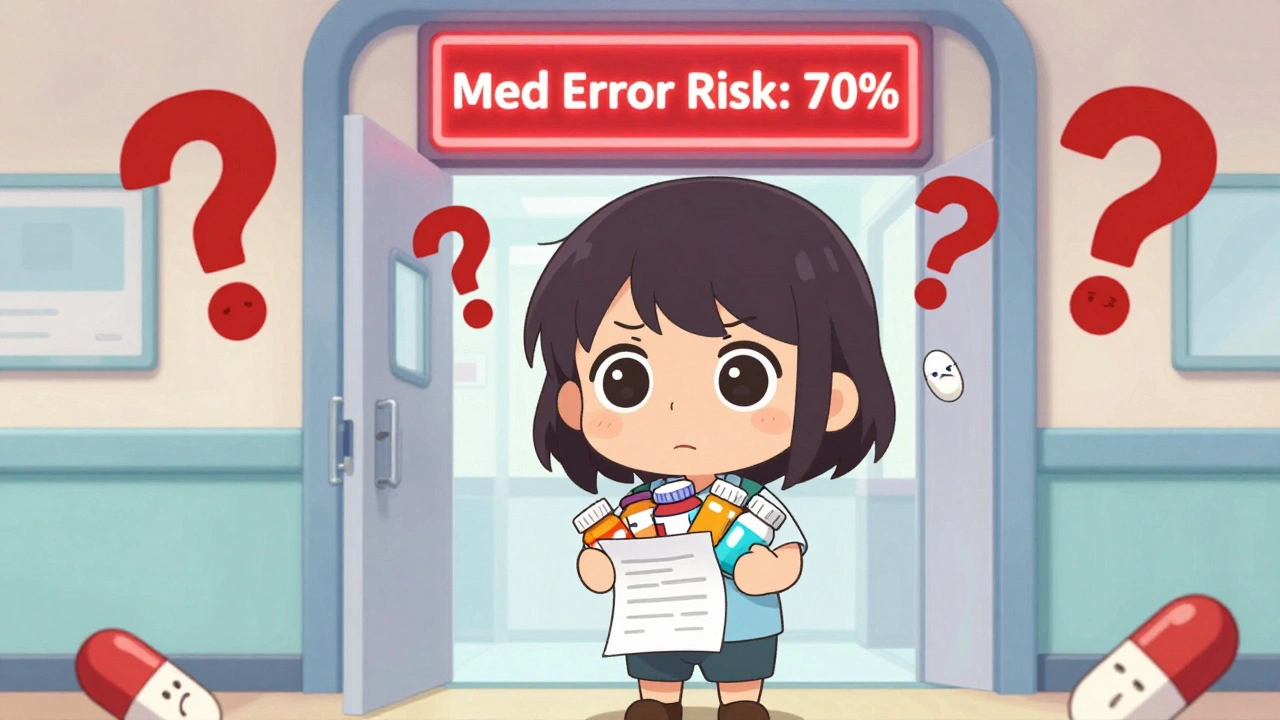
When you leave the hospital, your body is still healing. But the real danger doesn’t come from your surgery or illness-it comes from the pills you’re supposed to take at home. Studies show that medication reconciliation failures happen in 30% to 70% of cases after hospital discharge. That means for every three people leaving the hospital, at least one is going home with the wrong meds-or missing one entirely. And that’s not just a mistake. It’s a preventable crisis.
Why Medication Reconciliation Matters
Your hospital stay changes your meds. Maybe your blood pressure pill was stopped because your BP dropped too low. Maybe you got a new antibiotic for an infection. Maybe your diabetes meds were adjusted. All of that happens in the hospital. But when you go home, no one automatically tells your GP, your pharmacist, or even you what changed. That’s where medication reconciliation comes in. It’s not a fancy term. It’s simple: compare what you were taking before you went in, with what you’re leaving with. And make sure everything lines up. The National Quality Forum calls this NQF 0097. Medicare and Medicaid require it. But most patients never hear about it. They just get a discharge paper with a list of meds-and hope they got it right. Here’s the scary part: 18% to 50% of all medication errors after discharge happen because of this gap. That’s why 6.5% of hospital readmissions are tied to medication mistakes. And those cost the system over $21 billion a year.What Gets Lost in the Handoff
You’d think hospitals have perfect records. They don’t. Most use different electronic systems than your GP’s office. Your cardiologist doesn’t talk to your GP. Your pharmacist doesn’t see the discharge summary. Common mistakes:- A blood thinner like warfarin was stopped in the hospital for surgery-but never restarted at discharge.
- A painkiller like oxycodone was added for a week, but the prescription didn’t get sent to the pharmacy.
- A daily aspirin was discontinued, and no one told you to stop taking it.
- You were on a statin before admission, but the discharge list says you’re not anymore.
- You’re taking fish oil, garlic supplements, or herbal tea-and no one asked.
Who’s Responsible? (And Who Should Be)
The system is broken because no one owns this job. Doctors are focused on your condition. Nurses are rushing to get you out. Your GP gets a discharge letter three days later-with no clear list of changes. The best solution? Pharmacists lead the reconciliation. A 2023 study in the Journal of the American College of Clinical Pharmacy showed pharmacist-led reconciliation cut medication errors by 32.7% and reduced 30-day readmissions by 28.3%. Why? Because they:- Call you within 48 hours of discharge.
- Check your pharmacy fill history.
- Compare what the hospital ordered with what you were taking at home.
- Confirm you understand each pill’s purpose and dose.
- Fix errors before you leave the hospital-or call you the next day.

How to Do It Yourself: A 5-Step Checklist
You’re not powerless. Even if the system fails, you can protect yourself. Here’s what to do:- Get the full discharge list-in writing. Not just a printout. Ask for a printed copy with all meds: prescriptions, over-the-counter pills, vitamins, creams, eye drops, and supplements.
- Bring your home meds to the hospital-or at least a list. When you’re admitted, take a photo of every bottle in your medicine cabinet. Or write them down: name, dose, frequency, why you take it.
- Ask: “What changed?” Before you leave, ask your doctor or nurse: “What meds were added, stopped, or changed?” Write it down. Don’t rely on memory.
- Call your pharmacist within 24 hours. Give them the discharge list. Ask: “Do these match what you have on file?” Pharmacists see your fill history. They’ll spot missing scripts or duplicate meds.
- Schedule a follow-up with your GP within 7 days. Don’t wait for your 30-day window. If you’re on high-risk meds (blood thinners, insulin, heart drugs), see your doctor sooner.
What the System Should Be Doing (But Isn’t)
Medicare and Medicaid have rules for this. The measure is called NQF 0097. It requires:- A documented comparison of your pre-hospital and discharge meds.
- Proof that a provider reviewed both lists.
- Documentation in your outpatient chart within 30 days.
Technology Can Help-But Only If Used Right
New tools are emerging. AI can scan your EHR and flag mismatches between your home meds and discharge list. One 2022 study found AI caught 87% of potential errors. Patient apps let you update your meds in real time. If your hospital uses one, sign up. If they don’t, use a free app like Medisafe or MyTherapy. Take a photo of your pill bottles. Log your doses. Share the report with your doctor. But tech won’t fix this alone. If the staff doesn’t check the alerts, or the pharmacist doesn’t call you, the system fails. The real innovation isn’t software. It’s accountability. Who is responsible? Who gets paid? Who gets in trouble if you’re readmitted?
What to Do If You’re Readmitted
If you’re back in the hospital within 30 days, the first question your new team should ask is: “What happened after you left?” If they don’t ask, tell them. Say: “I think my meds were messed up when I left the last hospital.” Show them your discharge list. Show them your home meds. That’s your power. You’re the only one who knows what you took at home.Final Reality Check
You can’t wait for the system to fix itself. The data is clear: pharmacist-led reconciliation works. Patient involvement works. Documentation works. But none of it happens unless someone takes charge. So here’s your action plan:- Before discharge: Get your full meds list in writing.
- Within 24 hours: Call your pharmacist.
- Within 7 days: See your GP. Bring your list.
- Every day: Take your pills as written. If something feels wrong, stop and call.
What is medication reconciliation after hospital discharge?
Medication reconciliation is the process of comparing a patient’s current home medications with the list of medications they were prescribed at hospital discharge. The goal is to identify and fix any differences-like missing drugs, wrong doses, or unnecessary changes-to prevent harmful errors. It’s a required safety step under Medicare and Medicaid guidelines, and it must be documented within 30 days of discharge.
Who is responsible for coordinating my meds after I leave the hospital?
Ideally, a pharmacist should lead this process, especially if they’re part of the discharge team. But in practice, responsibility is often unclear. Your primary care provider should review your meds within 7 days, but many don’t. You are the most important person in this process-you need to take the initiative by bringing your own list, calling your pharmacist, and following up with your doctor.
Can my GP and specialist both bill for medication reconciliation after my discharge?
No. Medicare rules allow only one provider to bill for a Transition of Care (TRC) visit (CPT 99495 or 99496) per discharge episode. This creates a conflict: if your cardiologist and your GP both want to do the reconciliation, only one can get paid. As a result, neither may do it at all. This is a systemic flaw that leaves patients vulnerable.
What if I’m taking vitamins or herbal supplements? Do I need to tell the hospital?
Yes. Medication reconciliation includes all substances you take-even vitamins, fish oil, garlic pills, or herbal teas. Some supplements can interact dangerously with hospital meds. For example, St. John’s Wort can reduce the effect of blood thinners. Always list everything you take. If you’re unsure, bring the bottles to the hospital or take photos.
How do I know if my meds were properly reconciled?
Ask your GP or pharmacist: “Did you compare my home meds with my discharge list?” If they say yes, ask to see the documentation. You have a right to know. If they don’t have a written comparison or can’t show you proof, it wasn’t done properly. Don’t accept vague answers. Push for a clear, documented reconciliation.
What should I do if I miss a dose or can’t fill a prescription after discharge?
Don’t guess. Call your pharmacist or GP immediately. If you can’t afford a medication, ask about patient assistance programs. If you’re confused about a new dose, don’t wing it. Many hospitals have discharge follow-up nurses or pharmacists who can help. You’re not alone-there are resources. But you have to ask.
Is medication reconciliation required by law?
Yes, under Medicare and Medicaid rules, providers must document medication reconciliation within 30 days of hospital discharge for patients who have an outpatient follow-up. This is a federally mandated quality measure (NQF 0097). Failure to report it can reduce physician payments under the CMS Merit-based Incentive Payment System (MIPS). But compliance is still inconsistent-so don’t rely on the system. Do it yourself.
Next Steps: What to Do Today
If you or someone you care for was recently discharged:- Grab the discharge medication list.
- Open your medicine cabinet and take photos of every bottle.
- Call your pharmacy. Ask: “Did they send the right scripts?”
- Book a doctor’s appointment within the next week.
- Write down three questions to ask your doctor: “What changed? Why? What should I watch for?”
11 Comments
Marvin Gordon
Just got discharged last week. Did exactly what the post said-brought my whole medicine cabinet to the hospital, took pics, asked ‘what changed?’ Then called my pharmacist before I even got home. They caught a duplicate blood thinner they forgot to remove. Saved me a trip back. This isn’t rocket science. It’s basic survival.
Stop waiting for the system. You’re the only one who cares enough to fix it.
Rupa DasGupta
OMG YES 😭 I almost died because they took my beta blocker and never told me. I thought I was fine until I passed out in the kitchen. Now I carry a laminated card with my meds. No one else is gonna save you. Don’t trust the hospital. Don’t trust the GP. Trust your own damn eyes.
PS: They didn’t even ask about my turmeric pills. Guess what? That shit thins your blood too. 😤
ashlie perry
They’re lying. This isn’t about meds. It’s about control. The hospitals want you dependent. The pharmacists want you coming back. The doctors want their billing codes. You think they care if you live? Nah. They just want you to sign the paperwork and disappear.
They’re not fixing mistakes. They’re creating them so you’ll need them again. Watch the video on YouTube called ‘The Meds Conspiracy’.
Annie Grajewski
Oh wow so the solution is to make patients do the job of 5 different professionals? Genius. Next they’ll tell us to fix our own broken bones and file our own taxes too. How about we stop pretending this is a health system and admit it’s a profit-driven dumpster fire?
Also I misspelled ‘pharmacist’ on purpose. You’re welcome.
Lynette Myles
Pharmacists are the only ones who actually track your fills. Doctors don’t. Nurses don’t. You need to demand a pharmacist at discharge. No excuses.
Mark Ziegenbein
Let me be clear: the entire American healthcare infrastructure is a grotesque parody of medical care, and this medication reconciliation debacle is merely the most banal symptom of a terminal rot that has metastasized through every bureaucratic artery of this so-called ‘system’.
Do you know what NQF 0097 really means? It means the government has codified negligence into a billing code. It means that someone, somewhere, got paid to write a regulation that sounds like a safety net but functions as a liability shield. The fact that you’re being told to ‘take photos of your pill bottles’ is not empowerment-it’s institutional surrender.
And let’s not pretend pharmacists are saints. They’re just the last line of defense in a system that outsourced responsibility to the most overworked, underpaid professionals who are expected to compensate for the incompetence of everyone else. The 37% drop in discrepancies? That’s not a win. That’s a tragedy masked as progress.
Meanwhile, the CPT II code 1111F? A joke. A bureaucratic afterthought. A digital Band-Aid on a severed artery. And don’t get me started on how the ‘one provider can bill’ rule ensures that no one takes ownership because no one gets paid. It’s not broken-it was designed this way.
So yes, by all means, call your pharmacist. Take photos. Write lists. But don’t mistake your personal vigilance for systemic change. The system is not malfunctioning. It is operating exactly as intended. And you? You’re just the collateral damage they’ve trained you to manage yourself.
Jennifer Patrician
Of course they don’t want you to know about this. The pharmaceutical industry is in bed with the hospitals. They profit when you get readmitted. They profit when you take more pills. They profit when you’re confused. They profit when you die and your family sues and they settle quietly.
And you think they’re gonna let a pharmacist fix it? HA. They’d rather you take 12 pills a day and never question it. Wake up. This isn’t healthcare. It’s a pyramid scheme with stethoscopes.
Mellissa Landrum
you think this is bad wait till u see what they do with your social security number after u get discharged they sell ur meds info to chinese bots who then send u fake pills from shenzhen u think ur aspirin is aspirin? its laced with rat poison and microchips i swear to god im not joking
call your senator. or better yet dont take any pills at all. just drink lemon water. its 2024. trust no one.
Mark Curry
I’ve been thinking about this a lot lately. It’s weird how we expect doctors to fix us, but we never ask who’s fixing the doctors.
Maybe the real problem isn’t the meds. It’s that we’ve forgotten how to take care of each other. The system is broken, sure. But maybe the real solution is just… talking. To your pharmacist. To your neighbor. To your kid who knows how to use an app.
It doesn’t take a law. It takes a person who cares enough to ask, ‘Hey, did you take your pill today?’
That’s the real reconciliation.
Jimmy Jude
Let’s be real-this whole post reads like a TED Talk written by a hospital administrator who’s never actually talked to a patient. You think telling someone to ‘call their pharmacist’ solves anything? What if they’re on Medicaid and the pharmacy is 40 miles away? What if they’re 82 and blind? What if they don’t have a phone?
This isn’t a checklist. It’s a privilege. And the people who need this the most? They’re the ones the system was designed to leave behind.
So yes, take photos. Write lists. But don’t pretend this is justice. It’s just a Band-Aid on a gunshot wound.
Mark Curry
That’s why I started a neighborhood group. We help each other. Someone drives the elderly to the pharmacy. Someone reads the discharge papers out loud. Someone checks if the pills match the bottle.
It’s not perfect. But it’s human.
And maybe that’s the only thing that ever really works.