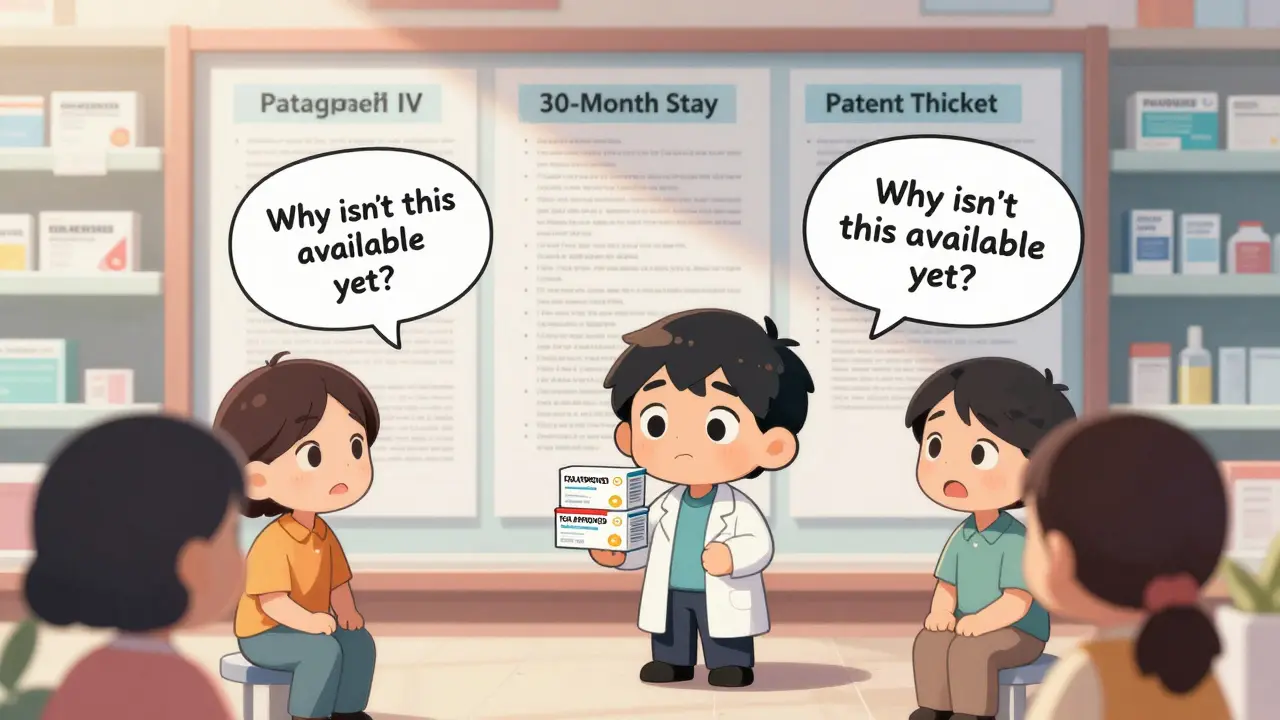
When the FDA approves a generic drug, you’d think it would hit pharmacy shelves soon after. But in reality, many of these drugs sit on shelves in warehouses - not in patients’ medicine cabinets - for years. Between 2023 and 2025, this gap between approval and availability became a national issue. Patients paid hundreds more per month for brand-name drugs that should’ve had cheaper alternatives. Pharmacists fielded the same questions over and over: "Why is this generic approved but not available?"
Why Approval Doesn’t Mean Availability
The FDA doesn’t control when generics launch. That’s the job of the courts and patent holders. Under the Hatch-Waxman Act, a generic company can file an Abbreviated New Drug Application (ANDA) and challenge a brand-name drug’s patents using a Paragraph IV certification. That triggers a 30-month legal stay. During that time, the FDA can’t give final approval - even if the generic passes all safety and quality checks.Here’s how it plays out in real life. In 2024, 68% of all ANDA filings included a Paragraph IV challenge. That’s up from 59% in 2020. The average number of patents listed per drug in the FDA’s Orange Book jumped from 12.3 to 14.7 in just five years. Brand-name companies aren’t just defending one patent anymore. They’re building walls - patent thickets - around their drugs. Each new patent, even if weak, adds another 30-month delay.
Take Eliquis (apixaban). The original patent expired in 2023. But by the time the first generic was approved in early 2024, brand-name maker Bristol Myers Squibb had filed five new patents covering formulations, dosing methods, and manufacturing processes. The result? The generic didn’t reach pharmacies until late 2025 - over a year after approval.
The Real Cost of Delay
Patients don’t just wait. They pay.A 2025 survey by Patients For Affordable Drugs Now found 412 documented cases where people skipped doses or went without medication because the generic wasn’t available. For drugs like Xarelto, Steglatro, or Trulicity, the brand version cost $487 a month on average. The projected generic price? Around $85. That’s an 82% price drop - if it ever reaches the market.
Medicare Part D alone spent $3.2 billion more in 2025 because of these delays, according to the Congressional Budget Office. That’s money that could’ve gone to insulin, cancer drugs, or mental health care. Instead, it went straight into pharmaceutical company coffers.
Hospitals felt it too. The American Society of Health-System Pharmacists reported that 78% of hospital pharmacy directors listed patent delays as a major cause of drug shortages. Many of these were life-saving injectables - oncology drugs like doxorubicin and paclitaxel. When these generics are blocked, hospitals scramble to find alternatives, often at triple the cost.
Complex Generics Face Longer Delays
Not all generics are created equal. Simple oral pills - like metformin or lisinopril - are easier to copy. But injectables, inhalers, and complex formulations? They’re harder to replicate. And that’s where patent delays hit hardest.Of all delayed generics between 2023 and 2025, 89% of complex products faced patent-related blocks. Compare that to 63% of simple oral solids. Why? Because complex generics require more manufacturing precision, and brand companies use patents to lock down every tiny detail - from particle size to container material.
Take Humira. The original patent expired in 2016. But AbbVie filed over 240 patents over the next seven years. Each one triggered a new 30-month stay. The result? The first biosimilar didn’t launch until 2023 - seven years late. Even then, multiple legal battles kept other biosimilars off the market until 2025.

Why the FDA Can’t Fix This
The FDA approved 63 first generics in 2025. But it can’t force them onto the market. Its hands are tied. Patent litigation happens outside its authority. Even with new tools - like AI-assisted review, which cut approval times by 22% for non-litigated applications - the 30-month stay remains untouched.Dr. Patrizia Cavazzoni, director of the FDA’s Center for Drug Evaluation and Research, admitted in May 2025 that patent thickets are beyond her agency’s control. "We’re working to increase transparency," she said. But transparency doesn’t break patents. It just makes them easier to find.
Meanwhile, the FDA’s own review times are slowing. In Q3 2025, only 73% of applications were approved on time - down from 87% in previous years. Rejections rose to 15%. Delays hit 11%. That’s partly due to staffing shortages and supply chain issues - but mostly because so many applications are tied up in litigation.
Supply Chains and Manufacturing Hurdles
It’s not just patents. Supply chains are breaking too. Between 2023 and 2025, 37% of delayed generics cited Active Pharmaceutical Ingredient (API) shortages as a factor. Most of these were injectables. The problem? Many APIs are made overseas - in China or India. Geopolitical tensions, factory shutdowns, and quality failures all contribute.Companies like Teva and Sandoz responded by diversifying suppliers. In 2022, they averaged 1.8 API suppliers per product. By 2025, that number jumped to 3.4. It’s expensive. But it’s cheaper than a 2-year delay.
Still, API shortages don’t explain why some generics sit for years with no supply issues. The real bottleneck? Legal battles.
Who’s Getting Hurt? Small Companies
Big generic manufacturers can afford $12.7 million lawsuits. But small companies? They can’t.RBC Capital Markets found that 63% of delayed generics involved companies with annual revenue under $500 million. These are the innovators trying to break into the market - not the giants. When a brand-name company files five patents, the small generic firm either folds or borrows millions to fight.
That’s why fewer small companies are filing ANDAs. The risk is too high. The reward? A 3-year delay and a 50% chance of losing in court.

How the U.S. Compares to the Rest of the World
In Europe, generics launch an average of 1.7 years after approval. In the U.S.? 3.2 years. Why the gap?Europe doesn’t have a 30-month stay. If a generic challenges a patent, the court decides quickly. No automatic pause. No endless litigation loops. And patent listings are stricter - only core patents are allowed.
The U.S. system is broken. It’s designed to balance innovation and access. But now, it’s being used to extend monopolies far beyond the original 20-year patent term. Harvard’s Dr. Aaron Kesselheim says the average extension is 3.7 years per drug. That’s not innovation. That’s manipulation.
What’s Being Done? (And What’s Not)
There are signs of change - but not fast enough.The FTC filed seven enforcement actions between 2024 and 2025 against companies using "pay-for-delay" deals and patent thicketing. One case against Jazz Pharmaceuticals over Xyrem led to an agreement that brought generics to market 18 months earlier.
The CREATES Act, passed in the House in 2025, would let generic companies get samples of brand drugs to test - something some manufacturers have blocked. But it stalled in the Senate.
The FDA’s new National Priority Voucher program speeds up reviews - but only for non-patent cases. It doesn’t touch litigation.
Meanwhile, the industry is fighting reform. PhRMA, the drug industry lobby, is pushing back hard against any limits on patent listings. "This would undermine innovation," they say. But innovation doesn’t mean hiding behind 15 patents.
What Comes Next?
The clock is ticking. The top 10 drugs losing exclusivity in 2025 represented $78.3 billion in annual sales. If generics had launched on time, patients and insurers could’ve saved over $50 billion.For now, the system remains broken. Patients wait. Pharmacists explain. Hospitals ration. And brand companies keep filing.
The fix isn’t complicated. Limit the number of patents per drug. End the automatic 30-month stay. Require courts to rule faster. Make patent listings transparent and enforceable.
Until then, the gap between approval and access will keep growing - and patients will keep paying the price.
11 Comments
Tom Bolt
The system is rigged. Five patents on a single drug? That’s not innovation-that’s legal extortion. The Hatch-Waxman Act was meant to balance access and incentive. Now it’s a weapon. And patients? They’re the collateral damage. We’re not talking about rare orphan drugs here-we’re talking about insulin, cancer meds, heart pills. People are skipping doses because they can’t afford the brand. This isn’t capitalism. It’s feudalism with a pharmacy label.
Shourya Tanay
The structural inefficiencies in the U.S. generic drug approval ecosystem are a confluence of regulatory arbitrage and patent litigation asymmetry. The Paragraph IV certification mechanism, while ostensibly designed to challenge IP monopolies, has been weaponized into a multi-layered procedural delay architecture. Each patent thicket incrementally extends the 30-month stay, creating a cascading effect that subverts market entry timelines. The aggregate impact on API supply chains, compounded by geopolitical fragility in manufacturing hubs, further exacerbates systemic bottlenecks. What we’re observing is not merely a policy gap-it’s an institutional failure of equilibrium.
Denise Jordan
So… we’re mad because big pharma is being… big pharma? Like, what did you expect? They’re not here to help you. They’re here to make money. If you want cheap drugs, move to Canada. Or stop being surprised that capitalism works the way it does.
Gene Forte
There is hope. Change is possible when we demand it. Every patient who speaks up, every pharmacist who documents delays, every legislator who pushes for reform-these are the seeds of real progress. The system is broken, yes. But it was built by people. And that means it can be rebuilt by people too. We have the data. We have the stories. Now we need the will. Let’s not wait for permission to fix what’s wrong. Let’s build the future we deserve.
Kenneth Zieden-Weber
Let me get this straight. The FDA approves a generic. Then the brand company files five more patents-each one a tiny, meaningless tweak-and suddenly we’re stuck for another 30 months? And we call this innovation? I’ve seen more creativity in a 7-Eleven parking lot. The real genius here is how they turned the law into a game of whack-a-mole. Every time you hit one patent, three more pop up. It’s like they’re playing Monopoly with our health care.
Chris Bird
This is why Africa can't get meds. You guys fight over patents while people die waiting. You think your system is advanced? It's just expensive. India makes the generics. China makes the pills. You just make the lawsuits.
David L. Thomas
The real kicker? The FDA’s review times are dropping because they’re drowning in litigation-heavy applications. They’re not slow because they’re underfunded-they’re slow because every application is now a legal minefield. The agency’s AI tools help with non-litigated cases, but when 68% of ANDAs trigger a 30-month stay? That’s not a backlog. That’s a design flaw. The system isn’t broken. It was engineered this way.
Bridgette Pulliam
I appreciate the depth of this analysis. The data is irrefutable. The human cost-412 documented cases of patients skipping life-saving medication-is not an abstract statistic. It is a moral failure. I am particularly struck by the disparity between U.S. and European timelines: 3.2 years versus 1.7. This is not a matter of regulatory complexity. It is a matter of political will. And yet, we remain silent. We must not.
Mike Winter
I’ve been thinking about this a lot… and I wonder if the problem isn’t just patents-it’s the assumption that patents = innovation. What if we redefined innovation as patient access, not legal maneuvering? The European model proves it’s possible. Simpler listings. Faster rulings. No automatic stays. Maybe we need to stop treating pharmaceuticals like luxury goods and start treating them like public infrastructure. Just a thought.
Randall Walker
I mean… I get it. Patents. But also… why do we keep pretending this isn’t a racket? The 30-month stay? That’s not a legal procedure. That’s a corporate pause button. And the fact that small companies can’t afford to fight? That’s not market competition. That’s monopoly by attrition. And don’t even get me started on how they use API shortages as an excuse when half the time, the drug’s sitting in a warehouse. It’s all theater. And we’re all just waiting for the curtain to fall.
Miranda Varn-Harper
This is why I no longer trust the FDA. They approve drugs, but they don’t ensure access. That’s not oversight. That’s negligence dressed up in a white coat. And the fact that Congress can’t pass the CREATES Act? That’s not bipartisan gridlock. That’s corruption with a PR team. We need to stop pretending this is a health issue. It’s a profit issue. And until we treat it as such, nothing will change.